
First-Call Resolution Is Killing Field Service Margins
Every failed first visit costs $250. For a 20-tech operation, that's $100K/month in lost margin. Here's the operational fix.
I’ve talked to a lot of field service operators — HVAC, plumbing, electrical, elevator, fire suppression. Different trades, same problem. Their margins aren’t being killed by one big thing. They’re being bled out by a steady drip of wasted truck rolls, misrouted techs, and missing parts.
The metric that captures all of it is first-call resolution. Industry average sits at 75-80%. Meaning one in four or five service calls requires a second visit. And every one of those return visits costs roughly $250 in loaded labor, vehicle cost, fuel, and opportunity cost — producing zero billable revenue.
For a 20-tech operation running 80-100 calls daily at 75% first-call resolution, that’s 20-25 wasted truck rolls per day — $100,000 to $125,000 per month in margin you’re burning. That’s the difference between a profitable quarter and a flat one.
Here’s why it happens and what actually fixes it.
The Three Root Causes (They’re All Information Problems)
Failed first calls aren’t random. They break into three categories, and every single one is an information failure:
1. Wrong Tech for the Job
Your dispatcher assigns based on territory and availability. Makes sense. But when the new guy gets sent to a rooftop Carrier 48TC throwing an unfamiliar fault code, he’ll spend 90 minutes on the roof, call your senior tech, and eventually figure out it’s a known economizer linkage issue. Your senior tech could have cleared it in 30 minutes — but he’s across town on a job any competent tech could handle.
The data to make a better dispatch decision exists. Which equipment types does each tech handle best? What are the callback rates by tech and equipment type? When Carrier 48-series RTU calls show 60% first-call resolution with junior techs but 94% with senior techs, the dispatch decision makes itself — if anyone has time to analyze that data in real time. Your dispatcher doesn’t. They’re managing 80 dispatches a day.
2. Right Tech, Wrong Parts
Your senior tech’s truck carries $15,000-20,000 in parts, stocked based on his experience. When dispatch sends him on an unfamiliar equipment type, he might not have the right parts. Meanwhile, the tech who usually handles that equipment is on a job that doesn’t need specialty parts.
The system knows what’s on every truck, the parts history for every equipment type, and which calls need which components. That matching should happen before dispatch — not after the tech opens the panel and realizes he needs an actuator that’s sitting in another truck across town.
3. Insufficient Diagnostic Information
A tech drives 45 minutes to a hospital chiller job. Confirms what everyone suspected — the Honeywell actuator is needed. Verifies it isn’t in stock. Drives back. That $250 truck roll produced nothing except confirmation of something the service history could have told you.
With equipment history, fault codes, and prior repair data surfaced before dispatch, the tech knows what to expect, what parts to carry, and whether the trip is even worth making until the part arrives.
👉 Tip: Track your return visit reasons for 30 days. Categorize every callback into these three buckets. The distribution tells you exactly where to focus. Most operations find 40-50% of callbacks are parts-related — the easiest category to fix.
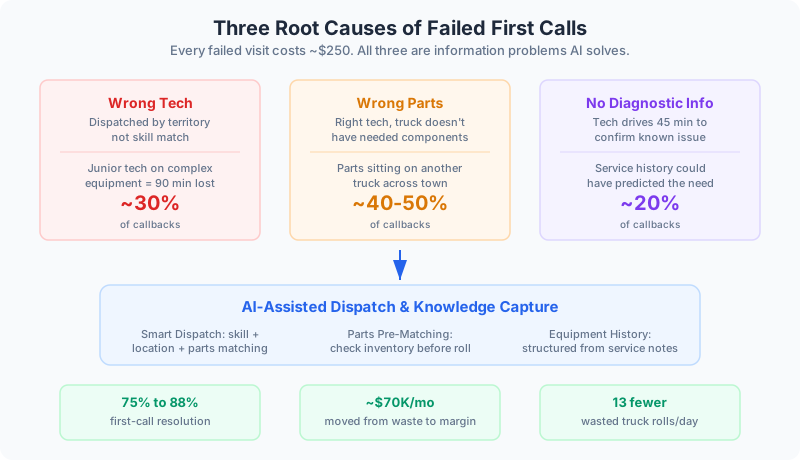
The Fix: AI-Assisted Dispatch and Knowledge Capture
Moving from 75% to 88% first-call resolution on 100 daily calls means 13 fewer wasted truck rolls per day. At $250 each, that’s $3,250 daily — nearly $70,000 per month moving from waste to margin. No new techs. No new trucks. Just better information at the point of decision.
Smart Dispatch
AI reframes the dispatch calculation from “who’s closest and available?” to “given every open ticket, every tech’s current location, skill set, truck inventory, and remaining hours — what sequence maximizes completed jobs across the fleet today?”
This is fleet-level optimization. A 15-minute detour for one tech might save 40 minutes for another downstream. Your dispatcher can’t see that second-order effect managing one dispatch at a time.
Parts Pre-Matching
Before any tech rolls, the system checks: does this equipment type typically require parts the assigned tech doesn’t carry? If yes, can we swap the assignment with a tech who has the right parts? If not, can we pre-position the part from the warehouse or another truck?
This alone can move first-call resolution 5-8 points.
Equipment History at Point of Dispatch
When the tech arrives at a site, they should already know: this unit has had four economizer damper issues in three years. Resolution is manual adjustment of the linkage arm, not damper motor replacement. Average repair time: 35 minutes.
That information exists in your service history. It’s just buried in unstructured notes like “replaced actuator, same issue as last time, adjusted linkage per Bob’s method.” AI extracts structured, searchable intelligence from years of those notes.
The Bigger Problem: When Your Best Tech Retires
Your best tech has 25 years in the trade. He knows the Trane units at the Route 9 office park have an ongoing damper issue Trane won’t acknowledge. He knows the hospital chilled water system has a control wiring quirk that makes fault codes misleading. He knows Mrs. Patterson at the dental office will call three times after any repair.
None of this is written down. When he retires, it all leaves.
The average age of HVAC technicians keeps climbing. Experienced techs retire faster than apprenticeship programs produce replacements. Each departure costs not just a headcount — it costs the accumulated knowledge of every piece of equipment that tech has touched.
AI captures that knowledge continuously. Every service call note, every part used, every diagnostic sequence — structured and searchable. The new tech arriving at Route 9 gets the institutional intelligence the senior tech built over decades, delivered at the point of need.
👉 Tip: If you have experienced techs within 5 years of retirement, knowledge capture is urgent. Start recording their diagnostic processes now. Every month you wait is institutional knowledge you’ll never recover.
Protecting Your PM Revenue Stream
For a healthy field service operation, PM contracts should represent 35-45% of total revenue. They’re predictable, schedulable, and carry better margins than break-fix. But they’re only valuable if execution is reliable and the data collected actually prevents emergencies.
AI turns PM visit data into failure forecasts. A rooftop unit’s compressor amp draw trending up 12% over three quarterly visits is a trajectory — not a failure yet, but flagged as tracking toward failure within 2-4 months. You schedule the repair proactively with the right parts on the truck, instead of an emergency call when the building hits 90 degrees in July.
Between visits, AI monitors equipment telemetry and catches issues between quarterly inspections. Refrigerant pressure trending low means a slow leak becoming an emergency. A proactive call to the client reinforces contract value and prevents the $800 emergency visit.
Benefits of AI-protected PM programs:
- 15-25% reduction in emergency callbacks on contract equipment
- Stronger contract renewal rates because you can demonstrate prevented downtime
- Proactive repair scheduling eliminates emergency pricing pressure
- On 200 PM contracts averaging $5,000 annually, that’s $1M in contract revenue protected
- Equipment data compounds — predictions get more accurate every quarter
Where to Start
The highest-leverage entry point is first-call resolution improvement. It’s the biggest single margin lever, the data already exists in your service history, and improvement is measurable within 60 days.
Implementation sequence:
- Analyze callback data (Week 1-2) — Which job types, equipment types, and tech assignments produce the most return visits? The answer tells you where AI dispatch optimization has the highest impact.
- Deploy smart dispatch matching (Month 1-3) — Match techs to jobs based on skill, parts inventory, and equipment history. This is the fastest ROI.
- Layer in predictive maintenance (Month 3-6) — Connect PM visit data to failure forecasting on contract equipment.
- Begin structured knowledge capture (Ongoing) — Every service call becomes a learning event. The institutional intelligence grows daily.
Every wasted truck roll — wrong tech, wrong parts, insufficient information — is $250 that doesn’t come back. The operators hitting 4-5 jobs per day per tech at 85%+ first-call resolution aren’t working harder. They’re working from better information. AI is how you build the information advantage your best dispatcher carries in her head, scaled across every tech and every call.
Continue reading:
- The 11 AI Primitives — the Monitor and Predict primitives are the backbone of field service AI
- AI Readiness Assessment Guide — how to evaluate whether your data and processes are ready
- The 10 Commandments of a Profitable Operation — the operational principles that make first-call resolution improvement stick
- Capability Matching — the concept behind matching the right tech to the right job
Related AI Articles
8 Ways Home Service Companies Use AI to Grow Without Trucks
A practical numbered list of where home services operators are finding real AI ROI — from dispatch optimization to callback reduction to guided quoting.
Read more7 Places AI Saves Money in a Dealership (Not the Pitch)
Forget the chatbot demos. Here are the seven areas where AI produces measurable ROI in auto dealerships — from the service lane to the used car lot.
Read moreWhy Franchises Are the Perfect AI Starting Point (And Most Don't Know It)
Franchises have what every AI project needs: standardized processes. Most multi-unit operators are sitting on an AI gold mine.
Read moreYour Hotel's RevPAR Problem Isn't Pricing — It's Operations
Most hotel operators obsess over rate strategy while operational waste silently eats their margins. Here's where the real RevPAR gains are hiding.
Read more