
The Distributor's Playbook: Where AI Actually Works on the Dock
A practical framework for distribution operators — receiving accuracy, inventory positioning, carrier audit, and dock scheduling.
I’ve walked enough distribution centers to know that the job isn’t moving boxes. The job is managing everything that goes wrong while moving boxes. Loads arrive early or late. Inventory isn’t where it should be. Carriers quote one thing and charge another. Customers change orders mid-route.
Distribution runs on exception management. The plan is a starting point. Reality is what happens when the doors open at 4 AM.
That’s exactly why AI works here — not as a planning tool that breaks on first contact with the real world, but as a reasoning system that handles exceptions the way your best ops manager does. Just faster, and at scale.
The distributor’s AI playbook isn’t about replacing dock workers — it’s about turning your operation’s exception-handling from reactive scrambles into structured, data-driven decisions.The Framework: Five Layers of Distribution AI
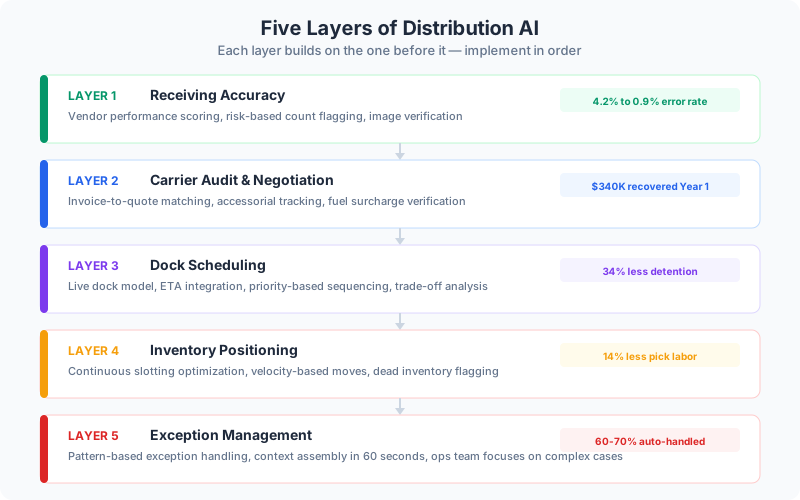
Think of distribution AI as five layers, each building on the one before it. You implement them in order because each layer generates data and organizational trust that makes the next layer easier.
Layer 1: Receiving Accuracy
This is where most money gets lost and nobody realizes it.
The national average for receiving accuracy in distribution is 94-96%. Sounds acceptable until you calculate the cost. On a $50M inventory, 4-6% error rates mean $2-3M in discrepancies — all creating downstream problems in picking, shipping, and cycle counts.
The root cause isn’t careless workers. It’s speed pressure. A receiver has 400 cases to check in, a driver who needs to leave, two more trucks waiting, and a radio that won’t stop.
AI receiving links every PO to vendor performance history. This vendor shorts orders 8% of the time, primarily on specific SKUs. High-risk lines get flagged for full count. Product images get checked against expected packaging. Discrepancies surface instantly instead of showing up as cycle count variances weeks later.
One distribution operation dropped receiving discrepancies from 4.2% to 0.9% in 90 days — $1.6M in inventory accuracy improvement on a $50M base. Receivers didn’t get replaced. They got supported.
👉 Tip: Start by tracking vendor accuracy rates for 90 days before deploying AI receiving. The data itself — knowing which vendors short which SKUs — is valuable even without automation. It changes how you write POs and negotiate with suppliers.
Layer 2: Carrier Audit and Negotiation
Carrier invoices don’t match carrier quotes. This is so universal that most operations have accepted it as a cost of doing business. The gap between quoted and invoiced rates runs 3-8% on average. On $10M in annual freight spend, that’s $300-800K in overpayment.
AI matches every invoice to the original quote, contract terms, and actual shipment data. It calculates expected weight from product master data, tracks accessorial patterns by carrier and route, and compares fuel surcharges to published indices.
When it’s time to rebid a lane, you negotiate with data showing exactly how each carrier has performed — not just what they promised.
One mid-size shipper recovered $340K in year one. Ongoing: $180K annually in billing accuracy plus $220K from better-informed negotiations.
Layer 3: Dock Scheduling
Dock scheduling is a constraint satisfaction problem where the constraints keep changing. You have X doors, Y inbound loads, Z outbound loads, and Q hours to make it work. A dock coordinator at a busy DC makes 15-30 schedule changes per shift, each rippling through labor assignments, load sequencing, and outbound timing.
AI maintains a live model of dock status. It receives carrier ETA updates and adjusts before arrival, resequences loads based on outbound priority (not arrival order), and evaluates trade-offs automatically — $120 detention cost versus $2,800 late-delivery penalty? Delay the inbound.
Benefits of AI dock scheduling:
- Real-time ETA integration eliminates reactive scrambles
- Priority-based sequencing instead of first-come-first-served
- Automated trade-off analysis logged with reasoning
- Dock coordinator role shifts from scheduling to exception oversight
One regional DC reduced detention charges 34% and eliminated late-delivery penalties entirely within 60 days.
Layer 4: Inventory Positioning
Having inventory is different from having it where you need it. A DC with 50,000 SKUs across 200,000 square feet has a positioning problem, not an inventory problem.
Most operations do slotting reviews annually — maybe quarterly. By the time the review happens, velocity has already shifted. You’re optimizing for last quarter’s demand.
AI optimizes continuously. It tracks pick frequency by SKU and location, calculates labor cost of current versus optimal position, schedules moves during slow periods, and flags dead inventory before it occupies prime space for a full quarter.
One 3PL reduced pick labor costs 14% in six months through continuous slotting — repositioning 50-100 SKUs per week based on live velocity data. No racking changes. No capital investment.
Layer 5: Exception Management
This is where everything comes together. A load arrives without paperwork. A customer changes their delivery window mid-route. A trailer has damage during unload. A carrier no-shows.
When a receiving discrepancy is logged, the AI immediately checks: Is this vendor known for shorts? Does the PO have a split shipment indicator? Is there an ASN to verify against? Within 60 seconds, it has context that would take a person 15 minutes to assemble.
In a typical DC, 60-70% of exceptions fall into patterns that can be handled without human intervention. The ops team’s remaining exceptions are genuinely complex — which is what they should be spending their time on.
👉 Tip: Don’t jump to Layer 5 first, even though exception management feels like the biggest pain point. Each earlier layer generates the data and workflow patterns that make exception management effective. Skip ahead and you’re automating on top of bad data.
The Compounding Intelligence Effect
Here’s what makes this framework powerful over time: each layer generates intelligence that feeds the others.
After 12 months, your system knows things no off-the-shelf software could tell you:
- Vendor ABC shorts orders 8% of the time — but only on SKUs in category Q, and only after the 15th of the month
- Carrier XYZ delivers eastbound in 2.1 days (quoted 3) but westbound in 3.4 days — changing how you plan backhauls
- Pick errors spike on Tuesday second shift when a specific operator is on aisle 7
You can’t buy six months of intelligence. Your competitor who starts in October won’t have what you have in March. That’s the moat.
Implementation Timeline
Month 1: Deploy receiving accuracy. Highest value, lowest complexity. You already have the data in your WMS.
Months 2-3: Add carrier invoice audit. Every overpayment recovered justifies the investment.
Months 3-4: Deploy dock scheduling. Requires tighter integration but delivers daily labor savings.
Months 4-6: Add inventory positioning and exception management. These benefit from the foundation laid by earlier layers.
Your dock is running right now. The question is whether the decisions being made are informed by everything you know — or just what one person can remember at 4 AM.
Continue reading:
Related AI Articles
5 Ways AI Cuts Deadhead Miles and Driver Turnover at the Same Time
Trucking margins live and die on loaded miles, driver utilization, and maintenance timing. Here are five specific ways AI moves the needle.
Read moreWhat Most Supply Chain Leaders Get Wrong About AI
Supply chain AI isn't about demand forecasting first. It's about PO exceptions, supplier risk, and clean data — in that order. Here's what actually works.
Read moreThe AEC Firm's Guide to Recovering 30% of Lost Billable Hours
A practical how-to for architecture and engineering firms that want to stop losing billable capacity to proposals, RFIs, spec coordination, and reporting.
Read moreWhat Your Senior Accountants Wish You Knew About AI
Most AI-for-accounting pitches miss the point. Here's what matters and the myths keeping firms from recovering senior capacity.
Read more