
Your Marketing Ops Team Is Drowning — Here's the AI Fix
Marketing ops teams spend 40% of their time on coordination, reporting, and asset management instead of strategy. Here's where AI recovers that capacity.
Here’s what I tell marketing ops leaders when they ask about AI: your team isn’t underperforming. They’re over-burdened. The bottleneck isn’t talent or budget — it’s that 40% of your team’s capacity disappears into coordination, reporting, and asset hunting before they ever touch strategy.
A marketing team of 12 at a $60M B2B company produces 40-60 content assets per month. Each touches 3-5 people before it ships. The calendar says 48 assets due this month. By week three: 19 published, 14 in review, 8 in draft, 7 not started. The bottleneck pattern hasn’t changed in two years.
That’s not a people problem. It’s an operations problem. And operations problems are exactly what AI fixes.
The Problem: Your Content Pipeline Is a Production Line Running Without Production Management
A content asset that takes 6 hours of actual work — 3 hours writing, 2 hours design, 1 hour review — typically takes 8-14 business days from brief to publish.
The writer finishes Tuesday, tags the designer in Asana. The designer starts Friday (three other assets in queue). Design draft back to writer Monday. Writer revises Wednesday. Demand gen reviews Thursday with CTA feedback. Final version ships the following Monday. Fourteen days for six hours of work.
Better project management tools help at the margins. The fundamental problem is serial dependencies and human switching costs that no process optimization eliminates.
Marketing operations is a production management function running on spreadsheets and status meetings — and that mismatch is why your team can never execute fast enough to match strategy.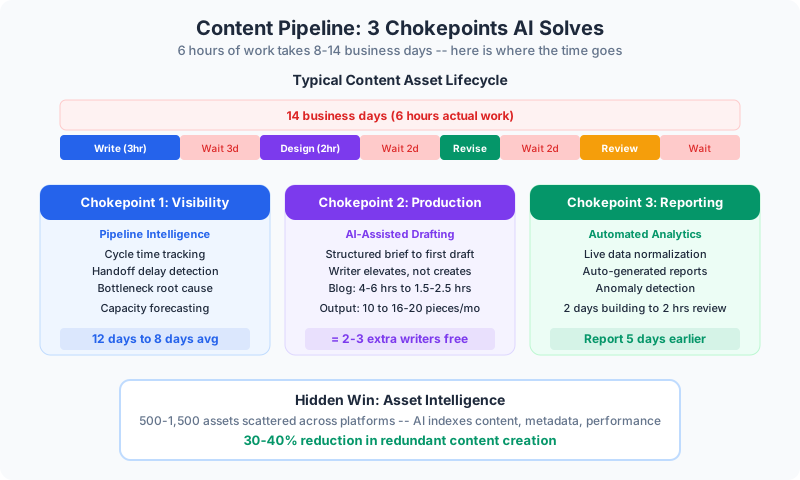
The Solution: AI at Three Chokepoints
Chokepoint 1: Pipeline Visibility and Bottleneck Detection
Most marketing teams know which assets are late. They don’t know why assets are late at the systemic level — which handoff consistently adds 3 extra days, which team member is a bottleneck because they’re overloaded (not slow), which content type always misses deadline.
AI pipeline monitoring watches cycle times, handoff delays, and bottleneck patterns across your entire content operation. Not “this asset is in design” but “this asset has been in design for 4 days — 2.3x average for this type — and the designer has 6 other assets queued ahead.”
Benefits of AI pipeline intelligence:
- Daily health reports showing exactly where bottlenecks are forming
- Root cause analysis (overloaded designer vs. unclear briefs vs. approval delays)
- Downstream risk alerts before deadlines are actually missed
- Capacity planning based on real throughput data, not estimates
Cycle time reductions of 25-40% are typical. A team producing 50 assets monthly that cuts average cycle time from 12 to 8 days can produce 60-65 without adding headcount.
👉 Tip: Before you deploy any AI, track your actual cycle times for 30 days — brief to publish, by content type, by team member involved. Most marketing leaders are shocked by how much time is spent waiting versus working. That data alone changes how you prioritize.
Chokepoint 2: First Drafts and Content Production
A senior content writer produces 8-12 finished pieces monthly. The constraint isn’t typing speed — it’s cognitive load: research, audience analysis, angle, structure, draft, self-edit, format. A 1,500-word blog post takes 4-6 hours. A white paper takes 12-20.
AI-assisted drafting produces first drafts from structured inputs: topic brief, persona, key messages, tone guidelines, SEO requirements, reference materials. The writer’s role shifts from blank-page creation to editorial refinement.
The model isn’t “AI writes, human publishes.” It’s “AI drafts, human elevates.” The writer adds specific examples, contrarian perspectives, and brand voice. AI handles structural work that doesn’t require creative judgment.
Results: Writer throughput from 10 to 16-20 pieces monthly. Blog posts drop from 4-6 hours to 1.5-2.5 hours. At 50 monthly assets with average writer cost of $85K/year, the productivity gain equals 2-3 additional writers without headcount — $170K-$255K in effective capacity.
Chokepoint 3: Reporting and Attribution
The monthly marketing report requires pulling data from 5-8 platforms, normalizing metrics, building visualizations, writing commentary, and presenting to leadership. One person, 1.5-2 full days. Most of it is data assembly.
AI maintains live connections that normalize data as it flows, then produces the monthly report — charts populated, period-over-period comparisons calculated, anomalies highlighted, draft commentary written.
The analyst spends 2 hours reviewing instead of 2 days building. Report goes out on the 3rd instead of the 8th. Five days of earlier visibility compounds across 12 months of leadership decisions.
Results: 60-70% less time on data assembly. 40-50% more time on analysis and recommendations — which is what you hired the analyst to do.
The Hidden Win: Finding What Already Exists
Here’s one most marketing leaders overlook. A three-year team has produced 500-1,500 assets scattered across Google Drive, CMS, design tools, email platforms, and someone’s “Final Final v3” desktop folder.
When a sales rep asks for a manufacturing case study about throughput, someone searches three platforms, checks with colleagues, and either finds an 18-month-old asset or starts from scratch. This happens 15-25 times weekly.
AI asset indexing searches all content across platforms — not just file names, but actual content, metadata, performance data, and usage history. It also identifies gaps and redundancies: 12 blog posts about email marketing, zero about ABM (your fastest-growing segment). Three case studies telling the same story. A 2024 white paper downloaded 400 times but never updated.
Result: 30-40% reduction in redundant content creation. A team producing 15 new assets monthly discovers 4-5 could have been updates to existing high-performers — and updates take 30-40% of new creation time.
👉 Tip: Run an asset audit before deploying AI indexing. Export a list of everything published in the last 24 months. Sort by topic. You’ll find duplicates, gaps, and high performers that deserve updates instead of new assets competing for the same keywords.
Where to Start
The highest-leverage starting point: content production pipeline monitoring. Most time lost, most acute capacity constraints, measurable throughput gains within 30 days.
Implementation sequence:
- Pipeline monitoring — cycle time and bottleneck analysis
- AI-assisted first drafts on highest-volume content types (blog posts, emails, social)
- Reporting automation — clear, bounded use case that builds organizational confidence
When your team’s capacity is consumed by production coordination, manual reporting, and asset hunting, strategy doesn’t matter — you can’t execute fast enough. AI removes the operational drag so your marketers can do the work that actually moves pipeline and revenue.
Continue reading:
Related AI Articles
7 Places AI Saves Money in a Dealership (Not the Pitch)
Forget the chatbot demos. Here are the seven areas where AI produces measurable ROI in auto dealerships — from the service lane to the used car lot.
Read moreFirst-Call Resolution Is Killing Field Service Margins
Every failed first visit costs $250. For a 20-tech operation, that's $100K/month in lost margin. Here's the operational fix.
Read moreWhy Franchises Are the Perfect AI Starting Point (And Most Don't Know It)
Franchises have what every AI project needs: standardized processes. Most multi-unit operators are sitting on an AI gold mine.
Read moreYour Hotel's RevPAR Problem Isn't Pricing — It's Operations
Most hotel operators obsess over rate strategy while operational waste silently eats their margins. Here's where the real RevPAR gains are hiding.
Read more