
6 Ways AI Cuts Food Cost Variance (That Don't Require a Data Scientist)
Food cost variance eats restaurant margins invisibly. Six AI applications that reduce waste, catch errors, and improve forecasting.
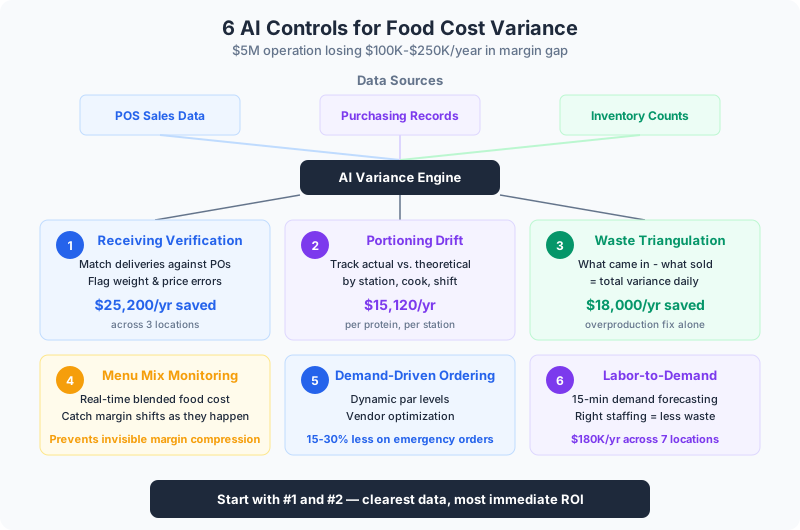
The average restaurant runs 2-5 percentage points above its theoretical food cost. On a $5M operation, that’s $100,000-$250,000 per year in margin that evaporates between what recipes should cost and what you actually spend.
I’ve worked with enough restaurant operators to know that this isn’t a knowledge problem. You know food cost matters. You know portioning drifts. You know waste logs are fiction. The problem is that tracking all of it manually — across every station, every shift, every vendor delivery — is impossible at the resolution needed to actually fix it.
AI doesn’t give you information you didn’t know was important. It gives you the operational resolution to act on information that’s been sitting in your POS and inventory systems all along.Here are 6 specific ways AI cuts food cost variance. None of them require a data scientist.
1. Receiving Verification
Your Tuesday delivery was supposed to be 40 pounds of salmon at $11.20/lb. Did someone actually weigh it? Did they check the price against the PO?
In most restaurants, the answer is “sometimes” and “no.” Deliveries come in during prep. The person receiving is also the person julienning carrots. Verification gets skipped.
AI matches every delivery against every PO — weights, prices, item counts. Flags discrepancies before the invoice gets paid. One operator found $2,100/month in receiving discrepancies across three locations. Product they were paying for but not getting.
That’s $25,200 a year. From one check that wasn’t happening consistently.
👉 Tip: You don’t need cameras or scales integrated with AI to start. Just digitize your POs and invoices, then run the comparison. Most of the savings come from catching price and quantity discrepancies on paper — not measuring every ounce.
2. Portioning Drift Detection
Your recipe says 7 oz of protein. Your Tuesday cook portions 7.5 oz. That’s a 7% overage. Sounds small. Here’s what it costs:
On a protein at $12/lb, across 80 covers a night: $42/night, $1,260/month, $15,120/year — from one protein on one station.
AI tracking actual vs. theoretical usage identifies drift by station, by cook, by shift. Not to punish anyone. To know where the money is going so you can retrain, recalibrate, or adjust the recipe if 7 oz is actually too small for the plate.
The math works like this: AI compares what you sold (from POS data and recipe cards) against what you used (from inventory counts and purchasing data). The gap is your variance. When the gap concentrates on specific stations or shifts, that’s actionable intelligence.
Benefits of portioning drift detection:
- Identifies which stations and which shifts drive the most variance
- Quantifies the dollar impact of overportioning in terms your kitchen team understands
- Creates a feedback loop — variance goes down when people know it’s being measured
- Catches recipe card issues where the portioned amount doesn’t match what actually fits the plate
3. Waste Triangulation
Most waste logs are fiction. Cooks don’t record waste during a 300-cover dinner rush. I get it. But without waste data, you’re flying blind on one of your biggest controllable costs. The average restaurant wastes 4-10% of purchased food.
AI doesn’t rely on manual logging. It triangulates:
- What came in — purchasing data
- What went out on plates — POS sales data mapped to recipes
- What should have been consumed — theoretical usage based on recipes and sales mix
The difference is your total waste and variance. Because this runs daily, you spot trends — not just events.
Here’s a real example: a seafood concept running three locations found that Thursday prep was consistently overproducing two sauces with a three-day shelf life. Produced Thursday, they’d expire Sunday before being fully used because weekend traffic had shifted. Fix: reduce Thursday production 30%, add a smaller Saturday batch. Annual savings: $18,000 across three locations.
The data was always there. Nobody had connected it.
4. Menu Mix Monitoring
This one’s subtle but it’s real. If your 34% food cost entree suddenly outsells your 26% entree by 20%, your blended food cost moves. If nobody recalculates theoretical, the variance report looks fine while actual margins compress.
AI monitoring menu mix against engineered costs catches this in real time. It tells you: “Your blended food cost shifted 0.8 points this week because the ribeye is outselling the chicken by 15% more than planned.”
That’s not a problem to fix — it might be great news if the ribeye has a higher contribution margin. But you need to know it’s happening so you can adjust purchasing, adjust pricing, or lean into the trend.
👉 Tip: If you don’t have recipe cards with accurate costing, start there. AI can’t calculate theoretical food cost without knowing what each dish is supposed to cost. This is the single most important prerequisite.
5. Demand-Driven Ordering
Every order your kitchen places is a decision with margin implications — most made quickly, under pressure, with incomplete information.
Should you order from Vendor A at $11.20/lb with a two-day lead time, or Vendor B at $10.80/lb with three days? The obvious answer is Vendor B — until the extra day means more safety stock, more spoilage risk, and a higher effective cost.
Nobody does this calculation manually in a restaurant. So ordering defaults to habit.
AI optimizes across multiple variables simultaneously:
- Par levels adjust based on actual sales velocity, not static numbers. Your romaine par should change between January and June.
- Vendor selection based on total cost of ownership — delivery fees, minimums, quality consistency, historical fill rates.
- Order consolidation across locations. Three locations each needing a partial case of the same specialty item? Consolidate and redistribute.
- Spoilage prediction based on inventory age and upcoming usage. If 12 pounds of halibut won’t be used before quality degrades, AI suggests a special or staff meal before it becomes waste.
The difference between planned orders at contracted prices with standard lead times and emergency orders at premium prices with expedited shipping is typically 15-30% per order. AI makes planned ordering the default instead of the exception.
6. Labor-to-Demand Alignment
I know — this isn’t technically “food cost.” But labor is your second largest line item at 25-35% of revenue, and labor misalignment directly affects food cost. An understaffed prep shift means shortcuts. Shortcuts mean waste.
Most scheduling treats every Tuesday the same. AI demand forecasting integrates weather, events, historical patterns, and reservation trends to project covers by 15-minute window, then maps to labor models.
One operator running seven fast-casual locations reduced labor cost by 1.8 percentage points — roughly $180,000 annually — without cutting a single shift. The AI found specific misalignments: overstaffed Monday lunches, understaffed Friday 5-6 PM transitions, and prep labor starting too early on slow days.
When your prep team is properly staffed, they have time to portion correctly, rotate stock properly, and follow recipes. Understaffed prep is where food cost variance starts.
The Compounding Effect
Month one, AI is working from historical data. It’s useful, but learning.
Month three, it knows your Tuesday sous chef portions heavy, Location 3’s walk-in reads 2 degrees warm (affecting dairy spoilage), and your salmon vendor’s quality drops on Monday orders.
Month six, it’s anticipating. It adjusts weekend pars before you ask. It connects vendor lead time delays to weather patterns affecting trucking routes. It knows that concert nights near Location 3 shift demand toward appetizers and drinks.
You can buy the software. You can’t buy six months of operational intelligence specific to your locations, vendors, team, and guests. That advantage widens every month your competitors don’t have it.
Where to Start
Don’t implement all six at once. Start with receiving verification and portioning drift detection — they have the clearest data requirements, the most immediate ROI, and they build the measurement foundation everything else depends on.
Your POS data and purchasing records are already sitting there. The question is whether you’re using them at the resolution needed to actually move food cost — or whether you’re still finding out about variance at the end of the month when it’s too late to fix.
Continue reading:
Related AI Articles
The AEC Firm's Guide to Recovering 30% of Lost Billable Hours
A practical how-to for architecture and engineering firms that want to stop losing billable capacity to proposals, RFIs, spec coordination, and reporting.
Read moreThe Real Money in Your Dental Practice Isn't in the Chair
Most dental AI marketing focuses on imaging and diagnostics. That's not what's killing your margins. Here's what is — and how to fix it.
Read moreFinancial Advisors: Double Client Capacity, Same Staff
A guide for advisors and RIAs who want more clients without more staff — by cutting the admin that eats 40% of the week.
Read more5 Compliance-Safe AI Wins for Banks, RIAs, and Insurance Firms
Financial services firms think compliance blocks AI. It doesn't. Five automation wins that improve operations without regulatory risk.
Read more