
Stop Talking to AI Like It's a Person — Start Compiling Your Expertise
Treat AI like a CPU needing compiled programs, not a skilled employee needing instructions. A framework for systems that compound.
Here’s the pattern I see everywhere: someone crafts a careful prompt, gives AI detailed context, and hopes for consistent output. It works for demos. It fails the moment you need it to run 50 times a day without babysitting.
The problem isn’t the AI. It’s the mental model. Most people treat AI like a skilled employee who needs good instructions. That framing caps your results at “sometimes useful.”
The breakthrough is treating AI like a CPU that needs a compiled program. You’re not delegating to intelligence — you’re architecting deterministic execution of codified expertise.The difference matters: a one-off answer vs. a system that compounds. Requiring expertise every time vs. embedding it once. Fragile prompts vs. durable architecture.
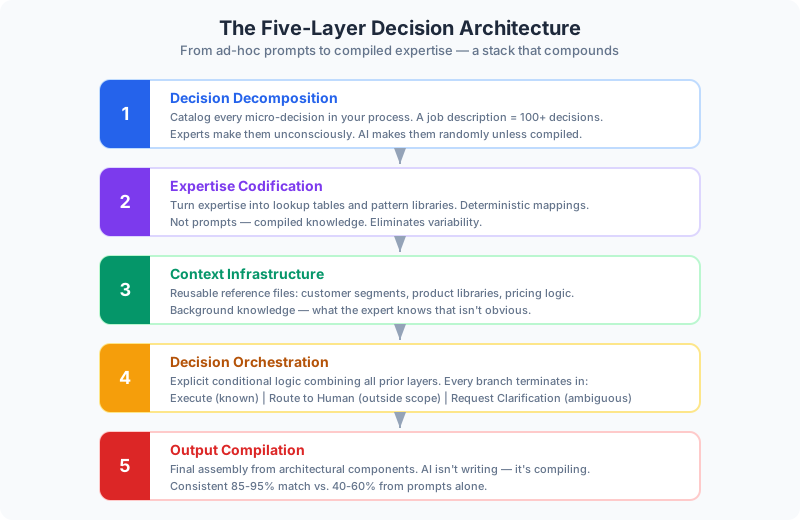
The Five-Layer Framework
Decision architecture decomposes work into five explicit layers. Most automation attempts skip straight to the last one — they ask AI to “write a proposal” without building the underlying decision infrastructure. That produces inconsistent output requiring constant human correction.
Here’s the full stack:
Layer 1: Decision Decomposition
Start by cataloging every decision point in your process. A job description isn’t one task — it’s 100+ micro-decisions. What tone? How structured? What depth on requirements? What behavioral traits to emphasize? What brand voice?
Most of these decisions are invisible until you decompose them. Experts make them unconsciously. AI makes them randomly unless you compile them into architecture.
👉 Tip: Record yourself doing the task while speaking your decisions aloud. The gaps between actions reveal hidden decision points that your prompts are currently missing.
Layer 2: Expertise Codification
Once decisions are visible, codify the expertise as lookup tables and pattern libraries.
Culture Index “Steady Processor” Profile becomes: methodical, patient, precise, calm, consistent, thorough, reliable
PI “Analyzer” Pattern becomes: data-driven, objective, systematic, logical, risk-aware, detail-oriented
These aren’t prompts. They’re compiled expertise. Deterministic mappings that eliminate variability. When the system encounters a Steady Processor, it doesn’t guess — it looks up the compiled pattern.
The job description that took 3 hours now takes 15 minutes because you’ve precompiled 90% of the decisions.
Layer 3: Context Infrastructure
Build reusable reference files that provide background without requiring it in every prompt.
- Customer segment patterns: Enterprise gets ROI focus and compliance language. SMB gets quick wins and cost-efficiency. Startups get speed and strategic partnership framing.
- Product/service library: Value propositions mapped to pain points, competitive differentiators by segment, specs with benefit translations.
- Pricing logic: Structured rules replacing subjective judgment. Volume thresholds with automatic tier calculations. Decision trees for custom vs. standard.
👉 Tip: Context files should answer “What would the expert know that isn’t obvious?” They’re background knowledge, not instructions. Think of them as the mental models your best people carry around.
Layer 4: Decision Orchestration
Design the execution flow with explicit conditional logic. This is where decomposed decisions, codified expertise, and context infrastructure combine:
Discovery Input
    ↓
Customer Segment Match (pattern library lookup)
    ↓
Product Selection (decision tree based on needs)
    ↓
Pricing Calculation (structured rules)
    ↓
Output Compilation (segment-specific template)
Every decision tree should terminate in one of three states: Execute (known pattern), Route to human (outside scope), or Request clarification (ambiguous input). The system knows what it doesn’t know. That’s architecture, not intelligence.
Layer 5: Output Compilation
Final assembly uses all prior layers. The AI isn’t writing — it’s compiling from architectural components. Templates from Layer 3, language from Layer 2, logic from Layer 4, specifics from Layer 1.
This is why architectural approaches produce consistent output. No creativity gap. Only deterministic assembly of pre-defined components.
Why This Beats Prompts at Scale
| Approach | Quality | Consistency | Expertise Required |
|---|---|---|---|
| Prompt-based | Variable | 40-60% match | Every time |
| Decision Architecture | Consistent | 85-95% match | Once (embedded) |
Benefits of the architectural approach:
- Junior team members execute at senior level — consistently
- Expertise survives turnover — knowledge is embedded in architecture, not people
- Teams spend time on judgment and exceptions, not routine execution
- Quality floor rises across the organization — not just for the people who write good prompts
- You can deploy 130+ use cases across departments using the same architectural patterns
The Production Threshold
Prompts are prototypes. They prove a use case exists but can’t sustain production load. Decision architecture is how you cross from demo to durable system.
Most organizations have hundreds of processes where experts make the same decisions repeatedly. Each one is a candidate for architectural decomposition. The pattern extends to every knowledge work domain: proposals, reports, communications, analysis, documentation — anywhere humans make repeated decisions following learned patterns.
👉 Tip: Start with your most painful repetitive task. The one where you think “I’ve explained this 100 times.” That frustration signals codifiable expertise waiting to be compiled.
The companies winning with AI aren’t the ones with better prompts. They’re the ones building decision architectures that compile human expertise into deterministic systems. That’s the difference between automation theater and production systems that compound value every single day.
Continue reading:
- 12 Prompt Frameworks That Turn AI From Toy to Tool — the starting point before you build full architectures
- AI Combo Plays: 6 Ways to Stack Primitives for 10x Results — connecting primitives into systems
- How to Implement AI Without Wasting Six Figures on the Wrong Vendor — the broader implementation framework
- Building Effective Business Systems — the non-AI version of systems thinking
Related AI Articles
Which of These 4 AI Adoption Profiles Is Holding Your Company Back?
Most companies stall at the same AI adoption stage. A framework for finding where you are, why you're stuck, and what actually moves you forward.
Read moreThe AEC Firm's Guide to Recovering 30% of Lost Billable Hours
A practical how-to for architecture and engineering firms that want to stop losing billable capacity to proposals, RFIs, spec coordination, and reporting.
Read moreWhat Your Senior Accountants Wish You Knew About AI
Most AI-for-accounting pitches miss the point. Here's what matters and the myths keeping firms from recovering senior capacity.
Read moreHow a Mid-Size GC Cut Bid Prep Time by 60% Without Adding Estimators
How one general contractor used AI to fix estimating bottlenecks, catch cost overruns weeks earlier, and stop losing tribal knowledge to turnover.
Read more