
Ops Command Center v3.2.1
AIA-PF-2024 Ready
Created Dec 25, 2024

Prompt Frameworks for Business Operations

Stop hoping AI understands you. 12 frameworks, advanced techniques, and real-world examples for ops, finance, and supply chain.

Tools
General
Joshua Schultz
-
ChatGPTClaudeGeminiCopilotUniversal
Tags:
#prompting #frameworks #operations #finance #supply chain #productivity
Article Content

You’re asking AI to “help with inventory analysis” and getting a generic college textbook response about ABC classification. You wanted specific recommendations for your $4.2M slow-moving SKU problem. Now you’re spending 20 minutes going back and forth, drip-feeding context, hoping it eventually understands.

Here’s the problem: you’re conversing when you should be commissioning. AI doesn’t read between the lines. It doesn’t know your business context. It doesn’t understand that “help with inventory” means “give me a prioritized action plan to reduce carrying costs on 847 SKUs with less than 2 turns annually.”

The gap between what you mean and what AI hears is where most business value gets lost.

Prompt frameworks close that gap. They’re not academic exercises or Twitter flexes. They’re compression algorithms for business context. The right framework turns a 6-message conversation into a single shot that nails it.

This guide covers 12 frameworks organized by use case, advanced techniques for complex work, and 40+ real examples for operations, finance, manufacturing, supply chain, and contracts. Not a list to bookmark and forget. A working playbook.
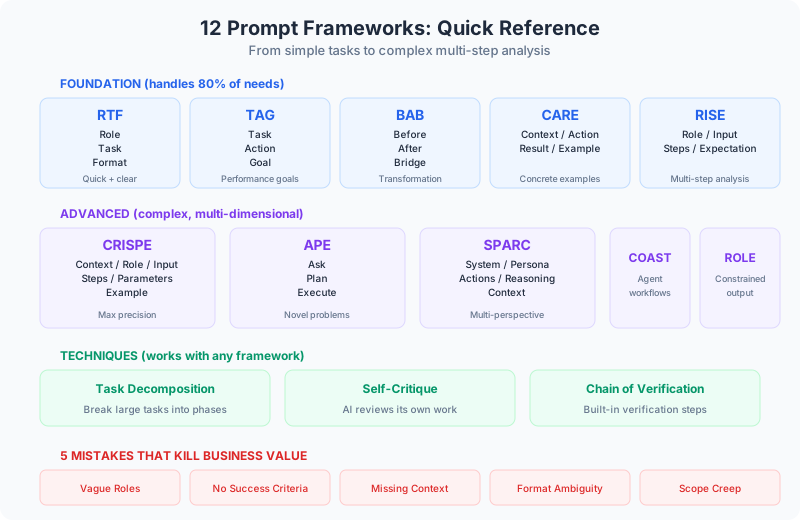
Why Frameworks Work

AI models are pattern completers. They predict what comes next based on structure, not mind reading. When you say “analyze this data,” the model draws from millions of generic analysis examples. When you structure your request with explicit context, role, and constraints, you narrow the pattern space to relevant expertise.

Three things make frameworks effective:

Cognitive offloading. Frameworks force you to clarify your own thinking before you type. Half the time, the act of filling out a framework reveals you don’t actually know what you want. That clarity alone saves cycles.

Context compression. Business problems have layers: historical context, stakeholder constraints, success criteria, format requirements. Frameworks ensure you don’t forget to mention that the CFO needs this by 3pm or that the analysis should assume a 12% cost of capital.

Pattern activation. When you specify “Act as a supply chain consultant with 15 years in automotive distribution,” you’re not just role-playing. You’re activating the model’s training on supply chain content, consultant communication patterns, and industry-specific vocabulary. The response quality shifts measurably.

Quick Reference: Framework Selection

Before diving deep, here’s when to reach for what:

SituationFrameworkWhy
Quick task, clear outputRTFFastest path to usable result
Performance improvementTAGBuilt for measurable goals
Problem → solution bridgeBABMaps current state to desired state
Need concrete examplesCAREAnchors output with reference points
Multi-step processRISEStep-by-step with clear expectations
Complex analysisCRISPEMaximum precision and control
Problem-solvingAPEForces planning before execution
Multi-perspective workSPARCBuilds specialized reasoning chains
Agent workflowsCOASTPlans multi-step agent tasks

Part 1: Foundation Frameworks

These five frameworks handle 80% of business prompting needs. Master these before touching advanced techniques.

R-T-F: Role → Task → Format

The minimum viable framework. Use it when you know exactly what you want and just need it done.

Structure:

  • Role: Who should the AI be?
  • Task: What specific thing do you need done?
  • Format: How should the output be structured?

Why it works: Format specification alone eliminates 50% of regeneration cycles. “Give me a table” versus “give me analysis” produces dramatically different outputs.

RTF is your default. When in doubt, start here.

Operations Example:

Role: Act as a warehouse operations manager with lean manufacturing experience.

Task: Analyze this pick path data and identify the top 5 opportunities to reduce
travel time. Consider zone layout, order batching potential, and slot optimization.

Format: Create a prioritized recommendation table with columns for: Opportunity,
Current State, Proposed Change, Estimated Time Savings (%), Implementation
Difficulty (1-5), and Dependencies.

Finance Example:

Role: You are a financial controller specializing in manufacturing cost accounting.

Task: Review this standard cost variance report and identify the three variances
that most warrant investigation. Consider materiality ($25K threshold) and
pattern persistence (3+ months).

Format: For each variance, provide:
1. Variance description and dollar impact
2. Most likely root causes (ranked)
3. Suggested investigation steps
4. Questions for operations team

Supply Chain Example:

Role: Act as a procurement specialist with experience in supplier relationship
management for industrial distribution.

Task: Draft a supplier scorecard email for ABC Manufacturing based on these Q3
metrics: 87% OTD (target 95%), 2.3% defect rate (target 1%), 45-day payment
terms. Tone should be collaborative but clear about improvement expectations.

Format: Professional email, 200-300 words. Include specific improvement targets
and timeline for follow-up review.

Contract Example:

Role: You are a commercial contracts analyst with experience in distribution
agreements.

Task: Review this vendor agreement redline and summarize all liability-related
changes the vendor proposed. Flag any shifts in risk allocation.

Format: Table with columns: Original Language (summarized), Proposed Change,
Risk Shift Direction (to us/to them/neutral), Recommendation (accept/reject/
negotiate).

T-A-G: Task → Action → Goal

Built for performance improvement scenarios. When you need to move a metric, TAG structures the thinking around measurable outcomes.

Structure:

  • Task: What’s the objective?
  • Action: What approach or method should be applied?
  • Goal: What’s the measurable target?

Why it works: The explicit Goal component forces quantification. “Improve customer satisfaction” becomes “increase NPS from 32 to 45 within two quarters.” This precision shapes the entire response.

Operations Example:

Task: Reduce order fulfillment cycle time in our DC.

Action: Analyze the attached process flow and identify bottlenecks. Act as a
lean operations consultant. Consider pick, pack, and ship stages separately.
Focus on changes achievable without capital investment.

Goal: Achieve 15% reduction in average cycle time (currently 4.2 hours) within
90 days. Secondary goal: reduce cycle time variability (currently 2.1 hour
standard deviation) by 25%.

Finance Example:

Task: Improve our cash conversion cycle.

Action: As a working capital specialist, analyze these DSO, DIO, and DPO trends
against industry benchmarks. Identify the component with greatest improvement
potential and develop specific initiatives.

Goal: Reduce CCC from 67 days to 52 days within 6 months. Each initiative should
have projected day-reduction impact and implementation requirements.

Manufacturing Example:

Task: Increase OEE on Packaging Line 3.

Action: Review the attached downtime Pareto and production logs. Act as a TPM
implementation consultant. Categorize losses by type (availability, performance,
quality) and prioritize improvement opportunities.

Goal: Improve OEE from 62% to 75% over the next quarter. For each opportunity,
estimate the OEE point improvement and required resources.

Supply Chain Example:

Task: Reduce supplier lead time variability for critical components.

Action: Analyze the attached lead time data for our top 20 suppliers by spend.
Act as a supply chain risk analyst. Identify suppliers with coefficient of
variation >0.3 and categorize root causes.

Goal: Reduce average CV from 0.42 to 0.25 across critical suppliers. Develop
supplier-specific action plans with timeline and escalation paths.

B-A-B: Before → After → Bridge

The transformation framework. Use it when you need a plan to get from current state to desired state.

Structure:

  • Before: What’s the current situation/problem?
  • After: What does success look like?
  • Bridge: What’s the path to get there?

Why it works: BAB mirrors how humans naturally think about change. It forces you to articulate both the pain (motivation) and the vision (direction) before asking for the plan.

BAB excels at strategic planning, process redesign, and any “how do we get from here to there” problem.

Operations Example:

Before: Our returns processing takes 14 days average from receipt to refund/
replacement. Customer complaints are increasing. We process 200-300 returns
daily with a 6-person team. No standardized disposition criteria exist—each
associate makes judgment calls.

After: Returns processed within 5 business days. Standardized disposition
matrix. Real-time status visibility for customer service. Quality data captured
for supplier chargebacks.

Bridge: Develop a phased implementation plan. Consider process redesign, system
requirements, staffing implications, and training needs. Identify quick wins
achievable in 30 days and foundational changes requiring 90 days. Include
success metrics for each phase.

Finance Example:

Before: Our monthly close takes 12 business days. The bottleneck is
intercompany reconciliation (3 days) and inventory valuation (2 days). We have
limited automation—most processes run in Excel. The team is burned out from
recurring fire drills.

After: Monthly close completed by business day 5. Automated reconciliation with
exception-only review. Real-time inventory valuation. Team capacity freed for
analysis rather than data compilation.

Bridge: Create a close acceleration roadmap. Prioritize initiatives by impact
and complexity. Identify technology investments required, process changes, and
organizational implications. Map dependencies and critical path.

Supply Chain Example:

Before: We manage 4,200 SKUs across 3 distribution centers with Excel-based
planning. Stockouts run 8% and excess inventory ties up $2.1M. Planners spend
80% of time firefighting expedites. No demand sensing or automated reordering.

After: Demand-driven replenishment with automated reorder triggers. Stockouts
below 2%, excess inventory reduced by 40%. Planners focused on exceptions and
strategic vendor management.

Bridge: Design a planning transformation roadmap. Evaluate build vs. buy for
planning technology. Sequence implementation to show early wins. Address
change management for planner role evolution. Include projected ROI timeline.

Contract Example:

Before: Contract review takes 3-4 weeks average. Legal is a bottleneck with 47
contracts in queue. Sales loses deals to faster competitors. No standardized
playbook exists—each negotiation starts from scratch.

After: Standard contracts approved in 48 hours. Playbook-based negotiation
with pre-approved fallback positions. Legal review only for non-standard terms.
Sales empowered to close without waiting.

Bridge: Design a contract automation and playbook strategy. Identify terms that
can be standardized. Propose tiering by contract value/risk. Outline technology
requirements, legal governance model, and training approach. Include risk
mitigation for empowering non-lawyers.

C-A-R-E: Context → Action → Result → Example

When abstract requests produce abstract responses, CARE grounds the output with concrete reference points.

Structure:

  • Context: Background situation and constraints
  • Action: What you need done
  • Result: Desired outcome
  • Example: Reference point for style, format, or approach

Why it works: Examples are worth a thousand words of description. “Like Patagonia’s ‘Don’t Buy This Jacket’ campaign” communicates more than paragraphs of explanation.

Operations Example:

Context: We're a $45M industrial distributor implementing a new WMS next quarter.
The project sponsor is skeptical after a failed ERP implementation two years
ago. The operations team has low technical literacy but strong process knowledge.

Action: Create a change management communication plan for the WMS go-live.

Result: Build confidence in the implementation, prepare users for workflow
changes, and establish clear escalation paths for issues.

Example: Model the communication cadence and tone on how Toyota communicates
major production system changes—emphasizing respect for current processes,
clear rationale for changes, and heavy involvement of floor-level input. The
communications should feel operational, not corporate.

Finance Example:

Context: Our PE sponsor requires monthly reporting by the 10th. Current package
takes 40 hours to prepare and includes 67 slides. Feedback indicates they only
review 8-10 slides closely. The sponsor values concise, decision-oriented
information.

Action: Redesign the monthly reporting package to maximize signal-to-noise.

Result: Package that takes <10 hours to prepare, focuses on actionable insights,
and addresses sponsor's actual decision needs.

Example: Structure it like a Bridgewater daily observation—lead with the key
takeaway, provide supporting evidence concisely, and clearly separate facts from
interpretation. Think "what would a busy board member need to know in 5 minutes."

Manufacturing Example:

Context: We're launching continuous improvement on the shop floor. The plant
manager is supportive but supervisors are resistant—they've seen "flavor of
the month" programs before. Union environment, 23-year average tenure.

Action: Develop a CI pilot proposal for one production cell.

Result: Quick win that builds credibility and demonstrates the approach without
overwhelming resources or triggering resistance.

Example: Model the approach on how Paul O'Neill introduced safety-first at Alcoa—
choose a metric everyone agrees matters, make progress visible daily, celebrate
publicly, and let success pull the next opportunity forward rather than pushing
top-down mandates.

Supply Chain Example:

Context: We source 60% of components from China with 45-60 day lead times. Recent
disruptions cost us $3.2M in expedite fees and lost sales. Board is asking for
a diversification strategy but concerned about cost increases.

Action: Develop a supplier diversification analysis framework.

Result: Fact-based recommendation on which categories to diversify, alternative
regions, and realistic cost/timeline impacts.

Example: Structure the analysis like a McKinsey supply chain risk assessment—
categorize by criticality and supply risk, quantify exposure, propose scenarios
with explicit tradeoffs, and provide a clear recommendation with implementation
sequencing.

R-I-S-E: Role → Input → Steps → Expectation

For multi-step processes where you need the AI to work through a structured approach and deliver against specific success criteria.

Structure:

  • Role: Expert persona to adopt
  • Input: Data, context, and materials provided
  • Steps: Specific process to follow
  • Expectation: Success criteria and deliverable specifications

Why it works: RISE is essentially a mini-SOW. The Steps component ensures the AI doesn’t skip straight to conclusions, and the Expectation component gives you something to evaluate against.

Use RISE when the process matters as much as the output—analysis, audits, reviews.

Operations Example:

Role: You are a logistics network optimization consultant with experience in
multi-echelon distribution.

Input: I've attached our current DC locations, shipping volumes by region, and
transportation costs. We're evaluating adding a West Coast DC.

Steps:
1. Analyze current shipping patterns and identify underserved regions
2. Model the impact of a West Coast DC on transit times and costs
3. Identify the optimal location zone (not specific address)
4. Quantify the investment vs. savings tradeoff
5. Assess risks and implementation considerations

Expectation: A 2-page executive summary suitable for presenting to our COO.
Include a recommendation with clear rationale, expected ROI range, and key
assumptions. Flag any data gaps that would change the analysis.

Finance Example:

Role: You are an FP&A director with experience in manufacturing companies during
economic uncertainty.

Input: Attached is our current 2024 budget, YTD actuals through October, and
industry forecasts. Revenue is tracking 8% below plan, but gross margin is up
2 points.

Steps:
1. Analyze the variance drivers and categorize as temporary vs. structural
2. Assess the likelihood of hitting revised full-year targets
3. Identify specific risks to Q4 forecast
4. Develop 3 scenarios (pessimistic, base, optimistic) with probability weights
5. Recommend specific actions for the remaining 2 months

Expectation: A forecast update memo for the CFO. Include clear scenario ranges,
probability assessments, and recommended actions. The CFO values directness—lead
with your recommendation, then support it. No hedging language.

Manufacturing Example:

Role: You are a quality engineer with Six Sigma Black Belt certification and
experience in discrete manufacturing.

Input: Attached is our defect data for Product Line X over the past 6 months,
including defect types, production shifts, operators, and machine IDs.

Steps:
1. Create a Pareto of defect types and identify the vital few
2. Analyze patterns by shift, operator, and machine
3. Develop hypotheses for root causes of top 3 defect types
4. Propose verification tests for each hypothesis
5. Outline a corrective action plan with ownership and timelines

Expectation: A structured quality investigation report suitable for review with
the plant manager. Include data visualizations, statistical significance notes
where relevant, and a prioritized action plan. Focus on actions within our
control—don't blame suppliers or customers.

Contract Example:

Role: You are a commercial attorney specializing in technology agreements.

Input: Attached is a SaaS agreement from a vendor we're evaluating. This would
be our first enterprise SaaS contract over $500K annually.

Steps:
1. Identify all terms that deviate from market-standard positions
2. Flag provisions with significant risk exposure
3. Assess the liability allocation and limitation of liability caps
4. Review data security, breach notification, and compliance terms
5. Evaluate exit provisions and transition assistance terms

Expectation: A contract review memo for the CFO and CIO. Use a risk matrix
format (high/medium/low) with specific clause references. For each high-risk
item, provide recommended negotiating language. The tone should be advisory,
not adversarial—we want this deal to happen if we can get reasonable terms.

Part 2: Advanced Frameworks

These frameworks handle complex, multi-dimensional problems. They require more setup but produce more sophisticated outputs.

CRISPE: Context → Role → Input → Steps → Parameters → Example

The precision instrument. Use CRISPE when you need tight control over every aspect of the output.

Structure:

  • Context: Business situation and background
  • Role: Expert persona with specific credentials
  • Input: All relevant data and materials
  • Steps: Exact process to follow
  • Parameters: Constraints, boundaries, and specifications
  • Example: Reference point for style and quality

Why it works: CRISPE leaves nothing to interpretation. Every dimension of the request is specified. This is ideal for high-stakes deliverables where regeneration isn’t acceptable.

Finance Example (Complex Analysis):

Context: We're a $120M specialty chemicals manufacturer preparing for a
potential sale process in 2025. Private equity buyers will conduct extensive
due diligence on our financial performance and growth story.

Role: You are a Big 4 transaction advisory professional with 10+ years in M&A
sell-side engagements for middle-market manufacturing companies.

Input: I'll provide 3 years of audited financials, monthly management reports
for the trailing 12 months, and our internal 5-year strategic plan.

Steps:
1. Analyze historical financial performance and identify key trends
2. Calculate and benchmark relevant multiples and metrics
3. Identify potential quality of earnings adjustments a buyer will make
4. Assess the credibility of the strategic plan assumptions
5. Identify likely due diligence focus areas and prepare talking points
6. Develop a preliminary valuation range with supporting rationale

Parameters:
- Assume a strategic buyer universe (not financial sponsor)
- Use EBITDA multiples appropriate for specialty chemicals (research current)
- Flag any metrics that fall outside industry norms
- Limit quality of earnings to adjustments >$100K impact
- Valuation range should reflect 20th to 80th percentile outcomes

Example: Structure the deliverable like a CIM (Confidential Information
Memorandum) executive summary section—professional tone, clear articulation of
investment thesis, honest about challenges but framed constructively.

Supply Chain Example (Vendor Selection):

Context: We need to select a transportation management system (TMS) to support
our growth from $80M to $200M revenue over 5 years. Current state is manual
with spreadsheets and phone calls to 14 carrier partners.

Role: You are a supply chain technology consultant who has led 20+ TMS
selection and implementation projects across industrial distribution.

Input: I'll provide our current shipping volumes, carrier mix, system
landscape, IT capabilities assessment, and budget parameters.

Steps:
1. Document functional requirements based on our current pain points and growth
2. Develop evaluation criteria with weightings
3. Create a vendor shortlist with rationale
4. Design a structured evaluation process and timeline
5. Identify implementation risks and mitigation strategies
6. Build a business case with ROI projections

Parameters:
- Cloud-only solutions (no on-premise)
- Must integrate with our Oracle ERP via standard APIs
- Implementation budget capped at $250K, annual SaaS under $80K
- Go-live required within 9 months
- Internal IT support limited to 0.5 FTE
- Carrier EDI capability required for top 10 carriers

Example: Follow Gartner's TMS evaluation methodology. The final recommendation
should read like an internal investment memo, not a vendor brochure. Include a
dissenting view section acknowledging risks of the recommended path.

APE: Ask → Plan → Execute

The problem-solving framework. Forces structured thinking before action.

Structure:

  • Ask: What’s the core question/problem?
  • Plan: How should we approach solving it?
  • Execute: Now solve it following that plan

Why it works: APE prevents the AI from jumping to conclusions. By explicitly planning the approach first, you get more thoughtful, comprehensive responses.

APE is excellent for novel problems where the approach itself is unclear.

Operations Example:

Ask: Our order accuracy has dropped from 99.2% to 96.8% over the past quarter.
What's causing it and how do we fix it?

Plan: Before analyzing root causes, outline your investigation approach. What
data would you need? What hypotheses would you test? What stakeholders would
you interview? What's the sequence of analysis?

Execute: Now apply that plan using the data I'll provide: pick error logs,
shipping manifests, customer complaints, and inventory accuracy reports. Provide
your analysis and recommendations following the structure you outlined.

Finance Example:

Ask: Our gross margin has compressed 340 basis points year-over-year despite
stable pricing. What's driving it?

Plan: First, outline your diagnostic framework. What are the possible drivers
of margin compression? How would you decompose the variance? What data would
confirm or refute each hypothesis?

Execute: Now analyze using the attached data: product-level P&Ls, material
cost trends, labor rates, and production volumes. Walk me through your analysis
step by step, then provide your conclusions and recommendations.

Manufacturing Example:

Ask: Line 4 productivity has diverged from Lines 1-3. They're running identical
equipment and products, but Line 4 runs 12% slower with 8% more scrap.

Plan: Develop a troubleshooting framework. What categories of causes would
explain equipment-specific underperformance? How would you isolate variables?
What data collection would you need?

Execute: Apply your framework to these inputs: OEE data by line, maintenance
logs, operator schedules, quality records, and setup time logs. Identify the
most likely root causes and propose a corrective action plan.

SPARC: System → Persona → Actions → Reasoning → Context

Builds specialized thinking chains for complex problems. Use SPARC when you need multiple expert perspectives.

Structure:

  • System: Define the overall system prompt and behavior
  • Persona: Create specialized expert roles
  • Actions: What each persona should do
  • Reasoning: How they should think through problems
  • Context: Shared background information

Why it works: SPARC essentially creates a panel of experts in a single prompt. Each persona brings different analytical lenses to the same problem.

Strategic Decision Example:

System: You will analyze a make vs. buy decision from multiple expert
perspectives, then synthesize a recommendation.

Persona 1 - Operations Leader: Focus on manufacturing capabilities, capacity
utilization, quality control, and operational complexity.

Persona 2 - Finance Leader: Focus on total cost of ownership, capital
requirements, working capital impact, and risk-adjusted returns.

Persona 3 - Supply Chain Leader: Focus on supplier reliability, lead time
implications, inventory requirements, and supply risk.

Actions: Each persona should independently analyze the decision, then engage
in a structured debate highlighting areas of agreement and tension.

Reasoning: Each persona should explicitly state their assumptions, identify
what data would change their view, and acknowledge tradeoffs in their position.

Context: We currently outsource machined components to 3 suppliers. Volume is
$4.2M annually. Lead time is 8-10 weeks. Quality is inconsistent—averaging 2.3%
defect rate. We have idle CNC capacity from a cancelled product line.

Provide each persona's analysis, the debate highlights, and a synthesized
recommendation with clear rationale.

COAST: Context → Objective → Action → Scenario → Task

Designed for agent workflows and multi-layered requests. Use COAST when you need sequential reasoning across scenarios.

Structure:

  • Context: Background and situation
  • Objective: High-level goal
  • Action: Specific approach
  • Scenario: Conditions or situations to consider
  • Task: Concrete deliverable

Finance Planning Example:

Context: We're entering budget season for FY25. Revenue grew 22% this year but
macroeconomic indicators suggest slowdown. Our PE sponsor expects continued
growth investment but also margin expansion.

Objective: Develop a budget framework that balances growth and profitability.

Action: Create a scenario-based budget model with clear decision triggers.

Scenarios:
1. Base case: 12% revenue growth, stable macro
2. Optimistic: 18% revenue growth, strong market
3. Pessimistic: 5% revenue growth, mild recession

For each scenario, model:
- Revenue by segment
- Required headcount and timing
- Margin targets and tradeoffs
- Capital expenditure priorities
- Cash flow implications

Task: Deliver a budget presentation framework (outline, not full deck) that:
1. Shows scenario-based targets
2. Identifies decision points where we'd shift between scenarios
3. Defines leading indicators we'll monitor monthly
4. Provides flex budget ranges for key expense categories

ROLE: Role → Objectives → Limitations → Evaluation

Sets clear boundaries and success criteria. Use when you need to constrain AI behavior.

Structure:

  • Role: Who the AI should be
  • Objectives: What success looks like
  • Limitations: What’s out of scope or off-limits
  • Evaluation: How to assess the output quality

Audit Example:

Role: You are an internal audit manager conducting a controls assessment.

Objectives:
- Identify control gaps in our procure-to-pay process
- Assess design and operating effectiveness
- Prioritize findings by risk level
- Provide practical remediation recommendations

Limitations:
- Do not assume fraud or intentional misconduct
- Limit scope to transactions over $10K
- Do not recommend technology solutions (that's a separate initiative)
- Findings must be based on evidence in the provided materials
- Do not interview stakeholders (this is document-only review)

Evaluation: Output quality will be assessed on:
- Clear linkage between evidence and conclusions
- Practical remediation recommendations (not theoretical)
- Appropriate risk rating calibration
- Professional tone suitable for audit committee presentation
- Completeness of process coverage

Provide your assessment in standard internal audit report format with executive
summary, detailed findings, and management action plans.

Part 3: Advanced Techniques

These techniques work with any framework to improve output quality on complex tasks.

Task Decomposition

Break large tasks into smaller, manageable steps. This prevents the AI from getting lost in complexity and ensures thoroughness.

When to use: Any task that would take a human more than 30 minutes. Multi-phase projects. Analysis requiring multiple data sources.

Basic Pattern:

I need help with [complex task]. Let's break this into phases:

Phase 1: [Discovery/Research]
Phase 2: [Analysis/Synthesis]
Phase 3: [Recommendation/Output]

Start with Phase 1. When complete, summarize findings and I'll confirm before
proceeding to Phase 2.

Operations Example:

I need to develop a warehouse labor model. Let's approach this systematically:

Phase 1 - Process Documentation:
- List all major warehouse activities (receiving, putaway, picking, packing, shipping)
- For each activity, identify the key volume drivers
- Document any current time standards we use

Phase 2 - Data Analysis:
- Calculate actual productivity rates from historical data
- Identify variability by day-of-week, season, and product type
- Benchmark against industry standards

Phase 3 - Model Development:
- Build the mathematical model linking volume to labor hours
- Include provisions for indirect time, training, and absenteeism
- Create a simple planning tool format

Let's start with Phase 1. I'll provide our current process maps.

Self-Critique and Reflection

Prompt the AI to review and improve its own work. This catches errors, strengthens arguments, and improves completeness.

Basic Pattern:

After providing your [analysis/recommendation/output]:

1. Critique your own work: What are the weakest points?
2. What would a skeptic challenge?
3. What did you assume that might not be true?
4. If you had more data, what would change your conclusion?

Then provide a revised version addressing the most significant weaknesses.

Finance Example:

Analyze the attached investment proposal and provide a recommendation.

After your initial recommendation, apply self-critique:
1. What's the biggest risk you might be underweighting?
2. What assumption, if wrong, would change your conclusion?
3. What would a conservative CFO challenge about this analysis?
4. What's the best argument against your recommendation?

Provide your original recommendation, then your critique, then a final
recommendation that addresses the critique.

Contextual Reasoning

Force the AI to consider multiple viewpoints before concluding. Reduces one-dimensional analysis.

Basic Pattern:

Consider this decision from multiple perspectives:
1. [Stakeholder 1] perspective: What do they care about?
2. [Stakeholder 2] perspective: What do they care about?
3. [Stakeholder 3] perspective: What do they care about?

Where do these perspectives align? Where do they conflict?
How would you balance competing interests?

Change Management Example:

We're implementing a new ERP system. Before recommending the communication plan:

Consider the perspectives of:
1. Executives: What do they need to feel confident the project is on track?
2. Middle managers: What concerns do they have about their team's performance during transition?
3. Front-line users: What fears do they have about learning new systems?
4. IT team: What support concerns do they have about go-live?
5. Customers: How might they be affected during the transition?

Map the concerns, then design a communication plan that addresses each
stakeholder group appropriately. Identify any conflicts between what different
groups need to hear.

Chain of Verification

For high-stakes outputs, build in verification steps.

Basic Pattern:

After providing your [calculation/analysis/recommendation]:

Verification step 1: Walk through your logic step by step
Verification step 2: Check each numerical calculation
Verification step 3: Verify consistency across all parts of the output
Verification step 4: Confirm the output actually answers the original question

Flag any discrepancies found during verification.

Financial Model Example:

Calculate the NPV of this capital project given the following inputs:
[inputs provided]

After your calculation:
1. Walk through each year's cash flow calculation showing your work
2. Verify the discount rate application for each period
3. Check that terminal value assumptions are consistent with growth rates
4. Confirm sensitivity ranges are mathematically correct
5. Validate that the recommendation aligns with the calculated results

Provide the analysis, then the verification walkthrough, flagging any issues.

Part 4: Framework Combinations

Real business problems often benefit from combining frameworks. Here are proven combinations:

BAB + RISE: Problem Diagnosis to Structured Solution

Start with BAB to frame the transformation, then use RISE to structure the solution development.

[BAB Section]
Before: Our accounts receivable is $4.2M with 52 DSO. Over 90 days represents
$890K. Cash flow is constrained and we're drawing on our line of credit.

After: DSO at 38 days. Over 90 reduced to under $200K. Cash flow positive
without credit line usage.

Bridge: We need a comprehensive AR improvement initiative.

[RISE Section]
Role: You are an AR management specialist with experience in B2B distribution.

Input: I'll provide our current aging report, customer payment history, credit
terms by customer, and collection activity logs.

Steps:
1. Segment customers by payment behavior and risk
2. Identify root causes of slow payment by segment
3. Develop segment-specific collection strategies
4. Propose credit policy adjustments
5. Design a monitoring and escalation framework

Expectation: An AR improvement playbook with 30-60-90 day milestones,
projected DSO improvement by month, and required resources.

CRISPE + Task Decomposition: Complex Project Planning

Use CRISPE for precision on each phase, with explicit decomposition.

This project will be completed in three phases. For each phase, I'll provide
CRISPE-structured requirements.

PHASE 1: Current State Assessment
Context: [situation]
Role: [expert type]
Input: [materials for this phase]
Steps: [specific process]
Parameters: [constraints]
Example: [reference]

[Complete Phase 1, then proceed]

PHASE 2: Gap Analysis
[CRISPE structure for Phase 2]

PHASE 3: Implementation Roadmap
[CRISPE structure for Phase 3]

TAG + Self-Critique: Goal-Oriented with Quality Check

Combine measurable goals with built-in quality review.

Task: Improve our supplier on-time delivery performance.

Action: As a supply chain manager, analyze the attached supplier performance
data and develop an improvement plan.

Goal: Increase average OTD from 82% to 94% within two quarters.

After developing your plan:
1. Which suppliers are most critical to hitting the goal?
2. What could cause this plan to fail?
3. What's the most optimistic assumption you're making?
4. How would you phase this if resources were cut by 50%?

Revise your plan based on the critique.

Part 5: Industry-Specific Prompt Libraries

Operations Prompts

Process Improvement:

RTF: Act as a lean sensei. Document the current state value stream for our
[process]. Format as a VSM with takt time, cycle times, WIP limits, and
identified waste categories.

Capacity Planning:

TAG: Task is to balance workload across our 3 production lines. Action: analyze
the attached demand forecast and production capabilities. Goal: Level loading
within 5% across lines while meeting 98% on-time delivery.

Standard Work Development:

RISE: Role: Industrial engineer. Input: Video observation notes and time study
data for the [task]. Steps: Identify best method, calculate standard time with
appropriate allowances, document step-by-step procedure. Expectation: Standard
work sheet ready for operator training, formatted for visual management board.

Finance Prompts

Variance Analysis:

RTF: Act as an FP&A analyst. Analyze the attached P&L variance report (actual
vs. budget). Format: Waterfall analysis of top 5 variances with root cause
hypotheses and recommended management responses.

Working Capital Analysis:

CARE: Context: We're a $65M distributor with seasonal demand peaks in Q4.
Action: Analyze our working capital cycle and identify improvement opportunities.
Result: Reduce cash conversion cycle by 10 days. Example: Structure like a PE
operating partner's working capital diagnostic—focus on actionable levers.

Investment Analysis:

CRISPE: Context: We're evaluating a $1.2M automation investment. Role: Capital
budgeting analyst. Input: [investment details and projections]. Steps: Calculate
NPV, IRR, payback; perform sensitivity analysis; assess strategic fit.
Parameters: 15% hurdle rate, 5-year analysis period, ignore tax impacts.
Example: Format like a board-ready investment memo with clear recommendation.

Supply Chain Prompts

Inventory Optimization:

TAG: Task: Reduce slow-moving inventory. Action: Apply ABC-XYZ classification
to the attached SKU list and develop segment-specific inventory policies.
Goal: Reduce slow-movers (bottom 20% of turns) by 40% while maintaining 97%
fill rate on A items.

Supplier Negotiation:

RISE: Role: Strategic sourcing manager. Input: Current contract terms, market
pricing data, supplier financial analysis. Steps: Identify negotiation levers,
develop BATNA, create negotiation strategy, prepare concession framework.
Expectation: Negotiation prep document with talking points, target vs. limit
positions, and counter-offer responses.

Demand Planning:

BAB: Before: Forecast accuracy averaging 68% MAPE. Stock-outs at 6%, expedite
costs $180K quarterly. After: 85% forecast accuracy, stock-outs under 2%,
expedite costs under $50K. Bridge: Design a demand planning process improvement
initiative with technology, process, and people recommendations.

Contract Prompts

Contract Review:

ROLE: Role: Commercial attorney. Objectives: Identify material risks in the
attached agreement, provide negotiating recommendations. Limitations: Focus
on terms over $25K impact, don't restructure the entire deal. Evaluation:
Risk matrix format, clear accept/reject/negotiate recommendations with
specific markup language.

RFP Response:

CRISPE: Context: We're responding to an RFP for logistics services. Role: Bid
manager with distribution industry experience. Input: RFP document, our
capabilities, competitive positioning. Steps: Analyze requirements, identify
win themes, develop compliance matrix, draft executive summary. Parameters:
Page limit 25, must address all mandatory requirements, focus on 3 key
differentiators. Example: Follow ShipBob's RFP response style—clear,
confident, quantified.

Manufacturing Prompts

Quality Investigation:

APE: Ask: Why did defect rate spike from 1.2% to 4.8% last week on Line 2?
Plan: What investigation methodology would you apply? What data would you need?
What hypotheses would you test? Execute: Apply that methodology to this defect
data, production logs, and maintenance records. Provide root cause analysis
with confidence levels and recommended corrective actions.

Production Scheduling:

CARE: Context: We run 12 products on 4 lines with significant changeover times.
Customer demand varies weekly. Current schedule is gut-based. Action: Develop
a production scheduling logic. Result: Minimize total changeover time while
meeting customer delivery requirements. Example: Apply SMED principles and
economic lot sizing concepts, formatted as decision rules operators can apply.

Part 6: Common Mistakes and How to Fix Them

Mistake 1: Vague Roles

❌ “Act as an expert”

✅ “Act as a distribution center operations manager with 10 years of experience in B2B wholesale, specializing in high-SKU-count environments”

The fix: Add years of experience, industry context, and specific expertise areas.

Mistake 2: Missing Success Criteria

❌ “Analyze our inventory”

✅ “Analyze our inventory with focus on: (1) identifying SKUs with >180 days supply, (2) calculating carrying cost exposure, (3) recommending disposition strategies with expected recovery rates”

The fix: Define what “done” looks like before asking for work.

Mistake 3: Insufficient Context

❌ “Help me write a collection letter”

✅ “Help me write a collection letter. Context: B2B customer, $47K outstanding, 67 days past due, previously reliable payer, we want to preserve the relationship, they recently had a CFO change”

The fix: Provide the relevant constraints and considerations.

Mistake 4: Format Ambiguity

❌ “Give me recommendations”

✅ “Provide recommendations in a table with columns: Issue, Recommendation, Priority (H/M/L), Owner, Timeline, and Dependencies”

The fix: Specify exact output structure.

Mistake 5: Scope Creep

❌ “Improve our warehouse operations” (way too broad)

✅ “Improve pick productivity in Zone A by reducing travel time through slot optimization” (specific, bounded)

The fix: Narrow the problem space before asking for solutions.

Mistake 6: No Quality Baseline

❌ “Write a good analysis”

✅ “Write an analysis that I could present directly to our CFO without editing. Match the analytical rigor and communication style of McKinsey deliverables. Flag any areas where additional data would strengthen conclusions.”

The fix: Define quality expectations and provide reference standards.


Part 7: Building Your Prompt Library

Top 1% prompters don’t write prompts from scratch. They maintain a library and adapt.

Creating Reusable Templates

Template Structure:

[FRAMEWORK NAME] - [USE CASE]

Purpose: When to use this template
Variables: What to customize {{variable}}
Example output: What good looks like

---

[Template body with {{variables}}]

Example Library Entry:

RTF - VARIANCE ANALYSIS

Purpose: Monthly variance analysis for management review
Variables: {{period}}, {{report_type}}, {{materiality_threshold}}

---

Role: Act as our FP&A analyst presenting to the leadership team.

Task: Analyze the attached {{report_type}} for {{period}}. Identify all
variances exceeding {{materiality_threshold}}. For each significant variance:
- Quantify the impact
- Identify root cause (confirmed or hypothesized)
- Assess whether it's one-time or recurring
- Recommend management response

Format: Start with a 3-sentence executive summary, then provide a variance
table sorted by absolute dollar impact, then narrative explanations for the
top 5 variances.

Organizing Your Library

By Function:

  • Finance: Variance analysis, forecasting, working capital, M&A
  • Operations: Process improvement, capacity, scheduling, quality
  • Supply Chain: Inventory, sourcing, logistics, planning
  • Contracts: Review, negotiation, RFP, compliance

By Output Type:

  • Analysis: Deep-dive assessments
  • Planning: Roadmaps and strategies
  • Communication: Emails, presentations, reports
  • Decision support: Recommendations with tradeoffs

Versioning and Improvement

Track which prompts produce the best results. Note:

  • Time to usable output
  • Amount of regeneration required
  • Quality of initial response
  • Areas where follow-up was needed

Iterate prompts based on failure patterns. If a prompt consistently requires a follow-up clarification, add that element to the base prompt.


The Meta-Skill

Prompt frameworks aren’t about AI. They’re about precision of thought.

When you can’t articulate what you want clearly enough for AI to understand, you probably couldn’t articulate it clearly enough for a new hire either. The discipline of structured prompting forces rigorous thinking about:

  • What exactly are we trying to accomplish?
  • What context is essential vs. nice-to-have?
  • How will we know if the output is good?
  • What constraints must be respected?

These questions matter whether you’re briefing AI, delegating to a team member, or writing requirements for a project.

The gap between intention and execution kills business value. Frameworks close that gap.

The businesses winning with AI aren’t those with the fanciest tools. They’re the ones whose people know how to specify what they want. They’ve built prompt libraries. They’ve trained their teams. They’ve made precision of thought a competitive advantage.

You now have 12 frameworks, advanced techniques, and 40+ examples. Don’t bookmark this. Use it. Start with RTF tomorrow. Graduate to CRISPE for your next complex project. Build your library.

The top 1% aren’t born. They’re built through deliberate practice with proven frameworks.

Start prompting like a professional.

Back to AI Articles
Submit Work Order