
The Orchestration Economy: Only Thinking Remains
Execution is getting commoditized. The operators who win will be the ones who think deepest about what to automate next.
I’ve been deep in Claude Code since last summer. Not casually — obsessively. Hundreds of agents, nearly 1,000 skills, thousands of scripts and templates. I’ve codified my hiring philosophy, my writing style across 17 mediums, my P&L analysis approach, my leadership frameworks. All of it executable by machines now.
And here’s what became painfully obvious: everything that can be codified will be codified. Soon. And when it is, the only thing left that matters is the quality of your thinking.
That’s not a motivational poster. It’s an operational reality that’s going to reshape how every business runs within the next few years.
Plain Text Just Became Infinitely More Powerful
Codification has always been the engine of operational leverage. Document your processes, create repeatable systems, build institutional knowledge. That’s been the playbook forever.
But there was a ceiling. Codified knowledge lived in static documents — process manuals, training guides, SOPs. Useful for reference. Terrible for execution. The old automation stack could only handle rules engines: if-then logic, decision trees. Anything requiring interpretation, context, or judgment? Human required.
LLMs blew the ceiling off. Plain text codification is now executable.
Your hiring philosophy can evaluate resumes and draft interview questions. Your code architecture principles can review pull requests. Your strategic frameworks can analyze opportunities and generate recommendations. Your business process designs can orchestrate workflows across systems and people.
The same knowledge that used to require a human to read, interpret, and apply can now drive agent execution. At scale. At speed. That’s not an incremental improvement — it’s a category change. Codification moved from “reference material for humans” to “executable strategy for machines.”
👉 Tip: Start codifying your most repeated decisions and frameworks in plain text right now. Not as documentation for humans — as instructions for agents. The companies that build this library first will have a compounding advantage.
The Shift From Execution to Orchestration
Here’s what it feels like on the ground. Before, I’d have an idea and spend 30 minutes to 2 hours executing it. Now? I think about what I want. With all the references, templates, scripts, and skills I’ve built, it executes as I’m thinking about the next thing. I move on.
The nature of the work has fundamentally changed:
- Before: Deep involvement in individual tasks
- Now: High-frequency coordination across dozens of tasks simultaneously
- Before: Create the output
- Now: Design the system that creates the output, then oversee execution
Your job isn’t to write the document anymore. It’s to orchestrate the 47 things that need to happen around that document — coordinating agents, skills, scripts, and humans. Working at a higher plane than before.
This is the orchestration economy. Your value isn’t in executing tasks. It’s in coordinating the execution of hundreds simultaneously.
Benefits of operating in orchestration mode:
- Hours of work compress into minutes
- You can run multiple workstreams that used to require dedicated people
- Quality becomes more consistent because codified standards don’t have bad days
- You spend your time on architecture and strategy instead of keystrokes
The Transfer Won’t Be Easy
The muscle memory of deep task involvement is powerful. A lot of knowledge workers define their professional identity through craft — the quality of their writing, the precision of their analysis. Orchestration asks you to delegate that craft to systems.
It’s the difference between being a master chef and running multiple restaurants. Both valuable. Totally different mindsets.
The people who struggle won’t be those who can’t learn the tools. They’ll be those who can’t let go of the craft — who keep diving into execution instead of staying at the orchestration layer.
The Danger Nobody’s Talking About
Here’s what keeps me up at night: orchestration murders deep thought.
Deep thought is a muscle. You lose it if you don’t use it. And orchestration — high frequency, high volume, shallow involvement — is the opposite of deep thought. They don’t blend. They compete.
Orchestration mindset: Rapid context switching. Surface-level engagement. System coordination. High velocity.
Deep thought mindset: Extended focus. First-principles reasoning. Novel connections. Creative synthesis.
As more gets codified, your ability to stand out depends on one thing: creative new ideas that haven’t been codified yet. And that requires massive amounts of deep, powerful thinking. Long walks. Protected time. Space for insights that can’t be scripted.
The danger isn’t that orchestration exists. It’s that it’s seductive. The dopamine hit of coordinating 50 things simultaneously. The visible productivity. It crowds out the invisible work of deep thought — the work that generates the insights that actually matter.
👉 Tip: Block one full day per week — no orchestration, no tools, no agents. Just thinking. I use Fridays. It feels unproductive in the moment. It’s the most valuable thing I do all week.
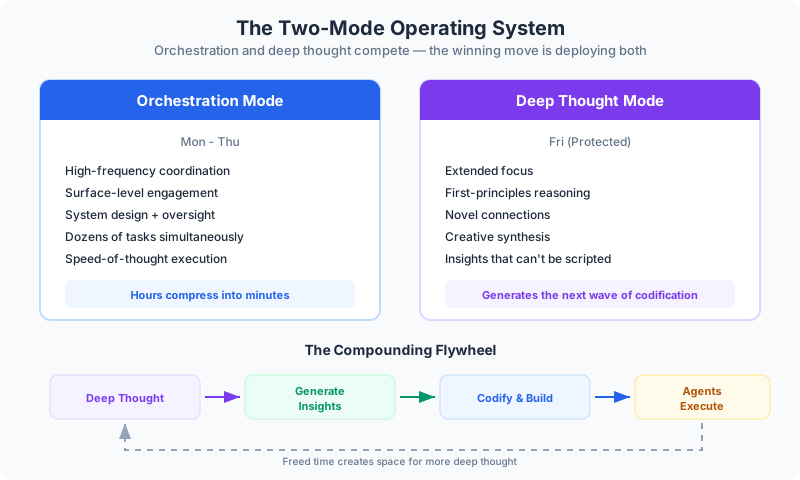
The Two-Mode Operating System
The future knowledge worker — and the future operator — runs in two modes:
Orchestration mode: High-frequency coordination of systems, agents, and humans. Speed-of-thought execution. Shallow involvement, broad impact. Monday through Thursday for me.
Deep thought mode: Protected time for creative synthesis. Cross-disciplinary connection. Novel solution generation. The work that can’t be automated. Fridays.
Both are muscles. Both need exercise. The mistake is choosing one. The winning move is developing both and knowing when to deploy each.
Here’s the compounding cycle: deep thought generates insights. Insights get codified. Codification drives agent execution. Agents handle orchestration. Freed time creates space for more deep thought. The flywheel spins faster every month.
What This Means for Your Business
Most companies are still optimized for task execution, not orchestration. The future org structure assumes people coordinate systems that do work. That changes everything:
- Job design: Roles shift from “do the thing” to “orchestrate the systems that do the thing, plus handle exceptions requiring judgment”
- Performance metrics: Output volume becomes less relevant. System design quality and creative problem-solving become more relevant
- Hiring criteria: You’re looking for people who can build systems and generate novel solutions to problems that don’t have playbooks yet
- Career paths: The promotion track changes from “execute better” to “design better systems and think more creatively”
This isn’t far-future speculation. The companies building orchestration capabilities and protecting deep thought space are already pulling away from those still optimizing for task execution.
The Only Sustainable Edge
The people who win in the orchestration economy won’t be those who automate everything. They’ll be those who know when to orchestrate and when to think deeply — and have the discipline to do both.
Orchestration is the price of entry. Everyone will have similar tools and agent systems. The differentiator won’t be orchestration quality — that commoditizes quickly.
The differentiator will be the quality of thought that goes into what you orchestrate. The strategic clarity. The novel frameworks. The creative leaps that no agent can make because nobody’s codified them yet.
Start building now. Codify what can be codified. Let agents execute it. But protect the space for deep thought — because that’s where the next wave of valuable codification comes from.
Continue reading:
Related AI Articles
10 Claude Code Best Practices I Wish Someone Told Me on Day One
Ten practices that transformed Claude Code from a novelty into my primary productivity tool. Each one addresses a mistake I made so you don't have to.
Read moreClaude Code: The Complete Guide (From Install to AI-Powered Workflows)
Everything you need to master Claude Code — install, architecture, agents, hooks, and the spec-driven workflow that changes how you build software.
Read moreMulti-Agent AI Framework: Spine Architecture in Python
A production-ready multi-agent AI framework in Python. Spine-based security, graph orchestration, and audit logging — not another toy demo.
Read moreThe 12-Month AI Roadmap: From First Agent to Compounding Intelligence
A phased AI implementation roadmap for $5-500M companies — from first agent to compounding intelligence in 12 months. No 50-slide strategy decks.
Read more