
AI-Powered Job Descriptions That Attract the Right Candidates
Use behavioral patterns and company context to generate job descriptions that make ideal candidates think 'this is me' while filtering out poor fits.
"What if your job posting could speak directly to the personality type most likely to succeed—before they even apply?"
Your next job posting could be a magnet or a repellent—and most companies have no idea which they’re creating.
Claude Code transforms job description writing from guesswork into science. By combining behavioral assessment patterns (like those from Predictive Index, Culture Index, or DISC) with structured company context, it generates job descriptions where the ideal candidate reads the opening paragraph and thinks “that’s exactly who I am.” Meanwhile, poor fits self-select out before wasting anyone’s time.
This isn’t about fancy language. It’s about psychological precision in every word choice.
The Problem
HR teams and hiring managers face the same frustrations:
- Generic postings attract generic candidates — Copy-paste job descriptions pull from Indeed templates, resulting in 200 applications where maybe 3 are worth interviewing
- Personality mismatches cost $15-50K per bad hire — You can teach skills, but you can’t teach someone to be detail-oriented or comfortable with ambiguity
- Writing takes forever and still misses the mark — 2-3 hours per job description, only to realize six months later the role needed a different type of person entirely
The tools exist to solve this. Behavioral assessments have mapped personality patterns for decades. But translating those patterns into compelling copy? That’s where it breaks down.
What Claude Code Actually Does
This isn’t a template filler. It’s an orchestrated system that combines multiple data sources and presents structured choices at each step.
Behavioral Pattern Matching Claude Code references detailed pattern libraries from common psychoanalytic frameworks (Predictive Index, Culture Index, Myers-Briggs, DISC). Each pattern maps personality traits to specific adjectives:
- Pattern intensity levels (+2 to -2) determine word choice strength
- Role categories (Operations, Sales, Technical, Admin, Leadership) have recommended patterns
- The system suggests top 3 patterns for the role, then waits for human confirmation
Company Context Integration A structured company information file provides the “sell the vision” content:
- Company mission and vision
- What you’re building and why it matters
- Culture highlights and decision-making philosophy
- Benefits and differentiators
Multi-Step Question Flow The system doesn’t guess—it asks:
- Role basics (title, location, reports to)
- Pattern selection (choose from 3 recommendations)
- Compensation and schedule (with “let AI estimate” fallback)
- Key outcomes and requirements
How It Works
The Pattern Reference System
The behavioral pattern reference file maps role types to recommended personality profiles:
// Pattern recommendations by role category
const warehousePatterns = {
  "Driver-Doer": {
    pattern: "A+1, B-1, C-1, D+1",
    traits: "Independent, task-focused, handles variety, detail-oriented",
    bestFor: "General warehouse, logistics coordination"
  },
  "Steady Processor": {
    pattern: "A0, B-1, C+1, D+1.5",
    traits: "Follows process, patient, methodical, very precise",
    bestFor: "Receiving, inventory, repetitive accuracy work"
  },
  "Operations Lead": {
    pattern: "A+1, B0, C-1, D+1",
    traits: "Takes charge, balanced people skills, fast-paced",
    bestFor: "Supervisory potential, team coordination"
  }
};

// Each trait level maps to specific adjectives
const traitAdjectives = {
  "D+1.5": ["Conforming", "Precise", "Cautious", "Expert", "Fussy"],
  "D+1": ["Accurate", "Careful", "Thorough", "Self-Disciplined"],
  "C+1": ["Relaxed", "Patient", "Stable", "Methodical", "Calm"],
  "B-1": ["Reserved", "Quiet", "Serious", "Sincere"]
};
The Question Flow
After pattern selection, Claude Code gathers compensation details through structured choices:
// Multi-choice questions with estimation fallback
const compensationQuestions = [
  {
    question: "What's the hourly pay range?",
    options: [
      { label: "$15-17/hour", desc: "Entry-level, lower cost market" },
      { label: "$17-20/hour", desc: "Competitive for region" },
      { label: "$20-24/hour", desc: "Above market, attracts experience" },
      { label: "Let Claude estimate", desc: "Research market rates" }
    ]
  },
  {
    question: "What's the work schedule?",
    options: [
      { label: "Mon-Fri, Day shift", desc: "Standard 7am-3:30pm" },
      { label: "Mon-Fri, Swing shift", desc: "Afternoon/evening" },
      { label: "Includes weekends", desc: "Rotating or fixed" },
      { label: "Let Claude estimate", desc: "Use typical for role" }
    ]
  },
  {
    question: "Which benefits to highlight?",
    options: [
      { label: "Use company defaults", desc: "From company-info.md" },
      { label: "Basic mention only", desc: "Competitive benefits package" },
      { label: "Let Claude estimate", desc: "Pick what attracts this role" }
    ]
  }
];
The Template Structure
Job descriptions follow a precise 5-section format:
## [Role Title]
**[Company Name]** - [Location]

### About the Role

[PARAGRAPH 1 - "This is me"]
Opening using behavioral adjectives from chosen pattern.
Weave naturally so ideal candidate recognizes themselves.

[PARAGRAPH 2 - "This is where I want to work"]
Company vision from context file. What you're building,
why it matters, the opportunity.

[PARAGRAPH 3 - Position summary]
1-3 sentences on day-to-day scope. High-level, not tasks.

### What You'll Own
[4-6 outcome-based bullets - results, not activities]

### Requirements
**Required:** [Must-haves]
**Preferred:** [Nice-to-haves]

### Compensation & Schedule
**Pay:** [Range]
**Schedule:** [Days/hours]
**Benefits:** [Key highlights]

### Ready to Apply?
[CTA with application instructions]
The Output
Opening Paragraph (Steady Processor Pattern)
When you select the “Steady Processor” pattern (A0, B-1, C+1, D+1.5), the system pulls these adjectives: Reserved, Quiet, Serious, Sincere, Relaxed, Patient, Stable, Methodical, Calm, Conforming, Precise, Cautious.
The generated opening:
You are methodical and patient - the person who does things right the first time, every time. While others rush and make mistakes, you stay calm and work through each task with precision. You are serious about your work and sincere in your commitment to quality. Reserved by nature, you do not need constant conversation to stay engaged; you find satisfaction in the quiet discipline of a job done correctly. You are cautious where it counts, precise in your documentation, and comfortable following established processes because you understand that consistency is what makes a warehouse run.
A “Hunter” sales pattern (A+1, B+1.5, C-1, D0) would generate completely different language—competitive, persuasive, urgent, adaptable.
Company Context File Example
## Company Information

### Company Overview
**Company Name**: Apex Industrial Supply

**Mission**: To be the most reliable link in our customers'
supply chains - right parts, right place, right time.

**Vision**: Building the most efficient distribution network
for manufacturing components in the region.

### What We're Building
Apex is a $200M wholesale distribution operation specializing
in manufacturing components. We serve 1,500+ manufacturing
facilities. When a production line goes down because a part
didn't arrive, it costs thousands per hour. That's why every
order matters here.

### How We Work
**Culture Highlights:**
- Results-oriented: We measure what matters
- Low drama: Adults solving problems
- Invest in people: Training, growth paths, promote from within

**Decision Philosophy:**
We hire good people and trust them to make decisions.
If you're closest to the problem, you're empowered to solve it.

### Benefits
- Health/dental/vision (company pays 75%)
- 401(k) with 4% match
- PTO starting at 2 weeks
- Safety bonuses quarterly
Complete Example: Warehouse Assistant
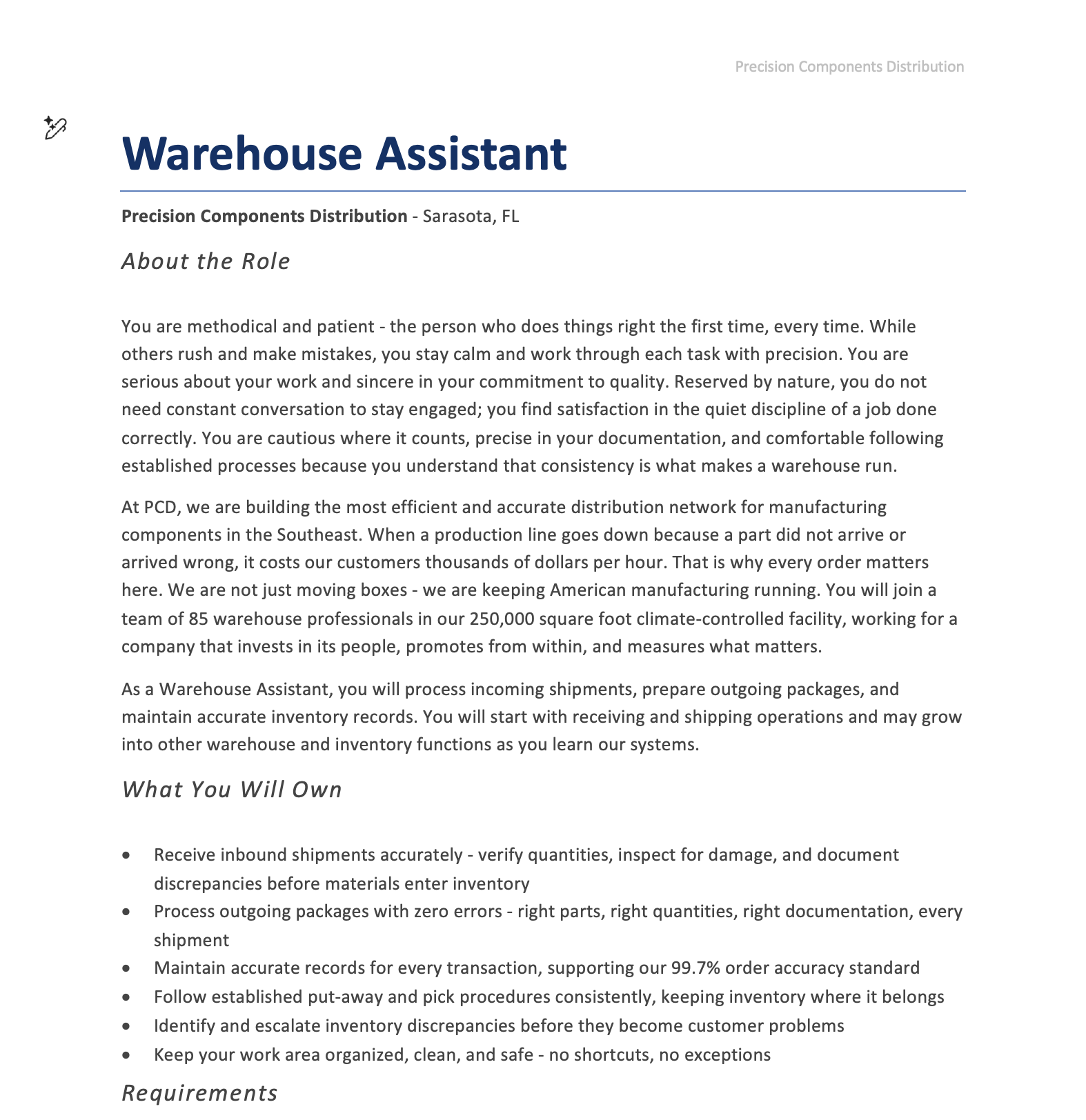
Here’s the final Word document output—professionally formatted and ready to post:
Click to see the full markdown source that generated this document:
View Full Warehouse Assistant Job Description (Markdown Source)
Pattern Selected: Steady Processor (A0, B-1, C+1, D+1.5)
Adjectives Used: Reserved, Quiet, Serious, Sincere, Relaxed, Patient, Stable, Methodical, Calm, Conforming, Precise, Cautious
## Warehouse Assistant
**Precision Components Distribution** - Sarasota, FL

### About the Role

You are methodical and patient - the person who does things right the first time, every time. While others rush and make mistakes, you stay calm and work through each task with precision. You are serious about your work and sincere in your commitment to quality. Reserved by nature, you do not need constant conversation to stay engaged; you find satisfaction in the quiet discipline of a job done correctly. You are cautious where it counts, precise in your documentation, and comfortable following established processes because you understand that consistency is what makes a warehouse run.

At PCD, we are building the most efficient and accurate distribution network for manufacturing components in the Southeast. When a production line goes down because a part did not arrive or arrived wrong, it costs our customers thousands of dollars per hour. That is why every order matters here. We are not just moving boxes - we are keeping American manufacturing running. You will join a team of 85 warehouse professionals in our 250,000 square foot climate-controlled facility, working for a company that invests in its people, promotes from within, and measures what matters.

As a Warehouse Assistant, you will process incoming shipments, prepare outgoing packages, and maintain accurate inventory records. You will start with receiving and shipping operations and may grow into other warehouse and inventory functions as you learn our systems.

### What You Will Own

- Receive inbound shipments accurately - verify quantities, inspect for damage, and document discrepancies before materials enter inventory
- Process outgoing packages with zero errors - right parts, right quantities, right documentation, every shipment
- Maintain accurate records for every transaction, supporting our 99.7% order accuracy standard
- Follow established put-away and pick procedures consistently, keeping inventory where it belongs
- Identify and escalate inventory discrepancies before they become customer problems
- Keep your work area organized, clean, and safe - no shortcuts, no exceptions

### Requirements

**Required:**
- Ability to stand, walk, and lift up to 50 lbs throughout an 8-hour shift
- Basic math skills and attention to detail
- Reliable attendance and punctuality
- Ability to follow written and verbal instructions consistently
- Comfortable working in a structured, process-driven environment

**Preferred:**
- Previous warehouse, distribution, or manufacturing experience
- Familiarity with RF scanners or warehouse management systems
- Forklift certification (or willingness to obtain)
- Experience with inventory counts or cycle counting

### Compensation & Schedule

**Pay:** $17-20/hour based on experience
**Schedule:** Monday-Friday, 7:00am - 3:30pm (occasional overtime available)
**Benefits:** Health, dental, and vision insurance (company pays 80%), 401(k) with 4% match, paid time off, quarterly safety bonuses, steel-toe boot allowance

---

### Ready to Apply?

Send your resume to **careers@pcdistribution.com** with "Warehouse Assistant" in the subject line. We review applications weekly and will reach out if there's a fit.

*Precision Components Distribution is an equal opportunity employer.*
Notice how the opening paragraph naturally weaves the “Steady Processor” adjectives—methodical, patient, precise, calm, conforming—to attract candidates who genuinely possess those traits. A “Hunter” sales personality would read this and think “not for me,” which is exactly the point.
System Architecture
This isn’t a single prompt—it’s an orchestrated system with three interconnected components:
Component 1: HR Agent
The hr-agent coordinates the entire workflow. It knows when to ask questions, when to wait for pattern selection, and when to generate output. The agent has access to two specialized skills and understands the multi-step approval gates that prevent the system from guessing when it should ask.
Component 2: Skills
Two skills handle the domain logic:
- hr-job-description: External job postings that sell the role using Culture Index traits
- hr-job-role: Internal documents defining outcomes, autonomy scope, and decision-making principles
Each skill contains the template structure, quality checklists, and execution steps. They reference external context files (company info, CI patterns) to keep the system modular and maintainable.
Component 3: Word Document Script
The markdown-to-word.py script converts generated markdown to professionally styled Word documents. The styling is fully configurable:
DESIGN = {
    'colors': {
        'primary': RGBColor(0, 51, 102),      # Dark blue headers
        'secondary': RGBColor(68, 68, 68),     # Dark gray body
        'accent': RGBColor(0, 102, 153),       # Medium blue accents
    },
    'fonts': {
        'heading': 'Calibri',
        'body': 'Calibri',
    },
    'sizes': {
        'title': Pt(28),
        'heading1': Pt(16),
        'body': Pt(11),
    },
}
Change the DESIGN dictionary, and every document generated uses the new styling—no manual reformatting required.
The Workflow
User Input → HR Agent → Skill Selection → Context Loading →
Question Flow → Markdown Generation → Word Conversion →
Professional .docx Output
The agent asks structured questions (with “let Claude estimate” fallbacks), the skill generates markdown following its template, and the script produces a Word document with consistent branding. Change company colors in one place, and every future document reflects it.
What Makes This Different
vs. Job Description Templates (Indeed, LinkedIn) Templates give you structure without substance. They can’t match personality patterns to role requirements or pull company-specific context. You fill in blanks; you don’t get psychological targeting.
vs. Generic AI (ChatGPT prompts) Without the structured pattern reference and company context files, generic AI produces generic output. It doesn’t know that a warehouse role needs different adjectives than a sales role, or that YOUR company has a specific vision worth selling.
vs. HR Consultants Consultants using behavioral assessments charge $500-2000 per role and take days. This system produces psychologically-targeted descriptions in 15 minutes once configured.
What You Get
| Metric | Before | After | Impact |
|---|---|---|---|
| Time per job description | 2-3 hours | 15 minutes | 90% reduction |
| Candidate quality fit | ~15% interview-worthy | ~40% interview-worthy | 2.5x improvement |
| Pattern-role alignment | Guesswork | Data-driven | Reduced mis-hires |
| Company voice consistency | Varies by writer | Always on-brand | Professional presence |
The compound effect: fewer interviews, faster hiring, better retention, lower training costs.
Going Further
This foundation enables:
- Internal job roles — Pair external descriptions with internal documents defining outcomes, authority scope, decision-making principles, and accountability frameworks
- Interview question generation — Auto-generate behavioral interview questions that probe for the specific pattern traits
- Onboarding customization — Tailor onboarding materials based on the behavioral pattern of each new hire
- Team composition analysis — Map existing team patterns to identify gaps before writing the job description
The technology handles the science of behavioral targeting. The art is knowing which pattern your team actually needs—and that requires someone who understands both your business and the humans who run it.
Related Use Cases
Autonomous SEO That Audits, Writes, and Interlinks Itself
Build a system that runs weekly SEO audits, generates content to fill gaps, and builds internal links—all while you sleep.
Read moreAutomated Receipt Processing and Expense Reports with AI
Turn a folder of scanned receipts into categorized, renamed files and a polished Excel report—with one command. No data entry required.
Read moreAI-Powered Reading Consolidation: Scatter to System
Transform 20+ saved articles on a topic into one comprehensive walkthrough document that preserves all knowledge while organizing it logically.
Read moreAutomated SEO Grow System
An always-on SEO system that crawls, analyzes, and optimizes your site 1-2x weekly—connecting to every major data source automatically.
Read more