
Entrepreneurship Through Acquisition: The Operator's Guide to Buying & Growing a Business
How to find, buy, and scale a small business through acquisition entrepreneurship. From search to close to first 90 days — by someone who's done it 5 times.
You want to run a business, but you don’t want to start one from scratch. Smart. Starting a business means spending years building a customer base, a team, and a reputation from nothing. Buying a business means acquiring all three on day one and spending your energy making them better.
That’s the thesis behind Entrepreneurship Through Acquisition (ETA) — also called acquisition entrepreneurship — the path where operators buy existing businesses instead of building from zero. It’s the model I’ve lived. I’ve been through five acquisitions now, on both the buying and operating side, ranging from a $2M services company to a $20M+ manufacturing operation. And the lesson I’ve learned the hard way is this: the deal doesn’t make you an operator. What you do after the deal closes is everything.
Most ETA content focuses on the search and the close. How to find deals. How to structure financing. How to negotiate. That matters, but it’s 10% of the story. The other 90% is what happens when you walk through the door as the new owner, inherit a team that didn’t choose you, and have to earn the right to change anything.
This guide covers the full arc — from search through scale — with emphasis on the phases most operators get wrong.
What Is Acquisition Entrepreneurship?
Acquisition entrepreneurship is the practice of becoming a business owner by buying an existing company rather than starting one from scratch. You’re still an entrepreneur — you still take risk, make decisions, and build value — but you skip the startup phase where most businesses fail.
The concept has roots in the Harvard Business School “search fund” model from the 1980s, but it’s evolved well beyond that narrow definition. Today, acquisition entrepreneurship includes:
- Search funds — An investor-backed searcher who raises capital to find and acquire a single business. The traditional HBS model.
- Self-funded searches — Operators who fund their own search and use SBA loans, seller financing, or personal capital to acquire. This is the most common path.
- Independent sponsors — Operators who find deals first, then raise capital deal-by-deal. More flexible than search funds, less institutional.
- Platform builders — Operators who acquire one business, stabilize it, then bolt on additional acquisitions to build scale. This is where the real enterprise value gets created.
In my experience, the self-funded search is the most accessible path for operators with relevant industry experience. You don’t need MBA pedigree or institutional investors. You need operational skills, a clear thesis about what industries you understand, and the discipline to evaluate dozens (or hundreds) of deals before committing to one.
ETA vs. Traditional Startups
I get asked this a lot: why buy instead of build? Here’s how I think about it after living both sides.
| Factor | Startup | Acquisition |
|---|---|---|
| Revenue on Day 1 | $0 | Existing cash flow |
| Time to profitability | 2-5 years (if ever) | Immediate (already profitable) |
| Failure rate | ~90% within 10 years | Significantly lower with due diligence |
| Capital required | Variable, often equity-heavy | Leverage available (SBA, seller notes) |
| Team | Recruit from zero | Inherited team with institutional knowledge |
| Customer base | Build from nothing | Existing relationships and reputation |
| Risk profile | Will anyone buy this? | Can I operate this better? |
| Ego satisfaction | ”I built this" | "I made this better” |
That last row is honest. Some people need to build from scratch because the identity of “founder” matters to them. Nothing wrong with that. But if your goal is to run a profitable business and build wealth, acquisition entrepreneurship gets you there faster with lower risk.
Here’s a specific example: my first acquisition was a services company doing about $3M in revenue with $600K EBITDA. The seller financed 20% of the purchase price, I used an SBA loan for 70%, and I put 10% down in equity. Within 18 months of operating — implementing a weekly operating cadence, standardizing processes, and adding one new service line — EBITDA was up to $950K. The business was worth significantly more than what I paid, and I was cash-flowing from day one. No startup in the world gives you that timeline.
Why Acquisition Over Startup
The statistics on startups are brutal. Roughly 90% fail within 10 years. Most never reach profitability. The ones that succeed usually take 3-5 years to generate meaningful income for the founder.
Acquisitions flip those odds. You’re buying a business that already works—already has customers, revenue, employees, and cash flow. The failure mode shifts from “will anyone buy this?” to “can I operate this better than the previous owner?” That’s a fundamentally different and more controllable risk.
The ETA model has several structural advantages:
Cash flow from day one. A startup might take years to break even. An acquisition generates cash immediately. You can pay yourself, service debt, and reinvest from day one.
Proven product-market fit. The business already has customers who pay for its products or services. You don’t need to validate demand—it’s proven by years of revenue.
Existing team and knowledge. The employees know the operations, the customers, and the industry. You don’t need to recruit an entire organization from scratch.
Leverage. Banks will lend against proven cash flows. They won’t lend against a business plan. SBA loans, seller financing, and PE-backed structures can allow you to control a $5M+ business with a fraction of that in equity.
The tradeoff: you inherit everything. The good systems and the bad ones. The strong employees and the weak ones. The loyal customers and the ones about to leave. Your job isn’t to build from a blank canvas—it’s to understand what you bought and make it better without breaking what works.
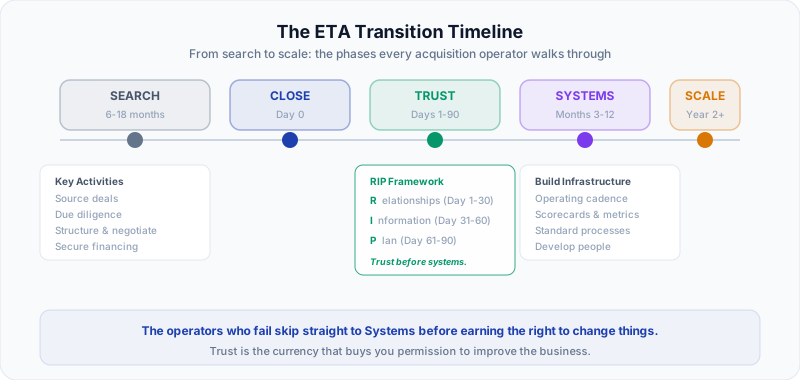
Phase 1: The Search (6-18 Months)
The search is where most aspiring acquirers spend their time, and where the quality of the eventual deal is determined. A bad search process leads to either no deal (you give up) or a bad deal (you overpay or buy the wrong business).
Defining Your Search Criteria
Before you look at a single deal, define what you’re looking for. Be specific:
Industry: What industries do you understand, or can you learn quickly? The best ETA operators buy in industries where their existing skills transfer. An operations leader from manufacturing shouldn’t buy a SaaS company. An engineer shouldn’t buy a restaurant.
Size: What revenue range? What EBITDA? In the lower middle market, I’d target $3M-$15M revenue with $750K-$3M EBITDA. Below $3M revenue, you’re often buying a job. Above $15M, the deal complexity and capital requirements increase significantly.
Geography: Are you relocating? How important is proximity? Remote acquisition management is possible but significantly harder, especially in the first two years.
Deal structure: How much equity can you contribute? Are you pursuing SBA financing, seller financing, PE backing, or self-funding? Your capital structure determines which deals are feasible.
Sourcing Deals
Deals come from four channels, in order of quality:
-
Proprietary sourcing — Direct outreach to business owners who haven’t listed their companies. This produces the best deals because there’s no competitive auction. It’s also the hardest and most time-consuming.
-
Broker relationships — Business brokers and M&A advisors represent sellers. Build relationships with 10-15 brokers in your target industry and geography. They’ll bring you deals that match your criteria.
-
Online marketplaces — BizBuySell, BizQuest, and similar platforms. Deal quality varies widely. Most listed businesses are overpriced, poorly documented, or have structural issues. But good deals do appear.
-
Network referrals — Attorneys, accountants, wealth advisors, and other professionals who work with business owners often know who’s thinking about selling before anyone else does.
Winning M&A deals in competitive markets requires differentiating yourself as a buyer. Sellers care about more than price—they care about what happens to their employees, their customers, and their legacy. The operators who win deals consistently are the ones who communicate a credible plan for growing the business, not just extracting value from it.
Due Diligence
Due diligence is where you validate (or invalidate) everything the seller told you. The goal isn’t just to confirm the numbers—it’s to understand the business deeply enough to operate it on day one.
Financial due diligence:
- Verify revenue quality. Is revenue recurring, contractual, or project-based?
- Analyze customer concentration. If one customer is 30%+ of revenue, that’s a risk.
- Validate EBITDA by adding back true owner discretionary expenses
- Review working capital trends—is the business consuming or generating cash?
- Check for seasonal patterns that affect cash flow timing
Operational due diligence:
- Observe the operation in person. Walk the floor. Talk to employees.
- Map the key processes. How does work flow from order to delivery?
- Identify the key people. Who are the 3-5 individuals the business depends on?
- Assess the technology. Is the operation running on modern systems or spreadsheets?
- Understand capacity. Can the business handle 20% more volume without significant investment?
Market due diligence:
- What’s the competitive landscape? Who are the top competitors and what’s their advantage?
- What’s the industry growth rate? Are you buying into a growing or shrinking market?
- What are the regulatory risks? Are there pending changes that could impact the business?
- What do customers think? Call 5-10 customers and ask about the business’s reputation.
Structuring the Deal
Deal structure matters as much as price. The right structure aligns incentives, manages risk, and preserves cash for post-close operations.
Key structural elements:
- Seller financing — The seller carries a note for 10-30% of purchase price. This keeps the seller invested in a smooth transition and reduces your upfront capital requirement.
- Earnout provisions — A portion of the price is contingent on future performance. This bridges valuation gaps and protects you if the business underperforms.
- Working capital adjustments — Define a target working capital level and adjust the purchase price based on actual working capital at close.
- Transition support — Require the seller to stay for 3-12 months in a consulting capacity. You need their knowledge.
Phase 2: The Close (Day 0)
Closing day is simultaneously anticlimactic and terrifying. You sign papers. Money moves. And then you own a business you’ve never operated.
The close itself is mechanical—your attorney handles it. What matters is what you’ve prepared before close and what you do immediately after.
Before close, prepare:
- Your Day One communication plan (what you’ll say to employees, customers, vendors)
- Your first 90-day observation plan (what you’ll watch and learn before changing anything)
- Your transition calendar with the outgoing owner
- Your banking and financial controls
- Your key employee retention strategy (bonuses, conversations, reassurance)
Phase 3: Trust — Days 1 Through 90
This is the phase that separates operators who succeed from operators who fail. And almost all ETA education skips it entirely.
The number one priority after any acquisition is building trust. Not implementing your value creation plan. Not fixing the things you found in due diligence. Not proving to your investors that you’re already adding value. Trust.
Why? Because you can’t change anything without the team’s cooperation. And the team doesn’t cooperate with someone they don’t trust. You’re a stranger who just bought their livelihood. They’re scared. They’re skeptical. They’re watching every move you make for signals about what kind of leader you are.
Day One
Mastering your Day One is critical because first impressions in an acquisition context are nearly permanent. What you say and do on Day One establishes the narrative that employees will use to judge everything you do for months.
What to communicate on Day One:
- Why you bought this business (genuine, specific reasons—not platitudes)
- What you plan to change (nothing, immediately—you’re here to learn first)
- What won’t change (the things people are most afraid of losing)
- How you’ll be spending your first weeks (listening, observing, understanding)
- Your open-door policy (and mean it)
What NOT to do on Day One:
- Announce organizational changes
- Question existing processes
- Make promises about raises or bonuses
- Criticize the previous owner’s decisions
- Bring in outside consultants
- Start “fixing” things
I’ve seen operators walk in on Day One and immediately announce a new ERP system, restructure the reporting lines, and schedule a company-wide strategy session. Within 30 days, their best employees were interviewing elsewhere. The operator had the right ideas — but catastrophically wrong timing.
In my own acquisitions, I’ve learned to keep Day One almost boring. At one company, I spent my first day shaking hands, asking people about their families, and eating lunch in the break room. A foreman told me three weeks later: “When you sat down and ate lunch with us on day one, we knew you were different from the last guy.” That one meal built more trust than any town hall speech could have. I’ve written about this in detail in how to take over a new acquisition and mastering your Day One.
The RIP Framework
The RIP Framework for your first 90 days provides the structure for the trust-building phase. It stands for Relationships, Information, Plan—in that order, and the order matters.
Relationships (Days 1-30):
Your sole objective in the first 30 days is to build genuine relationships with the people who make the business run. Not to evaluate them. Not to rank them. Not to decide who stays and who goes. To understand them as humans.
Spend time with every employee. In small businesses, this means individual conversations. In larger ones, it means small group sessions with every team. Ask questions:
- How long have you been here? What brought you to this company?
- What do you love about working here? What frustrates you?
- If you could change one thing about how this business operates, what would it be?
- What should I know that I probably don’t?
Write down what you hear. Patterns will emerge. The same frustrations will surface repeatedly. The same strengths will be praised consistently. This is intelligence you cannot get from any due diligence report.
Also build relationships with key customers, vendors, and partners. Take them to lunch. Let them tell you about their relationship with the business. Their perspective is different from the team’s, and both matter.
Information (Days 31-60):
Now that people trust you enough to tell you the truth, start gathering the operational intelligence you need to lead effectively. This is the observation phase—you’re still not making changes, but you’re building the foundation for your plan.
Map the actual processes (which are often different from the documented processes). Understand the financial systems. Learn the customer acquisition and retention dynamics. Identify the real constraints—the bottlenecks that limit growth or margin.
Key questions for the information phase:
- What are the actual unit economics? (Not what the P&L shows—what each job/order/project actually costs)
- Where does the business lose money? (Which customers, products, or services are unprofitable?)
- What’s the real capacity? (Not theoretical—actual demonstrated throughput)
- Where are the single points of failure? (People, systems, or relationships where loss would be catastrophic)
Plan (Days 61-90):
With relationships established and information gathered, you can now build a credible plan. Not a plan from your MBA playbook—a plan grounded in what you’ve learned about this specific business, this specific team, and this specific market.
The critical insight: your plan must be the team’s plan. Not because you need consensus on every decision, but because plans the team helped create are plans the team will execute. Plans imposed from above are plans the team will resist.
Share what you’ve learned. Present the patterns you’ve observed. Ask the team: “Based on what we know, what should we focus on first?” You’ll be surprised how often their answer matches yours—and how much faster they’ll execute when it’s their idea too.
How to Take Over
How to take over a new acquisition provides the tactical playbook for the entire transition period. The strategic insight is this: you are simultaneously running the business as-is and building the capability to improve it. These are parallel tracks, and neither can suffer.
Track 1: Maintain operations. Keep the trains running. Make sure customers get served, invoices go out, and employees get paid. Your credibility depends on competence, and competence starts with not breaking the basics.
Track 2: Build improvement capability. Install the management operating system that will drive improvement—daily huddles, weekly metrics meetings, monthly reviews. These don’t change what the business does; they change how leadership pays attention to it.
The sequencing is Track 1 first, always. Nothing erodes trust faster than a new owner who lets operational quality slip while chasing strategic improvements.
Phase 4: Systems — Months 3 Through 12
With trust established and your plan built collaboratively with the team, you can now start implementing the systems that drive sustainable improvement.
The Operating Cadence
Every well-run business needs a meeting cadence: daily huddles, weekly problem-solving meetings, monthly reviews, and quarterly planning sessions. This operating rhythm is the management infrastructure that keeps improvement happening consistently.
If you don’t have this cadence in place, build it now. Start with the daily huddle—15 minutes, same time every day, three questions: what did I do yesterday, what am I doing today, what’s blocking me. Add the weekly meeting in week two. Layer on monthly and quarterly sessions as the team builds comfort with structured accountability.
Scorecard and Metrics
You can’t improve what you don’t measure, but you also can’t measure everything. The scorecard should track 8-12 metrics that capture the health of the entire business. Include leading indicators (activity metrics) and lagging indicators (result metrics).
Essential scorecard metrics for post-acquisition:
- Revenue (weekly, compared to same week last year)
- Gross margin (actual vs. target)
- Customer count and retention rate
- Productive unit output (whatever your productive unit is)
- Quality metrics (defects, rework, callbacks)
- A/R aging (cash collection speed)
- Employee metrics (turnover, satisfaction proxy)
- Pipeline or backlog (future revenue visibility)
Process Standardization
This is where you start codifying the “one best way” to do core operations. Not by imposing processes—by documenting what already works and making it consistent.
Start with the process that has the highest impact on customer experience or profitability. Map it end-to-end. Identify the variations (different people do it different ways). Agree on the standard. Train everyone. Measure compliance.
One process at a time. Don’t try to standardize everything simultaneously. Each process takes 2-4 weeks to document, train, and stabilize. Plan for 3-4 major processes per quarter.
People Development
In months 3-12, you’ll discover which team members are capable of growth and which have reached their ceiling. This isn’t a judgment of character—it’s a reality of business scale. The person who ran operations at $5M revenue may or may not be capable of running operations at $15M.
Your job is to develop people as far as they can go, then make honest decisions about fit. This means:
- Setting clear expectations with measurable outcomes
- Providing regular feedback (weekly, not annually)
- Investing in training and development for high-potential people
- Making role changes when necessary, with dignity and transparency
- Hiring for the future, not just for today’s gaps
Phase 5: Scale — Year 2 and Beyond
If you’ve done the first four phases well, year two is where the investment thesis starts to pay off. You have a team that trusts you, systems that drive accountability, and data that tells you where to focus.
Growth Strategies
With operations stable and margins improving, growth becomes the priority. The best growth strategies for post-acquisition businesses:
1. Capacity unlocking. Most acquisitions have unused capacity that was invisible before you installed measurement systems. A manufacturing company running at 60% utilization has 40% available capacity that requires almost no additional fixed cost to activate. Fill it.
2. Customer expansion. Your existing customers are your cheapest growth opportunity. What else do they need that you could provide? Adjacent services, complementary products, higher-tier packages. Revenue per customer is often easier to grow than customer count.
3. Geographic expansion. If the business serves a local or regional market, can you replicate the model in adjacent markets? This works best when the operating systems are standardized enough to transplant.
4. Acquisition (again). Once you’ve demonstrated you can operate and improve one business, you can do it again. Many ETA operators build platforms—a first acquisition plus 2-5 additional bolt-ons that create scale advantages.
Building Enterprise Value
Everything you do in the scale phase should be oriented toward building a business that’s more valuable than what you bought. Enterprise value grows when:
- Revenue grows (obviously)
- Margins expand (pricing and operations improvements)
- Revenue quality improves (more recurring, less concentrated, more predictable)
- Management team deepens (the business isn’t dependent on you)
- Systems are documented and transferable (a buyer could operate this without you)
The endgame for most ETA operators is either a long-term hold with ongoing distributions or an eventual sale at a meaningful multiple of what they paid. Both paths require building a business that works without the owner in every decision.
The ETA Operator’s Mindset
The technical skills of acquisition—deal sourcing, financial modeling, negotiation—can be learned from books and courses. The mindset can’t.
Patience. You will want to change things faster than you should. The business survived without you for years. It can survive 90 more days while you build trust.
Humility. The team knows more about the operation than you do. They’ve been doing this while you were doing due diligence. Respect their expertise even when you see things that need to change.
Courage. At some point, you’ll need to make decisions that are unpopular—restructuring roles, raising prices, letting go of underperformers. The trust you built in Phase 3 is what gives you the credibility to do this without losing the team.
Systems thinking. Individual heroics don’t scale. If improvement depends on you personally overseeing everything, you haven’t improved the business—you’ve just inserted yourself into it. Build systems that produce results whether you’re there or not.
The Bottom Line
Entrepreneurship through acquisition is the most accessible path to business ownership for operators who want to build, not just buy. The deal gets you in the door. Trust earns you the right to lead. Systems make improvement sustainable. And scale creates the enterprise value that justifies the entire journey.
After five acquisitions, here’s what I know for certain: the operators who fail are almost always the ones who skip straight to systems — who walk in with a playbook and start implementing before anyone trusts them enough to follow. Trust is the currency that buys you permission to improve the business. Spend it wisely, and there’s no ceiling on what you can build.
If you’re considering acquisition entrepreneurship, here’s where to go next:
- Planning your first 90 days? Read how to take over a new acquisition for the complete tactical playbook.
- Closing soon? Mastering your Day One covers exactly what to say (and not say) when you walk through the door.
- Already in the building? Start installing the operating cadence — the daily huddle is the foundation everything else builds on.
Start by understanding what you bought. Then earn the right to change it. Then change it systematically. That’s the entire acquisition entrepreneurship playbook in three sentences.