
General
The Invisible Evolution: How Leadership Transforms YouReady
Leadership isn't doing more of what made you successful — it's a fundamental shift in how you work, think, and create value. Here's what changes.
Culture
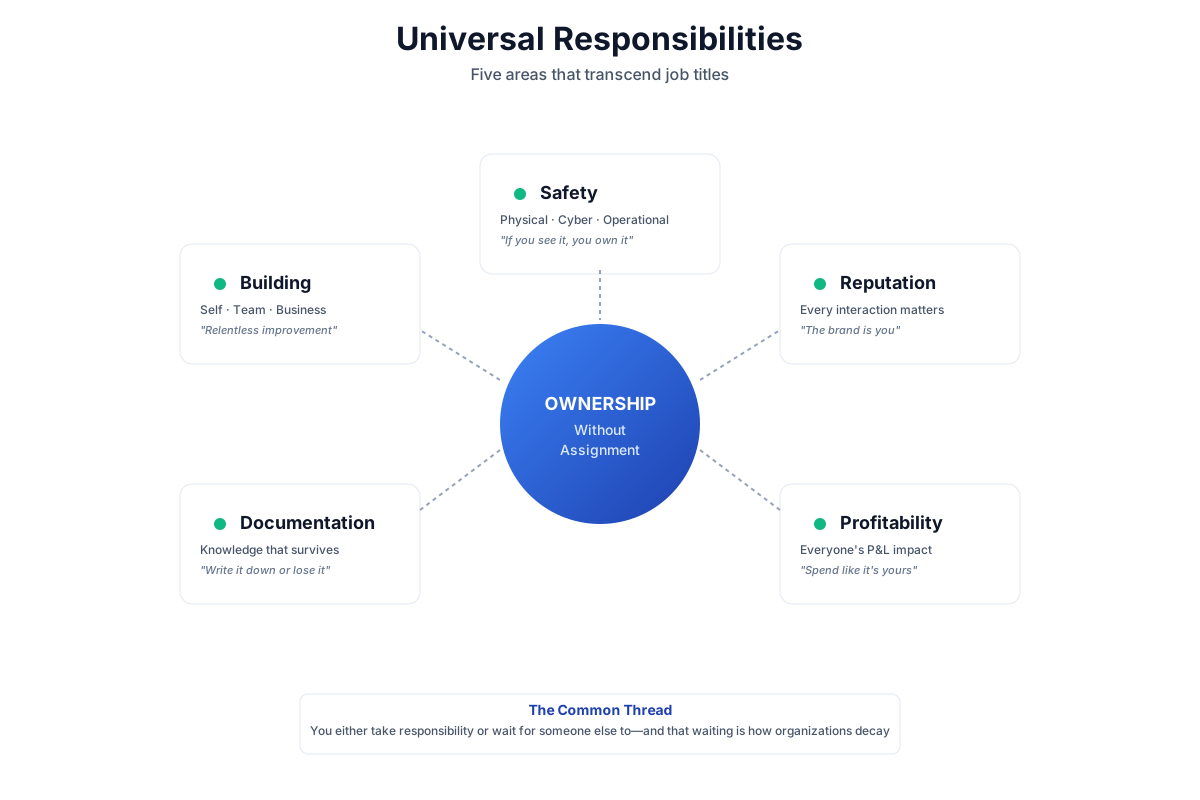
Five critical responsibilities that belong to everyone: safety, reputation, profitability, documentation, and continuous improvement.
Most organizational charts are lies.
Not because they’re intentionally deceptive, but because they suggest a world where every responsibility has a clear owner, every problem has a designated solver, and the gaps between boxes don’t exist.
The best companies are built by people who ignore the org chart when it matters most. In my view, there are certain responsibilites that are everyone’s.
Here’s what separates companies that achieve reduction in problems and fires… the willingness of people to own responsibilities that technically aren’t theirs.
Not because their job description says to. Not because they’ll get recognition. But because they were there, they saw it, and they refused to wait for “someone else” to handle it.
Five areas define this kind of ownership. Master these, and you build companies that compound. Ignore them, and you build organizations held together by bureaucratic duct tape.
Safety isn’t a department. It’s not owned by the person with “Safety Coordinator” on their LinkedIn.
Safety is a decision you make dozens of times every day—whether you notice the frayed cable behind the desk, the process that creates unnecessary risk, the phishing email that almost fooled you, or the meeting where everyone nodded along to a plan that will hurt someone down the line.
The person who sees it owns it. Full stop.
This applies to:
Waiting for “the safety person” to catch it is how accidents happen. Every investigation I’ve read starts with someone who saw something and assumed someone else would handle it.
If you see something that could hurt someone, damage systems, or expose the company—you own it until it’s addressed.
Every conversation you have—with a customer, vendor, partner, or colleague—is the company in that moment.
There’s no separate “brand” floating above us in the abstract. The brand is the accumulated experience of how we show up. And you’re showing up right now.
Your actions shape perception:
None of this lives in isolation. It shapes how the market sees all of us.
But excellence compounds the same way. One person going above and beyond creates relationships that last decades. One moment of genuine care creates evangelists. One extra hour spent getting it right creates trust that money can’t buy.
The person who treats every interaction like a handshake with their future self wins. The person who assumes “it’s just this once” or “they won’t remember” loses.
Guard the reputation like it’s yours. Because it is.
Profitability isn’t the finance team’s job.
It’s the output of thousands of daily decisions made by everyone:
You don’t need P&L access to impact profitability. Every resource you use, every hour you spend, every commitment you make has a cost.
Ask yourself:
The best operators I know treat company resources with more care than their own money—because they understand that waste at scale destroys companies.
Profitability is what happens when everyone thinks like an owner, even when they’re not.
If it’s not written down, it doesn’t exist.
If what’s written down is wrong, it’s worse than nothing.
Documentation isn’t administrative overhead. It’s how knowledge survives the person who created it. It’s how we onboard without starting from zero. It’s how we prove compliance, defend decisions, and avoid repeating mistakes.
Most companies fail documentation in predictable ways:
The fix is cultural, not technical:
The person who knows the information is the right person to document it.
This is doubly true in AI-native operations, where the gap between current state and documented state creates compounding errors. Your AI assistant is only as good as the knowledge base it references.
Companies don’t build themselves.
They’re built by people who see gaps and fill them—whether that’s a missing process, a better tool, a critical hire, or a different way of doing something.
But building isn’t just creating new things. It’s relentless improvement of what already exists.
The skills that got you here won’t get you where you’re going.
Read. Train. Seek feedback. Learn from mistakes. The best people are perpetually dissatisfied with their own capabilities—not from insecurity, but from ambition.
Your growth isn’t the company’s responsibility to hand you. It’s yours to pursue.
Mentor the person behind you. Give feedback that’s honest and useful, not comfortable and empty. Raise the bar on what “good” looks like.
Build people up so they can replace you—because that’s how you become available for what’s next.
Challenge “the way we’ve always done it” when it no longer makes sense. Kill processes that exist out of habit rather than value. Measure what matters and fix what isn’t working.
Small improvements, compounded daily, create organizations that are unrecognizable in five years.
The trap:
If you’re waiting, you’re already behind.
These five areas share something essential: they require ownership without assignment.
No one will tap you on the shoulder and tell you it’s your turn to care about safety, reputation, profitability, documentation, or building. You either take responsibility or you wait for someone else to—and that waiting is how organizations decay.
The best companies are built by people who act like owners, regardless of their title.
The worst are filled with people pointing at someone else’s job description.
You get to choose which company you’re building.
Not through what you say in meetings or put in your email signature. Through what you do when no one’s watching. Through the gap you fill when it’s not your job. Through the standard you hold when it would be easier not to.
Here’s the test: When was the last time you owned something you didn’t have to?
If you can’t remember, you’re waiting. And waiting builds nothing.
Continue the conversation: See how ownership transforms leadership in The Invisible Evolution, why You’re a Culture Setter, Not an Acceptor, and how Metric-Based Roles create clarity around ownership.
Leadership isn't doing more of what made you successful — it's a fundamental shift in how you work, think, and create value. Here's what changes.
Stop building rules around your weakest employees. Leaders who set culture proactively—not accept what they inherit—build teams that scale.
Stop getting pulled into every problem. Define metric-based roles that let employees make decisions without you and actually own their results.