TL;DR
Most companies think they have an AI strategy. What they have is a ChatGPT tab. That’s Level 2 with one stage — roughly a fifth of what’s available. There are four distinct levels of AI workflow and a separate three-stage spectrum of implementation modes. Every mature AI-native organization runs a portfolio across both axes. This framework shows you how to map every workflow to the right level and the right stage — and why “more agentic” is not the same as “more advanced.”
For the comprehensive AI implementation playbook, see the AI Playbook.
The Problem Isn’t Adoption
The most common gap I see right now isn’t that companies aren’t using AI. It’s that they’re using one kind of AI, for one kind of task, and assuming that covers the territory.
Executives treat “are we using AI?” as a yes/no question. It isn’t. There are four distinct levels of AI workflow — defined by who does the work and who validates it — and a separate three-stage spectrum of how you implement each one. The companies getting real operational leverage from AI run a deliberate portfolio across both axes. Everyone else is leaving most of the value sitting.
The Four Levels
The levels are defined by a single question: who does the work, and who validates it.
Level 1 — Manual. Human does the work. Human checks it. No AI in the loop. This is where most “AI adoption” surveys actually find most companies, regardless of what leadership told the survey.
Level 2 — Assisted. Human does the work with AI as a thinking partner. You open a chat window, think out loud, get ideas back, refine. The human is still producing the output; the AI is a collaborator in the cognition. Fast, cheap, and the right home for generative and exploratory work.
Level 3 — Delegated. AI does the work. Human validates the output. This is an agent producing a 40-page compliance document. A research agent running a market scan. An editing pass across fifty documents. You stop producing and start reviewing. The trust boundary shifts.
Level 4 — Autonomous. AI runs the loop. A cron-triggered agent, a set of tool calls, an ongoing agentic process. Work happens while you sleep. Validation lives inside the loop, with humans stepping in at exception boundaries or for periodic review.
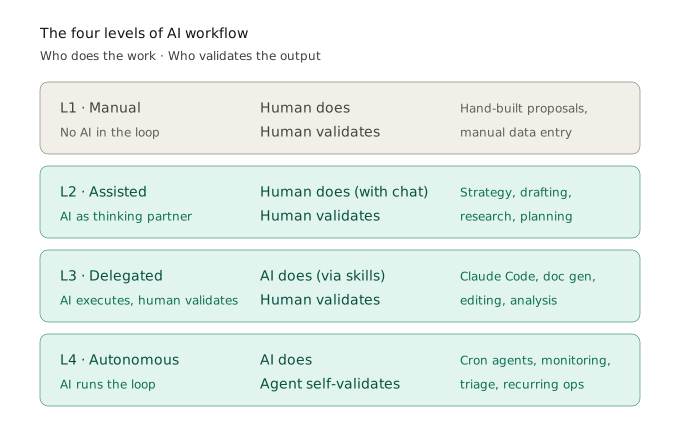
The most important shift in this framework isn’t L1 to L2, or L3 to L4. It’s the jump from L2 to L3. That’s where validation stops being automatic — you built it, so you know it’s right — and starts requiring real infrastructure. Evals. Review workflows. Rollback discipline. Output tracking. Spot-check sampling. The organizational muscles for trusting work you didn’t produce.
Most companies fail here. Not because the technology isn’t ready. Because they haven’t built the scaffolding to trust it.
The Agentic Spectrum
The levels tell you the work/validation split. The spectrum tells you the implementation mode — separate axis, separate question.
Stage 1 — Pure chat. A conversational interface, no tools, no plug-ins. You ask, it answers. Low token cost, tight feedback loop, ideal for exploratory cognition.
Stage 2 — Chat + skills. The chat interface augmented with skills, plug-ins, or defined tools. An LLM wired to your document generator. A coding assistant with file access. You’re still initiating each task, but the AI is doing real work with defined capabilities.
Stage 3 — Full agent. Memory, tool calls, and an ongoing execution loop. The agent runs itself. Checks state, decides actions, takes them, evaluates results, continues. This stage can easily consume 20–50x the tokens of a simple chat for the same creative or planning task — because it will tool-call its way through problems that would take a human two minutes of thought.
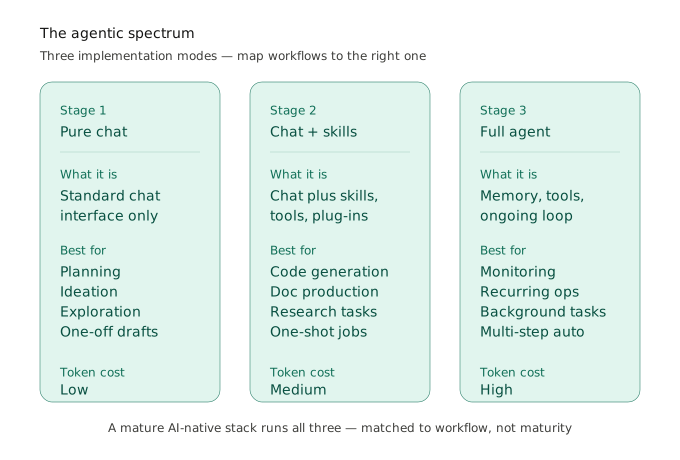
The critical point: these stages are not a maturity ladder. All three should coexist in any serious AI deployment. They’re implementation modes for different kinds of work.
Match the Workflow to the Level
The single most common mistake I see is treating “more agentic” as synonymous with “more advanced.”
It isn’t. Some workflows belong at L2 forever. Chat is the best tool for the job.
Chat belongs here:
Planning a keynote. Writing a proposal from scratch. Working through a hard strategic question. These are generative tasks. They benefit from the tight, cheap feedback loop of chat. Putting them inside an agent doesn’t make them better — it makes them slower, more expensive, and less thoughtful. You’re paying agent prices for work that has no repeatability to amortize.
Autonomous agents belong here:
Invoice reconciliation. Log monitoring. Nightly report generation. Routine triage. These are repetitive, rule-driven, and well-bounded. They belong at L4. Running them through chat every morning is a waste of the one thing you can’t scale: human attention.
Delegated AI (L3 with skills) belongs here:
Doc generation at scale. Code refactors. Compliance document production. Research across hundreds of sources. You need the AI doing the work and a human catching what it misses. Chat is too slow. An autonomous agent is too risky until the outputs have been validated enough times to earn the demotion.
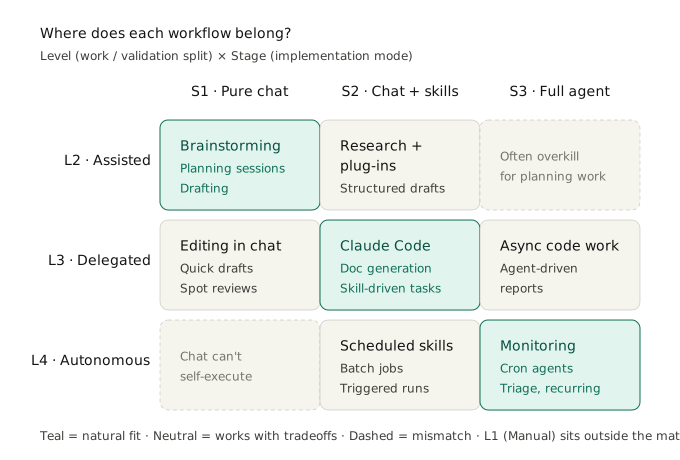
The framework isn’t “climb higher.” It’s: every workflow has a right level and a right stage. The job is to find them.
When to Drop Back Down
One pattern worth naming, because nobody talks about it: workflows can and should move down the ladder, not just up.
An agent that was handling monitoring well last quarter starts producing weird outputs because an upstream schema shifted. You don’t keep it running. You drop it back to L3 — AI executes, human validates — until the guardrails hold again. Then push it back up.
This isn’t failure. This is the system working.
A mature AI-native operation has the discipline to downgrade workflows when trust breaks and upgrade them when it’s been rebuilt. If you can only move workflows up, you don’t have a system — you have a collection of brittle agents and a prayer.
What a Portfolio Actually Looks Like
If your entire AI footprint is “we bought ChatGPT licenses,” you’re operating at L2 with one stage. That’s not nothing. But it’s roughly a fifth of what’s available.
A real portfolio looks like this:
- Chat for planning, ideation, drafting, strategic thinking. Cheap, fast, used by every knowledge worker, every day.
- Skills (chat + tools) for one-shot execution: document generation, code changes, research at scale, structured data work. Medium cost, high throughput. Used by specific functions for specific deliverables.
- Agents for recurring operations, monitoring, triage, and anything with clear guardrails. High cost per run, but running while you sleep. Used by specific systems, with dashboards and oversight.
Companies that run this portfolio well get three things:
- Token efficiency. They don’t burn agent cycles on work that belongs in a chat window.
- Output quality. They don’t expect chat to handle operations, or agents to do creative planning.
- Team clarity. Everyone knows which workflow belongs where, and why.
What to Do Monday Morning
If you’re running a traditional business — distribution, manufacturing, a VAR, services, anything with real operational depth — and you’re trying to build an AI-native operation, don’t start by asking what you can automate.
Start by mapping your existing workflows across these two axes. Put every recurring piece of knowledge work on a list. For each one, answer two questions:
- What level does this belong at? (Not where it is now — where it should be.)
- What stage delivers that level most efficiently?
Some workflows will need to move. Many won’t — and that’s not a failure, that’s the point of the framework. The ones that stay where they are matter just as much as the ones that migrate. You’re not looking for a uniform upgrade. You’re looking for the right fit, workflow by workflow.
Not “adopt AI.” Not “buy more licenses.” Not “build one big agent.”
Match the workflow to the level. Match the level to the stage. Run the portfolio.
That’s how you go from having a ChatGPT tab to having an AI strategy.
For the complete implementation playbook — including vendor evaluation, change management, and industry-specific guides — see the AI Playbook.