
General
10 Commandments Of A Profitable OperationReady
Ten non-negotiable operating principles that separate profitable businesses from ones that just look busy. Applicable across any industry.
Operations
Toyota and Danaher stated their priorities and repeated them obsessively. Here's the 4P framework that drives every decision at scale.
Want the secret sauce behind Toyota and Danaher’s success?
They purposefully state their priorities, their approach, and their principles.
They didn’t just state them—they repeated them in meetings and presentations. They reiterated them in the midst of problems. They preached them like a sermon to people both inside and outside of their company.
Why does this matter? Whether you state them explicitly or they are implied by daily decisions and conversations, they provide the needed reference for prioritizing work, decisions, and the application of your actual business.
Toyota laid out a simple yet powerful 4P model as the basis for their approach:
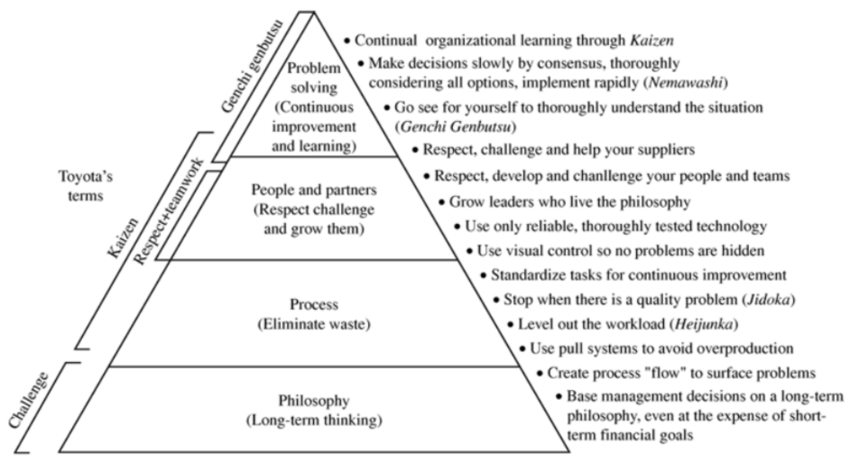
Toyota’s philosophy was all about long-term thinking. Every decision gets filtered through: “Will this still be the right choice in 10 years?” This prevents the short-term optimization that kills companies—cutting training budgets, deferring maintenance, squeezing suppliers for quick savings.
Most small businesses I work with are stuck in firefighting mode. They make decisions based on this week’s cash flow, not this decade’s trajectory. The philosophy pillar forces you to step back and ask: what are we actually building here?
With philosophy as the foundation, Toyota then created processes to eliminate wasteful time, material, energy, and resources. They identified seven types of waste (muda):
When I walk through a distribution center or manufacturing floor, I can usually spot 20-30% waste within the first hour. Most of it is hidden in plain sight because “that’s just how we do things.”
Toyota wanted a culture of respect, but also one where people challenged each other and wanted to grow—not only individually, but as a team. This is the hardest pillar to implement because it requires genuine humility from leadership.
Respect means trusting frontline workers to identify problems. Challenge means expecting them to propose solutions, not just complaints. Most companies get one or the other. Toyota gets both.
Finally, they wanted continuous improvement in all areas of the company through proper problem-solving. This is where tools like the 5 Whys, A3 thinking, and PDCA (Plan-Do-Check-Act) come in.
The key insight: problem-solving is a skill that must be taught and practiced. Most employees have never been trained to systematically identify root causes. They jump to solutions, creating operational debt that compounds over time.
This idea was the basis for 14 specific management principles that governed the very ethos of the company and allowed them to run an extremely effective operation.
Years later, Danaher created their own version of the 4P model known as the Danaher Business System (DBS):
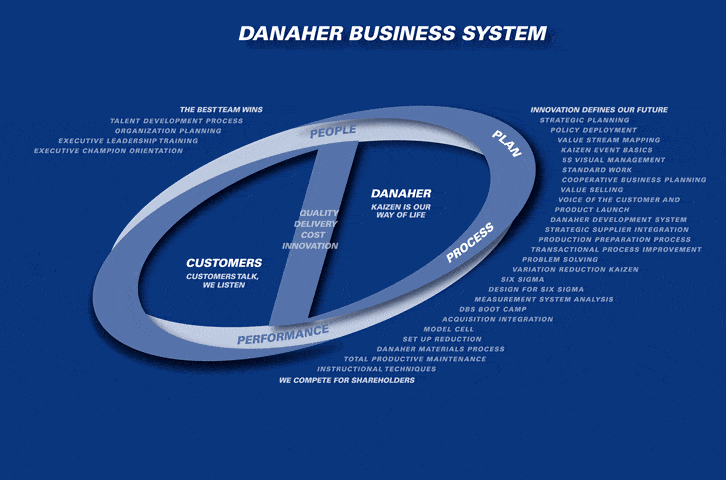
For them, these 4 aspects work together to create outstanding results. As they put it:
Exceptional PEOPLE develop outstanding PLANS and execute them using world-class tools to construct sustainable PROCESSES, resulting in superior PERFORMANCE. Superior performance and high expectations attract exceptional people, who continue the cycle.
This is a virtuous cycle. Great people create great results, which attracts more great people. But it starts with having the discipline to define what “great” means in your context.
Here’s how I’ve helped companies adopt these principles:
After implementing these frameworks across manufacturing, distribution, and home services companies, I’ve seen the same mistakes repeatedly:
1. Starting with tools, not philosophy. Companies buy expensive software or hire consultants to implement “lean” before defining what they actually believe. Tools without philosophy create cynical employees who’ve “seen this before.”
2. Treating it as a project, not a culture. The 4P framework is never “done.” Companies that assign it to a project manager and expect completion miss the point entirely.
3. Skipping the people pillar. Process improvements without people development create resentment. Employees feel like they’re being squeezed for productivity rather than supported for growth.
4. Expecting quick results. Toyota took decades to build their system. You won’t transform your culture in 90 days. The first year is about building foundations; the returns compound in years 2-5.
When implemented properly, companies typically see:
The real ROI isn’t in any single metric—it’s in the compounding effect of a team that continuously improves.
Having a simple way to encapsulate your culture, philosophy, and approach won’t in and of itself transform anything. What it does is make it easier to remember, to reiterate, to preach it over and over again until it becomes ingrained in every aspect of your business.
So what are your values? What are your foundational concepts—what I call “core tenets”—that you are building everything on?
Start by asking:
Write these down. Repeat them. Let them guide your hiring, your promotions, your daily decisions. That’s how Toyota and Danaher built world-class operations—not through complex systems, but through simple principles applied with relentless consistency.
Related Reading:
Ten non-negotiable operating principles that separate profitable businesses from ones that just look busy. Applicable across any industry.
Every business runs on three machines: sales, operations, and finance. Master all three or one will bottleneck your growth.
“Sam Zell’s operating philosophy distilled — risk, conviction, and the entrepreneurial mindset that built a $6B real estate empire.”