
The PE Operating Partner's AI Playbook: Portfolio-Wide Wins in 90 Days
A framework for PE operating partners to assess, deploy, and scale AI across portfolio companies — 90-day sprints with real ROI.
If you’re an operating partner with nine portfolio companies and your LPs are asking about your “AI strategy,” I already know what your board decks look like. Three companies mention AI. None of them can tell you what they’re specifically doing. The slide has a robot on it.
That’s not a strategy. That’s a placeholder.
Here’s what I tell operating partners: AI at the portfolio level isn’t a technology initiative — it’s an operating model. You need a standardized assessment, a repeatable deployment framework, and a way to transfer learnings across companies. Without those three things, you’re running nine unrelated consulting engagements.
I built a framework for exactly this. Let me walk you through it.
The Portfolio AI Framework
PE is different from single-company operations. You have a hold period. Every initiative competes for management attention — the scarcest resource in any portfolio company. An AI project that consumes six months of the COO’s bandwidth and delivers ambiguous results isn’t just a failed project. It’s an opportunity cost against everything else on the value creation plan.
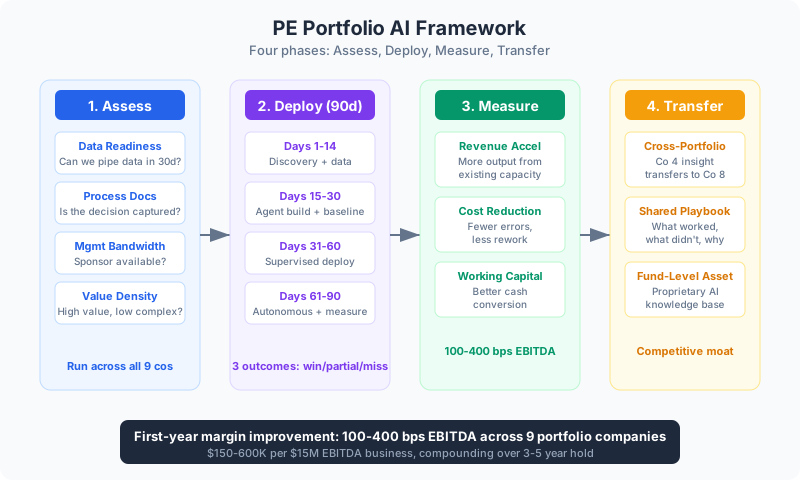
The framework has four phases: Assess, Deploy, Measure, Transfer.
Phase 1: The Standardized Assessment
Every portfolio company gets the same assessment across four dimensions. The output differs because the companies differ, but the framework is consistent — which means you can compare readiness and opportunity across the portfolio.
Dimension 1 — Data Readiness. Not “do you have data” but “can we access, clean, and pipe it into an AI system within 30 days.” A company on QuickBooks and spreadsheets has different readiness than one on a modern ERP. Both can use AI. The starting point differs.
Dimension 2 — Process Documentation. AI automates decisions. If the decision process isn’t documented, you can’t automate it. A warehouse manager who “just knows” how to prioritize orders has an undocumented process that needs to be captured first. Not a blocker — a sequencing issue.
Dimension 3 — Management Bandwidth. AI deployment requires a business-side owner who understands the workflow and has authority to change it. If every leader is maxed out, AI goes on the waitlist. Unsponsored projects fail 100% of the time.
Dimension 4 — Value Density. Where’s the highest-value, lowest-complexity use case? This varies wildly by industry:
- Healthcare services: prior auth automation and billing accuracy
- Distribution: receiving accuracy and carrier invoice audit
- Professional services: proposal generation and resource allocation
Run this across nine companies and you get nine different starting points but a comparable view of readiness and opportunity. That’s what goes in the LP deck: “Company 3 has a 90-day deployment plan targeting $180K in annual margin improvement through billing accuracy, with data readiness confirmed and an operational sponsor identified.”
👉 Tip: Run the assessment during diligence on new acquisitions. You’ll identify AI opportunities before the deal closes, which compresses time-to-value dramatically.
Phase 2: The 90-Day Deployment Sprint
Ninety days is the right window. Shorter and you’re running a demo. Longer and management moves on to the next fire.
Days 1-14: Discovery and data integration. Connect to source systems — ERP, CRM, WMS. This is where timelines blow up if you skip the assessment. The standardized assessment catches data readiness issues before you commit.
Days 15-30: Agent build and baseline. Configure the AI agent for the use case. Establish baseline metrics. If you’re deploying billing accuracy, measure current denial rate, coding distribution, days in A/R.
Days 31-60: Supervised deployment. The agent runs alongside existing processes. Makes recommendations; humans decide. This validates accuracy and builds team trust.
Days 61-90: Autonomous operation and measurement. Agent operates with oversight, not manual execution. Results measured against baseline.
Three possible outcomes — and all three are useful:
- Clear win. Measurable margin improvement. Expand the deployment.
- Partial win. Some value, less than projected. Diagnose the gap and adjust.
- Miss. Use case didn’t deliver. Document why and move to the next opportunity.
Even a miss informs deployments across the rest of the portfolio.
Phase 3: Measure in EBITDA Terms
PE operates in EBITDA. Everything translates to margin impact or it doesn’t get funded.
Revenue acceleration — more output from existing capacity:
- Medical practice adds 2-4 patients per provider per day through documentation automation
- Distribution center processes 12% more orders through dock scheduling
- Professional services firm cuts proposal time from 8 hours to 90 minutes
Cost reduction — fewer errors, less rework:
- Billing denial rates dropping from 11% to 5%
- Carrier invoice overpayments caught and recovered
- Prior auth labor cut by 80%
Working capital improvement — better cash conversion:
- Days in A/R dropping from 38 to 26
- Inventory turns increasing from 8x to 11x
First-year AI margin improvement typically runs 100-400 basis points of EBITDA. On a $15M EBITDA business, that’s $150-600K. Compound it across nine companies over a 3-5 year hold and it becomes a meaningful part of the value creation bridge.
Phase 4: Transfer Learnings
This is the underappreciated advantage. When Company 4 discovers that prior auth submissions with specific clinical documentation get approved 23% faster, that insight transfers to Company 8. When Company 7 reduces carrier invoice overpayment by $340K, the methodology transfers to Company 2.
Over 2-3 years, a fund deploying AI systematically builds proprietary knowledge about what works by industry vertical, what readiness factors predict success, and what margin improvements are realistic. That knowledge base is a fund-level asset.
👉 Tip: Build a shared playbook across your portfolio. Document what worked, what didn’t, and why. This becomes your competitive advantage when raising the next fund.
Capability vs. Dependency
This is where most PE AI strategies fail. You hire consultants to build a custom solution. It works. They leave. Six months later something breaks. Nobody internal knows how to fix it. That’s dependency, and it destroys value.
Benefits of capability-building deployments:
- The operational team owns the use case definition — not the vendor, not the fund
- Agent logic is transparent — when the billing agent recommends 99215 over 99214, the team can see why
- The internal team can modify agent behavior without external help — adjust rules, update thresholds, add exceptions
- If you replace the vendor tomorrow, the team still knows how to run the process
Adoption Profiles Across the Portfolio
After deploying AI across multiple companies, I see four patterns:
- Fast adopters — operational leader sees AI as a tool, not a threat. Has a specific problem they’re tired of solving manually. Give them a 90-day sprint with clear metrics and get out of their way.
- Deliberate adopters — need proof before commitment. Want to see results from another portfolio company first. Build cross-portfolio peer connections.
- Reluctant adopters — leadership views AI as a distraction. Usually the companies with the most to gain. Start with the smallest possible deployment.
- Non-adopters — fundamental blockers like no data infrastructure or active organizational dysfunction. Fix the basics first. AI amplifies what’s working. It doesn’t fix what’s broken.
The operating partner’s job is correctly identifying each company’s profile and adjusting the approach accordingly.
The LP Narrative
LPs want three things: a systematic approach, actual results, and a forward plan.
Give them: “We assessed all nine companies. Companies 1, 4, and 7 deployed in Q1 and generated a combined $890K in annualized margin improvement. Companies 3 and 8 are in 90-day sprints. Companies 5 and 9 are in assessment. Companies 2 and 6 are addressing data readiness prerequisites.”
That’s a portfolio operations narrative, not a technology narrative. And it’s the kind of specificity that separates funds that talk about AI from funds that deploy it.
Continue reading:
Related AI Articles
What Your Senior Accountants Wish You Knew About AI
Most AI-for-accounting pitches miss the point. Here's what matters and the myths keeping firms from recovering senior capacity.
Read moreThe AEC Firm's Guide to Recovering 30% of Lost Billable Hours
A practical how-to for architecture and engineering firms that want to stop losing billable capacity to proposals, RFIs, spec coordination, and reporting.
Read moreHow a Mid-Size GC Cut Bid Prep Time by 60% Without Adding Estimators
How one general contractor used AI to fix estimating bottlenecks, catch cost overruns weeks earlier, and stop losing tribal knowledge to turnover.
Read moreThe Real Money in Your Dental Practice Isn't in the Chair
Most dental AI marketing focuses on imaging and diagnostics. That's not what's killing your margins. Here's what is — and how to fix it.
Read more