
5 Questions That Surface 80% of Your AI Opportunities
Five simple questions I ask every client to find where AI can actually help. No vendor pitches, no hype — just the friction points hiding in your operation.
I’ve walked into dozens of businesses where the CEO says, “We know we need AI, but we don’t know where to start.” The answer isn’t in a vendor demo. It’s in your operation — specifically, in the places where smart people spend their time doing dumb work.
These are the five questions I ask in every discovery session. They aren’t fancy. But they consistently surface the spots where AI creates real, measurable value — not theoretical value, not “someday” value, but dollars-back-in-your-pocket value.
Every point of operational friction is an AI opportunity — and these five questions find most of them.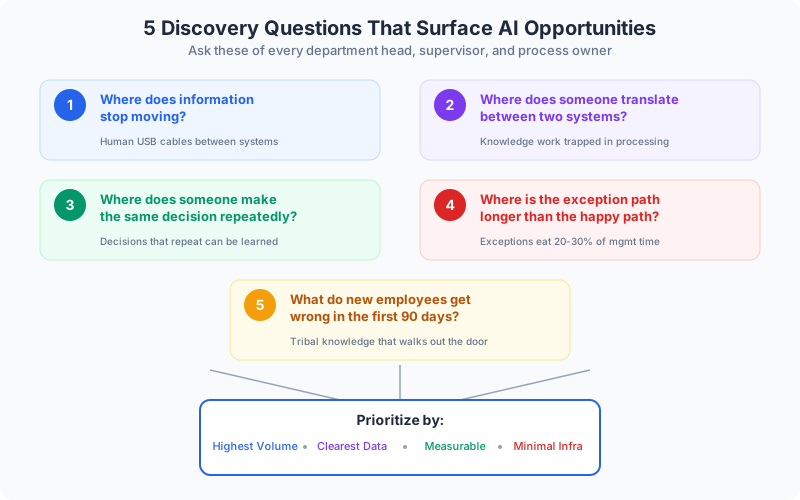
1. Where Does Information Stop Moving?
Information wants to flow. When it stops, you’ve got a person — usually an expensive one — acting as a human USB cable between two systems.
Look for these patterns:
- An email that has to become a CRM entry
- An invoice that has to become an ERP record
- A customer complaint that has to become a quality ticket
- A sales order that has to become a production schedule
I worked with a contract manufacturer where 23% of incoming EDI orders triggered exceptions — wrong part numbers, missing specs, quantities that didn’t match contract terms. Each exception took about 52 minutes to resolve. At 150 orders a week, that’s almost 16 hours of labor just unsticking information that should’ve flowed automatically.
Benefits of finding these stoppages:
- You quantify labor costs that are invisible on the P&L
- You find integration gaps your IT team already knows about but can’t prioritize
- You identify where AI agents can move data and make judgment calls traditional integrations can’t
👉 Tip: Walk your floor and literally follow a piece of information from entry to completion. Count every time it stops moving. Every stop is a candidate.
2. Where Does Someone Translate Between Two Systems?
This is different from information stopping. This is information moving — but requiring a human interpreter to make the translation.
Think about the analyst who reads sales data and produces a demand forecast. The planner who reads customer orders and builds a production schedule. The accountant who reads bank statements and categorizes transactions. They’re not copying data — they’re interpreting it.
A wholesale distributor I worked with had buyers processing vendor price increases from PDFs. Read the PDF, identify affected SKUs, calculate margin impact, decide what to adjust, update the pricing system, notify sales. A single increase affecting 200 SKUs took 4-6 hours. They got 15-20 increases a month. That’s 60-120 hours monthly on a purely mechanical task being done by people with pricing expertise who should’ve been making strategic decisions.
👉 Tip: Ask your team leads this question: “What’s the most boring part of your job that still requires your expertise?” That’s translation work. It’s knowledge work trapped inside a processing task.
3. Where Does Someone Make the Same Decision Repeatedly?
Decisions that repeat are decisions that can be learned. Not all of them — strategic calls, novel situations, and ethical judgment should stay human. But look for decisions that happen frequently, have clear inputs, produce consistent outputs most of the time, and occasionally need escalation.
A credit manager reviewing 50-80 applications a month, spending 30-60 minutes each. About 80% are straightforward approvals or denials based on clear criteria. An AI agent can auto-approve the 60% that clearly qualify, auto-decline the 15% that clearly don’t, and route the 25% that actually require judgment — with analysis and a recommendation attached.
The credit manager’s volume drops 75%. But the decisions they do make are the ones that genuinely need a human brain.
Benefits of automating repeated decisions:
- Your best people spend time on the hard problems, not the routine ones
- Decision consistency goes up (humans get tired, AI doesn’t)
- You build a decision audit trail that’s impossible to maintain manually
- Processing speed drops from hours to minutes
How to Spot Them
Ask: “What decisions do you make more than 10 times a week?” Then ask: “What percentage of those could someone else make with a clear rubric?” If the answer is above 50%, you’ve found an AI opportunity.
4. Where Is the Exception Path Longer Than the Happy Path?
Every process has two versions — what happens when everything goes right, and what happens when it doesn’t. The happy path is documented. The exception path is improvised, lives in experienced employees’ heads, and eats your most expensive people’s time.
Here’s a real example from e-commerce returns:
- Happy path: Customer initiates return, prints label, ships item, gets refund. About 30 seconds of labor.
- Exception path: Item arrives damaged, wrong item returned, customer disputes the amount, or it’s 91 days on a 90-day policy. Each exception: 15-45 minutes.
At a 15% exception rate on 10,000 monthly returns, that’s 1,500 exceptions consuming 375-1,125 labor hours. More labor than all the happy-path returns combined.
An AI agent triages those exceptions, gathers context from multiple systems, applies policy rules, resolves the unambiguous cases, and presents the genuinely weird ones with full context and a recommendation. Exception handling time drops 60-70%.
👉 Tip: Ask your supervisors: “What percentage of your day is spent on things that went wrong versus things going right?” If the answer is above 30%, your exception paths are eating your operation alive.
5. What Do New Employees Get Wrong in the First 90 Days?
This question surfaces tribal knowledge — the institutional understanding that lives in experienced employees’ heads and takes months to acquire.
New hires make predictable mistakes. They don’t know the customer who always needs rush handling. They don’t know the vendor who ships early. They don’t know the ERP workaround that everyone uses but nobody documented. This knowledge walks out the door when people leave.
An AI agent that captures and surfaces this context changes the game. It recognizes customers with special handling requirements before a new rep processes the order wrong. It provides deal intelligence — prior quotes, historical objections, win/loss patterns — before a new salesperson wings it. It incorporates all known constraints into scheduling before a new planner makes the same mistake the last three planners made.
Benefits of capturing tribal knowledge:
- Onboarding time drops dramatically
- You eliminate the “key person risk” that keeps owners up at night
- Institutional knowledge compounds in the system instead of walking out the door
- Every employee operates with the context of your best employee
From Questions to Action
These five questions don’t just find AI opportunities — they prioritize them. Once you’ve mapped the friction, ask:
- Which has the highest volume?
- Which has the clearest data already available?
- Which produces the most measurable outcome?
- Which can you start with minimal infrastructure?
Start with the one that scores highest across all four. Build the first agent. Measure the result. Then move to the next one. Each deployment gets faster because the infrastructure compounds.
The opportunities are already in your operation. These questions just make them visible.
Continue reading:
Related AI Articles
The AEC Firm's Guide to Recovering 30% of Lost Billable Hours
A practical how-to for architecture and engineering firms that want to stop losing billable capacity to proposals, RFIs, spec coordination, and reporting.
Read moreThe Real Money in Your Dental Practice Isn't in the Chair
Most dental AI marketing focuses on imaging and diagnostics. That's not what's killing your margins. Here's what is — and how to fix it.
Read moreFinancial Advisors: Double Client Capacity, Same Staff
A guide for advisors and RIAs who want more clients without more staff — by cutting the admin that eats 40% of the week.
Read more5 Compliance-Safe AI Wins for Banks, RIAs, and Insurance Firms
Financial services firms think compliance blocks AI. It doesn't. Five automation wins that improve operations without regulatory risk.
Read more