
The Handoff Document Pattern for Multi-Skill AI Workflows
Stop losing detail when AI workflows compact context. Use handoff documents to chain skills cleanly, preserving exact data between steps without summary loss.
Complex business workflows fail in AI systems for a predictable reason. By the third or fourth skill in a sequence, context has accumulated past the point where the model can hold detail. Compaction kicks in. The system summarizes earlier work into a few paragraphs, drops the granularity, and proceeds with a sanitized version of what came before. The output looks reasonable. It’s wrong in subtle ways.
This shows up most in workflows that chain specialized skills: research, then analysis, then drafting, then review, then publication. Each step needs the precision of what came before, not a summary of it. A drafting skill that gets “the analysis identified three customer segments” instead of the actual segment definitions will produce generic copy.
The fix isn’t a bigger context window. It’s a smaller one, reset deliberately at every workflow boundary.A working multi-skill workflow needs three things in sequence: identity that survives the reset, a handoff document that captures the work, and a load procedure that rebuilds context cleanly. Skip any one and the workflow degrades back to compaction-driven summarization.
The Compaction Problem
Context windows are not free. Even when they’re large, the model’s attention degrades across long inputs, and active token counts drive cost and latency.
Why Summarization Hurts
Compaction is lossy by design. It keeps narrative and drops specifics. For a creative chat, that’s fine. For a workflow where step five depends on the exact numbers from step two, it’s catastrophic. The summary will say “revenue grew” without preserving the segment-level breakdown that determined the strategy.
Where It Shows Up
The failure mode is silent. The next skill produces output that reads well, references the right concepts, and contains made-up specifics. You only catch it when you compare against the original work.
👉 Tip: Audit your longest AI workflows by checking whether step N output contains specific data from step 1, not just paraphrased themes. If specifics are missing, compaction has already happened.
The Handoff Document
Between every skill, write a markdown file. This is the only state that survives the context reset. Treat it like an API contract.
What Goes In It
Decisions made and the reasoning behind them. Specific data the next skill needs (numbers, names, identifiers, exact strings). Constraints that apply downstream. Any open questions or known gaps. Skip the narrative recap of process. The next skill needs inputs, not a story about how you got there.
Where It Lives
Pick a deterministic location. Something like workflows/{workflow-id}/handoffs/{step}-to-{next-step}.md. The next skill must be able to find it without searching.
👉 Tip: Define the handoff schema before you build the workflow. If a skill produces a handoff that the next skill can’t parse, the entire chain breaks at that boundary.
Format Discipline
Each handoff follows the same structure: context, inputs, decisions, constraints, open items. Predictable structure means predictable loads. Free-form notes mean the next skill burns tokens parsing your formatting instead of doing the work.
The Clean Reload Pattern
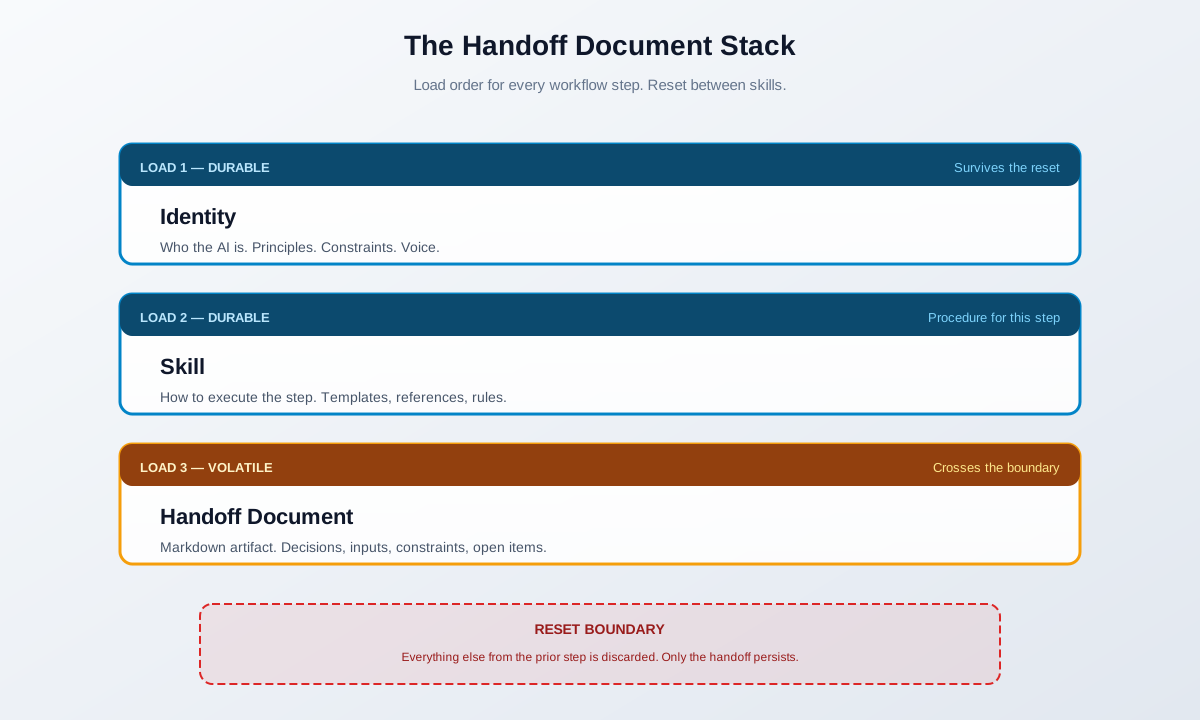
Every workflow step starts the same way. Fresh session. Load the system identity. Load the skill. Load the handoff. Proceed.
Identity First, Then Skill, Then Data
Order matters. Identity (who the AI is, what principles govern it) gets loaded first because it shapes how the skill is interpreted. The skill (the procedure) loads second because it shapes how the handoff data gets used. The handoff loads last because it’s the most volatile and most specific layer.
This sequence keeps the system coherent. Load data first and the model anchors on specifics before it knows the principles. Load skill before identity and the procedure overrides judgment.
What You Preserve, What You Discard
Identity and skill are durable. They don’t change between workflow steps. The handoff is the only thing that crosses the boundary. Everything else from the previous step (reasoning chains, exploratory dead ends, intermediate drafts) gets dropped.
👉 Tip: Build a session-startup script that loads identity, then skill, then handoff in that exact order. Manual loading drifts; scripted loading stays consistent.
The Operational Win
Context costs drop. Latency drops. Output quality goes up because each skill operates with full attention on a focused input. The workflow becomes auditable: every step has an artifact, every transition has a contract.
Conclusion
Most teams trying to scale AI workflows reach for bigger models or longer contexts. The actual constraint is structural. Long-running context accumulates noise faster than value, and compaction strips the specifics that make later steps work.
Handoff documents flip the model. Each skill becomes stateless. The state lives in versioned markdown that you can inspect, debug, and improve independently of the AI itself. Workflows become composable: swap a skill, change a handoff schema, run two paths in parallel. The discipline is in defining the handoff precisely. Get that right and the rest of the system gets simpler, faster, and more reliable than any monolithic context approach can match.
Related AI Articles
Claude Code's 2-Level Memory System: Local + Global Learning
A practical framework for capturing learnings at local and global levels. Apply to software, marketing, finance, HR, legal, and any knowledge work.
Read more10 Claude Code Best Practices I Wish Someone Told Me on Day One
Ten practices that transformed Claude Code from a novelty into my primary productivity tool. Each one addresses a mistake I made so you don't have to.
Read moreClaude Code: The Complete Guide (From Install to AI-Powered Workflows)
Everything you need to master Claude Code — install, architecture, agents, hooks, and the spec-driven workflow that changes how you build software.
Read moreMulti-Agent AI Framework: Spine Architecture in Python
A production-ready multi-agent AI framework in Python. Spine-based security, graph orchestration, and audit logging — not another toy demo.
Read more