
Multi-Agent AI Framework: Spine Architecture in Python
A production-ready multi-agent AI framework in Python. Spine-based security, graph orchestration, and audit logging — not another toy demo.
Most AI agent frameworks are built for demos. They look great in a README and fall apart the moment you need to handle real documents, real security requirements, and real scale.
I built Spine Architecture because I kept running into the same problem: organizations needed multiple specialized AI agents working together on complex workflows, and nothing available could handle production requirements. The security model was an afterthought. The orchestration was either too rigid or too chaotic. The prompt management was string templates held together with duct tape.
This is a production Python framework for building coordinated AI agent systems. Think of it like a nervous system — instead of individual agents running in isolation, they attach to a central “spine” that handles resource sharing, security, tool access, and workflow orchestration.
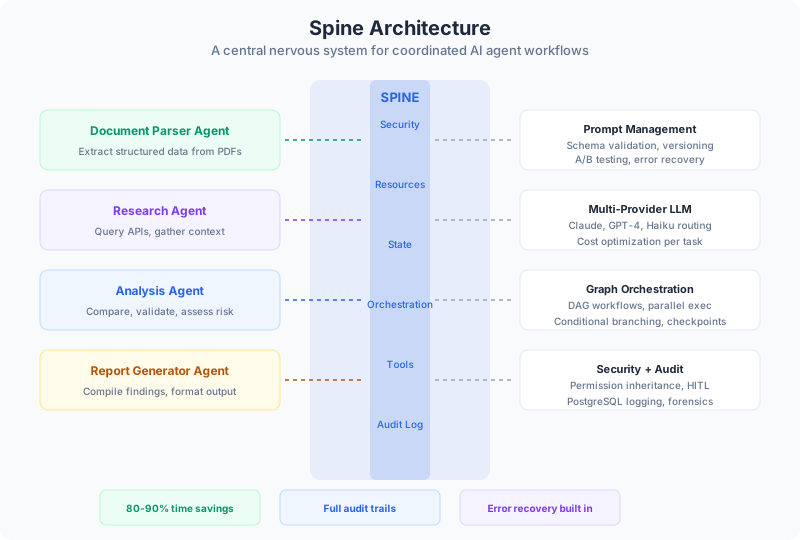
Why This Matters for Operations
If your organization deals with complex document processing, multi-step workflows, or needs AI systems with multiple specialized capabilities working together, you’ve probably hit the ceiling of single-agent systems.
Benefits of multi-agent architecture over single-agent approaches:
- Labor compression at scale. Multi-agent workflows compress 8-12 hours of expert review into 15-20 minutes of compute. Implementation partners report 80-90% time savings on document analysis.
- Better output through specialization. Instead of one agent doing everything (mediocre results), specialized agents handle their strengths — document parsing, research, analysis, report generation. Each agent has the right tools and prompts for its specific job.
- Audit trails that actually work. Every agent action, tool execution, and data flow gets logged to PostgreSQL with full security context. When auditors ask “how did your system arrive at this determination,” you have complete forensics.
- Error reduction. Graph-based orchestration ensures steps happen in the right order with proper validation. Parallel execution where it makes sense, sequential where dependencies exist.
The Core Architecture
Enterprise-Grade Prompt Management
Prompts are code. They need version control, testing, and the ability to update without redeployment. The prompt system goes beyond string templates:
- Template engine: Variable substitution, conditional rendering, loops with index access, nested structures
- Schema validation: Type enforcement, required fields, enum constraints, custom validators on every input and output
- Output parsing with error recovery: Handles malformed LLM responses — extracts JSON from markdown, fixes unquoted keys, converts single quotes, removes trailing commas. Your workflows don’t fail because an LLM returned slightly broken JSON.
- Database-backed storage: Runtime updates without deployment, A/B testing, analytics, collaborative development
fields:
  priority:
    type: enum
    required: true
    values: ["critical", "high", "medium", "low"]
  requirements:
    type: list
    item_type: string
    required: true
    validators:
      - type: min_length
        value: 1
        message: "Must have at least one requirement"
Multi-Provider LLM Client
Unified interface across providers with intelligent switching and cost optimization:
- Expensive models (GPT-4, Claude Opus) for critical analysis
- Cheap models (GPT-3.5-turbo, Claude Haiku) for simple transformations
- Automatic fallback if primary provider is unavailable
- Routing based on context length, multimodal needs, or cost
## High-quality analysis agent
analysis_llm = create_llm("anthropic", model="claude-3-opus-20240229")

## Fast document processing agent
parsing_llm = create_llm("chatgpt", model="gpt-3.5-turbo")

## Cost-optimized bulk operations
bulk_llm = create_llm("nvidia", model="llama-3.1-nemotron-70b-instruct")
Built-in response handling includes token usage, cost calculation, latency metrics, streaming support, and automatic retry with exponential backoff.
Spine-Based Security
Security is built into the architecture, not bolted on. The spine acts as a security boundary where all agent operations are validated.
Human-in-the-loop approval flow:
- Agent requests spine attachment, logged to database
- Human approver reviews: what does this agent do, what tools does it access, what data can it read?
- Approval grants specific permissions — read memory, write memory, execute tools, attach sub-agents
- All subsequent operations validate against this context
Permission inheritance: Sub-agents inherit a subset of parent permissions — never more. Revoked parent permissions cascade to children. Temporal security supports short-lived permissions for temporary agents with automatic expiration.
👉 Tip: Design your permission model before building your first agent. Retrofitting security onto a multi-agent system is exponentially harder than building it in from the start.
Graph-Based Workflow Orchestration
Workflows are directed graphs — nodes are agent operations, edges define data flow. More flexible than rigid pipelines, more structured than “let agents figure it out.”
## Sequential pipeline
graph.add_node("parse", parse_document)
graph.add_node("extract", extract_requirements)
graph.add_node("analyze", analyze_compliance)
graph.pipeline("parse", "extract", "analyze")

## Parallel execution
graph.parallel("research_entity_a", "research_entity_b")

## Conditional branching
graph.conditional(
    from_node="check_quality",
    condition=lambda state: state['quality_score'] < 0.8,
    true_node="manual_review",
    false_node="auto_process"
)
State persists to database at each node. Failed workflows resume from last successful node — no reprocessing completed steps. Error handling includes retry with backoff, fallback nodes, checkpoint rollback, and notification for manual intervention.
Real-World Use Cases
Manufacturing: Quality Control and BOM Verification
Multi-agent workflow for quality: parse inspection reports, extract measurements, validate against specs (ISO 9001, AS9100), detect trends across batches and shifts, flag risks before shipment, generate executive summaries. Inspection analysis drops from 2 hours to 5 minutes.
BOM verification: extract parts from engineering docs, query supplier APIs in parallel, compare pricing, check lead times, suggest alternatives, assess supply chain risk. Verification time drops from days to hours with 10-15% cost savings through better supplier selection.
Professional Services: RFQ Response and Contract Analysis
Parse RFQ requirements, check feasibility against capabilities, model capacity for delivery dates, estimate costs, assess risks, generate formal quotes. Turnaround from 3 days to 8 hours.
Government: Procurement and FOIA Processing
Document classification, parsing, compliance verification against FAR/DFARS, cost reasonableness analysis, risk assessment, report generation. 80-85% reduction in document review time with complete audit trails for protests.
👉 Tip: Start with a workflow where you already have clear process documentation. Multi-agent systems amplify good process design — and amplify bad process design equally.
What This Doesn’t Do
I want to be direct about limitations:
- Not a complete application. You write the agents, define workflows, configure tools. The framework provides the foundation.
- Not no-code. Building multi-agent systems requires Python. The framework reduces complexity but assumes engineering resources.
- Not for simple chatbots. If you need one agent answering support questions, use something simpler. This shines when multiple specialized agents coordinate on complex workflows.
- No pre-built agents. You build workflows for your specific requirements using the framework’s components.
Why I Built It This Way
The prompt management system came from the reality that prompts are code — they need version control, testing, and hot-swapping. Multi-provider support came from not wanting vendor lock-in and needing cost optimization per task. The security model came from compliance requirements that most frameworks ignore. The graph orchestration came from workflows too complex for pipelines but needing more structure than agent free-for-all.
This framework handles the infrastructure so you can focus on what your agents do and what problems they solve.
Continue reading:
- Claude Code Mastery: The Complete Guide — architecture, agents, skills, and workflows
- 10 Best Practices for Using Claude Code — quick-reference practices
- Stop Talking to AI Like It’s a Person — Start Compiling Your Expertise — the decision architecture that feeds multi-agent systems
- Building Effective Business Systems — the systems thinking that underpins good agent design
Related AI Articles
The Orchestration Economy: Only Thinking Remains
Execution is getting commoditized. The operators who win will be the ones who think deepest about what to automate next.
Read moreThe AEC Firm's Guide to Recovering 30% of Lost Billable Hours
A practical how-to for architecture and engineering firms that want to stop losing billable capacity to proposals, RFIs, spec coordination, and reporting.
Read more10 Claude Code Best Practices I Wish Someone Told Me on Day One
Ten practices that transformed Claude Code from a novelty into my primary productivity tool. Each one addresses a mistake I made so you don't have to.
Read moreClaude Code: The Complete Guide (From Install to AI-Powered Workflows)
Everything you need to master Claude Code — install, architecture, agents, hooks, and the spec-driven workflow that changes how you build software.
Read more