
The Complete Guide to Improving Business Profitability
Master the three levers of profitability—operations, pricing, and capital efficiency—to drive sustainable margin improvement.
Most companies try to improve profitability the wrong way. They cut costs. They lay off 10% of staff. They renegotiate vendor contracts for pennies. And six months later, profitability is worse than before because they cut muscle, not fat.
I’ve operated and advised companies across distribution, manufacturing, and services. The pattern is always the same: profitability isn’t a single number to improve—it’s three interconnected systems that either compound each other or cancel each other out. Fix operations without fixing pricing, and you’re efficiently delivering underpriced work. Fix pricing without fixing operations, and customers leave because you can’t deliver. Fix both without addressing capital efficiency, and your cash is trapped in inventory and receivables.
This guide covers all three levers, how they interact, and where to start based on the type of business you’re running.
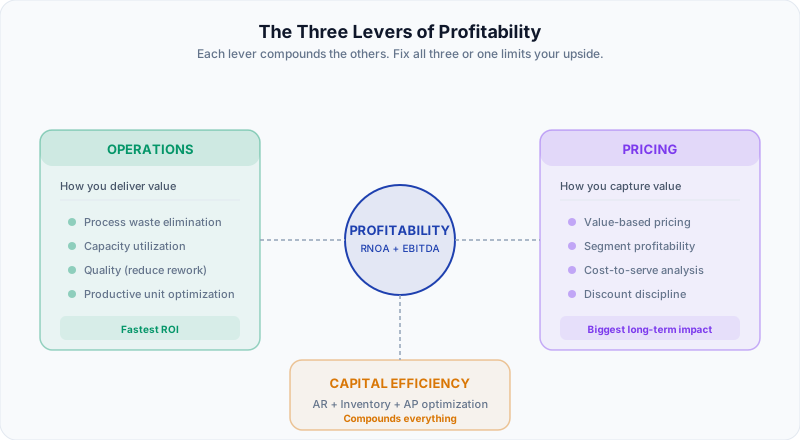
Understanding Profitability Beyond EBITDA
Before we talk about improving profitability, we need to agree on how to measure it. Most operators default to EBITDA because that’s what PE firms and lenders use. EBITDA matters for valuation, absolutely. But it’s a blunt instrument.
I prefer RNOA (Return on Net Operating Assets) because it tells you something EBITDA can’t: how efficiently your operating assets generate returns. A company with $2M EBITDA on $5M of net operating assets is fundamentally different from one with $2M EBITDA on $20M of net operating assets—even though EBITDA is identical.
RNOA decomposes into two components:
- Profit Margin (NOPAT / Revenue) — How much of each dollar you keep
- Asset Turnover (Revenue / Net Operating Assets) — How hard your assets work
This decomposition is powerful because it immediately tells you where profitability improvement should come from. High-margin, low-turnover businesses (professional services, software) need to focus on asset utilization. Low-margin, high-turnover businesses (distribution, retail) need to protect and expand margins.
Most operators only look at the income statement. They miss the balance sheet entirely. That’s like diagnosing engine problems by only looking at the speedometer.
The EBITDA Layer
Improving EBITDA in a middle-market company is still essential—it drives valuation and cash generation. But think of EBITDA as the output of the three-lever system, not the input. When you improve operations, optimize pricing, and tighten capital efficiency, EBITDA improvement is the natural result.
The companies I work with typically start around 10% EBITDA margins and end up at 13-18% within 12-18 months. That’s 300-800 basis points of improvement. At $50M revenue, that’s $1.5M to $4M in additional annual profit. At a 6x multiple, that’s $9M to $24M in additional enterprise value.
The question is: where does that improvement come from?
Lever 1: Operations — How You Deliver Value
Operations is where most profitability improvement lives. I estimate 50% or more of available margin improvement in a typical middle-market company sits in operational inefficiency. Not because people are lazy—because the systems that organize their work are broken.
Finding Waste
The operator’s guide to eliminating waste covers the nine categories of operational waste in detail. Here’s the strategic layer: waste isn’t always visible. In fact, the most expensive waste is the kind everyone has accepted as “just how things work.”
I walked into a distribution company where the warehouse team spent 40 minutes per order picking because the layout hadn’t been updated since the product mix changed three years ago. Nobody complained because they’d always done it that way. We reorganized the warehouse by pick frequency—high-velocity items near the dock, slow movers in the back—and cut pick time to 18 minutes. Same team, same products, same technology. Just better systems.
The nine wastes to audit:
- Movement — Are people walking, reaching, or transporting unnecessarily?
- Waiting — Where do workflows stall waiting for approvals, information, or materials?
- Overproduction — Are you making more than customers want, when they want it?
- Over-processing — Are you doing work that adds no value the customer would pay for?
- Defects — What’s your rework and warranty rate?
- Inventory — Where is excess stock tying up cash?
- Transportation — Are materials or products moving more than necessary?
- Underutilized talent — Are skilled people doing unskilled work?
- Information — Is data trapped in silos or people’s heads?
Every percentage point of waste eliminated typically adds 0.5-1.5% to operating margins. In a company doing $30M revenue, finding and fixing 5% waste is $1.5M straight to the bottom line.
The Productive Unit
Here’s where most operators miss the forest for the trees. They focus on revenue as a single number, but revenue is actually a composite metric driven by what I call the productive unit—the fundamental output of your operation.
In a plumbing company, the productive unit is completed jobs per technician per day. In a manufacturing plant, it’s units produced per machine-hour. In a consulting firm, it’s billable hours per consultant.
When you identify and optimize the productive unit, revenue becomes a formula instead of a hope:
Revenue = Productive Units × Revenue per Unit
This changes the entire conversation. Instead of “how do we grow revenue?” you’re asking “how do we get more productive units?” and “how do we increase revenue per unit?” Those are operational questions with operational answers.
A home services company I worked with was doing $8M revenue with 15 technicians. Revenue per tech: $533K. Industry benchmarks showed top performers at $750K+. The gap wasn’t sales—it was dispatch efficiency, first-time fix rates, and call-back reduction. We improved productive unit output by 22% in one quarter by fixing scheduling algorithms and stocking trucks with the right parts. Revenue jumped to $9.7M with the same headcount.
Process Improvement Without Over-Engineering
There’s a counterintuitive trap here: perfect systems kill cash. I’ve watched companies spend six figures on ERP implementations, process mapping tools, and continuous improvement programs that consumed more resources than they saved.
The 80/20 rule applies aggressively to process improvement. The first 20% of improvement effort captures 80% of the available value. After that, you’re into diminishing returns. A good-enough process that people actually follow beats a perfect process that sits in a binder.
My rule for process improvement:
- Can you describe the process on one page? If not, simplify.
- Does the team own it, or was it imposed? Imposed processes die.
- Does it have a measurable outcome? If you can’t measure improvement, you can’t confirm it.
- Will it pay for itself in 90 days? If the ROI timeline is longer, question whether it’s worth doing now.
Cost Management vs. Cost Cutting
These are not the same thing. Smart cost management is strategic—it’s about directing resources toward activities that generate returns and away from activities that don’t. Cost cutting is a meat cleaver. Cost management is a scalpel.
The distinction matters because cost cutting creates organizational trauma. People get scared. Performance drops. Your best people leave first because they have options. Cost management is positive—you’re investing more in what works and less in what doesn’t.
Start with a spend analysis. Pull every dollar of spending, categorize it, and ask: does this spending generate revenue, protect revenue, or neither? The “neither” category is usually 15-25% of total spend in companies that haven’t done this exercise. That’s your immediate opportunity.
Lever 2: Pricing — How You Capture Value
Pricing is the most powerful profitability lever and the one operators are most afraid to pull. A 1% price increase drops almost entirely to the bottom line—there’s no incremental cost to serve. Compare that to a 1% increase in volume, which requires incremental production, delivery, and support costs.
McKinsey research shows that a 1% improvement in pricing generates an 8-11% improvement in operating profit for the average company. Nothing else in business has that kind of leverage.
Yet most small and mid-market companies set prices by one of two methods:
- Cost-plus — Add a margin to your costs. This guarantees mediocre profitability because it ignores what customers value.
- Competitive matching — Charge what competitors charge. This guarantees a race to the bottom.
Both approaches leave money on the table.
Value-Based Pricing
The right framework is value-based pricing: charge proportionally to the value you deliver, not the cost you incur. This requires understanding what customers actually value, which is usually different from what you think.
A commercial cleaning company I worked with charged by square foot. Every customer paid the same rate regardless of complexity. When we analyzed cost-to-serve, we found that medical facilities cost 3x more to clean than office buildings (sterilization protocols, compliance documentation, insurance requirements) but paid the same rate. We restructured pricing by facility type and increased overall revenue per square foot by 28% with zero customer losses—because we were still below the value the medical clients received.
Segment Profitability
Not all revenue is created equal. Some customers are highly profitable, some are break-even, and some are actively losing you money. Until you know which is which, you’re subsidizing bad business with good business.
The analysis is straightforward: allocate direct costs to each customer or segment, include the labor and overhead they consume, and calculate profit by segment. In most companies, this reveals that 20-30% of customers generate 150-200% of profit, while the bottom 20% destroy 50-100% of that profit.
This doesn’t mean you fire the bottom 20%. It means you either reprice them to profitability or redesign how you serve them to reduce cost-to-serve. Sometimes the answer is a lower-touch service model. Sometimes it’s a price increase. Sometimes it genuinely is walking away.
Discount Discipline
Discounts are the silent killer of profitability. A 10% discount on a product with 30% margins requires a 50% increase in volume just to break even. Most salespeople don’t understand this math, and most companies don’t have systems to enforce discount discipline.
Rules for discount discipline:
- No discount without documented justification tied to a strategic objective
- Approval thresholds: over 5%, manager approval; over 10%, VP approval; over 15%, executive approval
- Track discount frequency by salesperson and by customer
- Review discount trends in monthly accountability reviews
- Set maximum discount authority by role
One of the fastest profitability wins I’ve ever seen was at a services company that cut average discount rate from 12% to 6% by implementing approval thresholds. Revenue stayed flat. Margins jumped 6 points. That was $3M straight to EBITDA on a $50M business.
Lever 3: Capital Efficiency — How Your Balance Sheet Works
Capital efficiency is the lever most operators ignore entirely. They manage the income statement obsessively and treat the balance sheet like furniture—it’s there, but nobody thinks about it.
The Three Machines framework illustrates this clearly: your business converts inventory into cash through a cycle. The faster that cycle spins, the less capital you need tied up in the business, and the more profit each dollar of capital generates.
Working Capital Optimization
Working capital is the cash trapped in your operating cycle: accounts receivable (what customers owe you), plus inventory (what you’ve bought but haven’t sold), minus accounts payable (what you owe suppliers).
Each component is a lever:
Accounts Receivable:
- What are your payment terms? Are they enforced?
- What’s your DSO (Days Sales Outstanding)? What should it be?
- Who are your slowest payers, and what are you doing about it?
- Do you offer early-pay discounts? Are they actually used?
Inventory:
- How many days of inventory do you carry? How does that compare to industry?
- What’s your slow-moving and obsolete inventory? Can it be liquidated?
- Are you stocking based on forecasts or actual demand patterns?
- What’s your order-to-delivery time, and can you shorten it?
Accounts Payable:
- Are you paying suppliers faster than necessary?
- Can you negotiate extended terms without damaging relationships?
- Are you capturing all available early-pay discounts (when the discount exceeds your cost of capital)?
I worked with a distributor carrying $4M in inventory on $20M revenue—73 days of supply. Industry benchmark was 45 days. We implemented ABC classification, reduced safety stock on slow movers, and negotiated faster replenishment from top suppliers. Inventory dropped to $2.5M within six months. That $1.5M in freed cash funded two new delivery trucks and a warehouse expansion that drove 15% revenue growth the following year.
Asset Utilization
Beyond working capital, look at your fixed assets. Equipment, facilities, vehicles—are they earning their keep?
The Resource ROI framework provides a structured way to evaluate this. For every major asset, ask:
- What does this asset cost fully loaded? (Depreciation, maintenance, insurance, space, opportunity cost)
- What revenue does it enable? (Direct attribution where possible)
- What’s the utilization rate? (Hours used vs. hours available)
- What would happen if we didn’t have it? (The existential test)
In manufacturing, equipment utilization below 65% is a red flag. In services, vehicle utilization below 80% suggests fleet right-sizing. In office environments, space costs per employee above industry benchmarks suggest consolidation opportunity.
The goal isn’t to run every asset at 100%—you need capacity for growth and variability. The goal is to eliminate assets that aren’t carrying their weight and maximize output from the ones you keep.
How the Three Levers Compound
Here’s why the three-lever framework matters more than any individual tactic: the levers compound each other.
Operations + Pricing: When you reduce cost-to-serve through operational improvement, you have two choices. You can keep prices the same and pocket the margin improvement. Or you can lower prices selectively to win volume in attractive segments. Either way, you win—but only if you understand both levers.
Pricing + Capital: Higher margins mean you generate cash faster. Faster cash generation means you can reduce reliance on debt, lower interest expense, and reinvest in growth. The pricing lever directly feeds the capital efficiency lever.
Capital + Operations: Freed-up capital from working capital optimization funds operational improvement. Better equipment, better technology, better training—all paid for by cash that was previously trapped in excess inventory or slow receivables. The capital lever enables the operations lever.
All Three Together: A company that simultaneously improves operational efficiency by 15%, increases effective pricing by 5%, and reduces working capital by 20% doesn’t get a linear improvement. They get a compounding effect where each lever amplifies the others. I’ve seen this pattern generate 100-300% EBITDA improvement in 12-18 months.
The Profitability Diagnostic
Before you start pulling levers, you need to know which ones matter most for your specific situation. Here’s the diagnostic I run in the first two weeks with any company:
Week 1: Data Gathering
Financial:
- Trailing 12-month P&L with monthly detail
- Balance sheet (current and prior year)
- A/R aging report
- Inventory aging or turnover report
- Gross margin by product line or service type
Operational:
- Revenue per employee (total and by department)
- Customer count and revenue per customer
- Capacity utilization (whatever your productive unit is)
- Quality metrics (defects, rework, callbacks, warranty)
- Process cycle times for core operations
Pricing:
- Pricing structure (how you charge, what you charge)
- Discount history (frequency, depth, by customer/salesperson)
- Win rate on proposals/quotes
- Customer concentration (top 10 customers as % of revenue)
Week 2: Analysis and Prioritization
With the data in hand, I score each lever on two dimensions: opportunity size (how much improvement is available) and implementation speed (how quickly you can realize it).
| Lever | High Opportunity Signs | Low Opportunity Signs |
|---|---|---|
| Operations | Labor productivity below industry, high defect rates, low utilization | Already lean, high utilization, strong quality |
| Pricing | Cost-plus pricing, uniform discounting, no segment analysis | Value-based pricing, strong discipline, regular reviews |
| Capital | High DSO, excess inventory, short payables | Low working capital, fast collections, right-sized inventory |
Start with the lever that has the highest opportunity AND the fastest implementation. In most companies, that’s operations—specifically waste elimination and productive unit optimization. Operations improvements are visible, tangible, and build organizational confidence for the harder pricing and capital work that follows.
Implementation Sequence
Months 1-3: Operations Foundation
- Identify the productive unit for each revenue stream
- Map the top 3 processes by revenue impact
- Run the waste audit across all nine categories
- Implement quick wins — the improvements that cost nothing and return immediately
- Build the scorecard — weekly metrics for productive unit output, quality, and utilization
Months 3-6: Pricing and Cost-to-Serve
- Complete the segment profitability analysis — know which customers make money
- Implement cost-to-serve tracking — allocate costs to customers/segments
- Adjust pricing on the most egregious mismatches
- Install discount discipline — approval thresholds, tracking, monthly review
- Test value-based pricing on new customers or new services
Months 6-12: Capital Optimization and Compounding
- Optimize working capital — AR collections, inventory right-sizing, AP terms
- Evaluate asset utilization — identify underperforming assets
- Reinvest freed capital into the operations improvements with highest ROI
- Install monthly profitability review at the segment level
- Set annual targets for each lever with quarterly milestones
Common Mistakes
1. Starting with cost cutting instead of revenue quality. Cost cutting has a floor—you can only cut so much before you damage the business. Revenue quality (better pricing, better mix, better utilization) has no ceiling. Start with quality, not cuts.
2. Treating all revenue equally. $1M from your best customer and $1M from your worst customer look identical on the income statement. They’re vastly different on the balance sheet and in operational cost. Know the difference.
3. Ignoring the balance sheet. Most operators live in the P&L. The balance sheet is where capital efficiency lives. If you’re not reviewing your balance sheet monthly, you’re flying half-blind.
4. Making pricing decisions by gut. “I feel like we should charge more” is not a pricing strategy. Data-driven pricing based on cost-to-serve and willingness-to-pay consistently outperforms intuition. Do the analysis.
5. Over-engineering improvements. A founder spent $150K on tools in six months and couldn’t tie a single feature to revenue. Don’t automate a broken process—fix the process first, then decide if automation is worth it.
6. Expecting overnight results. Operations improvements show up in weeks. Pricing improvements take months because they roll through the customer base gradually. Capital improvements take a full cycle to materialize. Plan accordingly and don’t declare failure too early.
The Bottom Line
Profitability improvement isn’t a single initiative. It’s a system of three interconnected levers—operations, pricing, and capital efficiency—that compound when you pull them together.
The companies that sustainably improve profitability:
- Measure with RNOA, not just EBITDA
- Identify and optimize their productive unit
- Price based on value, not cost
- Treat the balance sheet as an active management tool
- Eliminate waste systematically, not randomly
- Install the operating cadence to review and adjust monthly
Start with the diagnostic. Know which lever matters most for your business right now. Then pull it deliberately, measure the result, and move to the next one.
The math is straightforward: 15% better operations, 5% better pricing, and 20% less trapped capital doesn’t add up to 40% better profitability. It compounds to something much larger. That’s the power of the three-lever system.
Related Guides
The Complete Framework for 4x Business Growth
A comprehensive framework for scaling your organization from current revenue to 4x growth and beyond, without breaking internal systems.
Read moreBusiness Meeting Cadence: Daily, Weekly, Monthly Rhythm
What cadence means in business, why it matters, and exactly how to build a daily-to-quarterly meeting rhythm that drives accountability.
Read moreEntrepreneurship Through Acquisition: Buy and Grow Guide
How to find, buy, and scale a small business through acquisition entrepreneurship. From search to close to first 90 days — by someone who's done it 5 times.
Read moreThe Complete Guide to Finding and Serving Your Core Customer
A complete framework for identifying your most valuable customers and aligning your entire business to serve them exceptionally well.
Read more