
Stop Firefighting Ecommerce: Let AI Run the Boring Ops
A framework for ecommerce operators tired of stockout alerts, ad spend blowouts, and unresolved tickets. Hand the pattern recognition to AI.
If you run ecommerce ops, your mornings probably look like this: open laptop, fourteen Slack messages, three stockout alerts, a returns spike on a product you launched six weeks ago, and a Google Ads campaign that burned $1,200 overnight on keywords converting at 0.4%. Your customer service queue has 147 unresolved tickets. Thirty-eight of them are “where’s my order?”
Every single one of those problems was predictable twelve hours ago. The data was there. The capacity to act on it wasn’t.
That’s the fundamental problem with ecommerce operations — they run on reaction. Somebody notices the stockout after the listing goes inactive. Somebody catches the ad spend after the budget’s gone. Somebody reads the return reviews after twenty units come back. The data always exists to make better decisions. The question is whether you’re going to keep making those decisions manually at 7:42 AM with fourteen Slack messages open, or build a system that handles the pattern recognition while you sleep.
Here’s a framework for making that shift. I call it the Ecommerce Ops Automation Stack.
The Framework: Three Layers of Automation
Most ecommerce operators try to automate everything at once, or they pick one tool and wonder why it doesn’t transform their business. The mistake is treating automation as a tool decision rather than an architecture decision.
The right approach has three layers, and they build on each other:
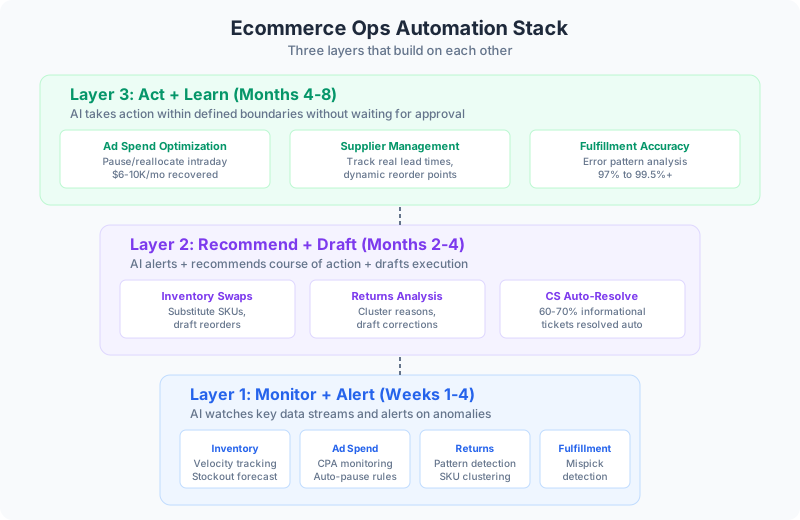
Layer 1: Monitor and Alert (The Foundation)
Before AI can act on your behalf, it needs to watch. This is the simplest layer — AI agents monitoring your key data streams and alerting when something needs attention.
- Inventory velocity tracking — not just “you’re low on stock” but “at current velocity, SKU-2847 stocks out in 4 days, and your supplier’s actual lead time is 12 days”
- Ad spend monitoring — pause keyword groups when CPA exceeds your threshold, flag campaigns where performance shifted overnight
- Returns pattern detection — cluster return reasons by SKU, supplier, and time period to identify emerging problems before they compound
- Fulfillment accuracy tracking — catch mispick patterns by warehouse station, shift, and SKU similarity
This layer alone eliminates the morning firefighting. Instead of fourteen alerts you discover reactively, you get a briefing of what happened overnight and what needs your decision.
👉 Tip: Start here, even if you want to go further. The monitoring layer generates the data and trust you need for the action layers. Skip it and you’ll never trust the system to act on its own.
Layer 2: Recommend and Draft (The Intelligence Layer)
Once the monitoring is running, the next layer adds reasoning. The AI doesn’t just alert — it recommends a course of action and drafts the execution.
Inventory example: The agent detects that SKU-2847 will stock out before the supplier can deliver. It identifies two substitute SKUs with adequate stock, drafts a merchandising swap for the primary listing, and queues a reorder at the contracted price. You review and approve instead of building the solution from scratch.
Returns example: Returns hit 11% on a specific SKU. The agent clusters return reasons — they’re mostly about sizing. It traces the issue to a supplier change on March 3rd. New supplier’s sizing runs small based on review sentiment analysis. The agent drafts corrective actions: updated listing copy with sizing clarification, a sizing chart revision, and a supplier quality note. You decide which actions to take.
Customer service example: Of your 147 open tickets, 60-70% are informational — where’s my order, how do I return this, can I change my address. The agent resolves the informational tier automatically using tracking data and policy rules. It escalates the 30-40% that need human judgment with full context and suggested responses.
For a brand handling 2,000 tickets per month, this layer recovers 80-120 hours of labor monthly while improving response time from 14 hours to under 20 minutes on the automated tier.
Layer 3: Act and Learn (The Autonomy Layer)
The third layer is where AI agents take action within defined boundaries without waiting for your approval. This is where the compounding advantage really kicks in.
Ad spend optimization: The agent doesn’t just flag underperforming keywords — it pauses them intraday and reallocates budget to high-converting segments in real time. It connects ad spend to actual margin contribution, not just ROAS. And critically, it coordinates ad spend with inventory levels — automatically scaling down spend on SKUs approaching stockout.
Over 90 days, an agent managing $50K/month in ad spend typically recovers $6K-$10K in wasted spend while improving overall conversion efficiency.
Supplier management: The agent tracks actual supplier lead times (not the quoted ones — the real ones), adjusts reorder points dynamically, detects when a supplier’s reliability is degrading before it causes a stockout, and prepares negotiation briefs with performance data for quarterly reviews.
Fulfillment accuracy: The agent analyzes error patterns and identifies SKUs that are frequently confused with each other, recommending bin relocation or visual differentiation. It catches address mismatches and carrier selection errors before shipment. Most operations see accuracy improve from 97-98% to 99.5%+ within 60 days.
👉 Tip: Don’t jump to Layer 3 before you’ve built trust with Layers 1 and 2. The autonomy layer only works when you’ve validated that the AI’s judgment matches yours. Let it recommend for 30 days before you let it act.
Why the Layers Compound
Here’s what happens when these layers run together for six months:
- The inventory agent has learned that your TikTok launches spike demand 3x for 72 hours then settle at 1.4x baseline
- The ad spend agent knows that audiences acquired through influencer campaigns return products at 2.1x the rate of search-acquired customers
- The returns agent connects a supplier change to a quality shift and adjusts inventory projections before the returns even come in
- The customer service agent learns which product categories generate sizing questions and proactively updates listing content
Each agent’s intelligence feeds the others. The ad spend agent reduces spend on SKUs the inventory agent flagged as approaching stockout — not because someone programmed that rule, but because they share context and aligned objectives.
Benefits of the layered approach:
- You build trust incrementally instead of betting everything on autonomous AI from day one
- Each layer generates data that makes the next layer smarter
- You can stop at any layer and still have meaningful ROI
- Your team learns to work with AI gradually instead of all at once
- The system gets smarter every day — a competitor starting the same tools next year starts at zero
The Implementation Timeline
Phase 1 — Foundation (Weeks 1-4): Deploy monitoring on your highest-pain-point function. For most ecommerce brands, that’s inventory forecasting or customer service. Establish human review loops. Set baseline metrics. Build your knowledge base with product data, policies, and the tribal knowledge that currently lives in people’s heads.
Phase 2 — Coordination (Months 2-4): Add the intelligence layer. Connect inventory to ad spend. Connect returns to product quality. Connect customer service to fulfillment. Let them share context. Implement decision traces so you can audit what each agent did and why.
Phase 3 — Intelligence (Months 4-8): Enable the autonomy layer where trust has been established. Let compounding intelligence develop. Measure not just individual function improvements but system-level metrics: overall margin contribution, customer lifetime value, and cash conversion cycle.
Three Questions for Your Next Ops Meeting
-
How much of your team’s week is invisible work? Time spent on inventory reconciliation, return processing, ticket triage, bid adjustments, and report assembly. That’s your starting line for ROI.
-
What decisions are you making too slowly? The stockout you caught Tuesday was predictable Saturday. The ad spend blowout was visible at midnight. Speed of decision is the primary advantage AI provides.
-
What intelligence walks out the door every time someone quits? Your best buyer knows which suppliers lie about lead times. Your best CS rep knows which products generate complaints. That knowledge should be in a system, not in someone’s head.
Your ecommerce operation generates thousands of signals every day. The framework isn’t complicated — monitor, recommend, then act. The hard part is starting. Everything after that compounds.
Continue reading:
- The 11 AI Primitives — the building blocks that power every layer of the automation stack
- Combo Plays: AI Frameworks — how to combine AI primitives for cross-functional coordination
- Why Smart Businesses Start Manual Before Automating — why the monitoring layer needs to come first
- Mastering the 3 Machines of Business — how to think about the operations machine before automating it
Related AI Articles
What Your Senior Accountants Wish You Knew About AI
Most AI-for-accounting pitches miss the point. Here's what matters and the myths keeping firms from recovering senior capacity.
Read moreThe AEC Firm's Guide to Recovering 30% of Lost Billable Hours
A practical how-to for architecture and engineering firms that want to stop losing billable capacity to proposals, RFIs, spec coordination, and reporting.
Read moreHow a Mid-Size GC Cut Bid Prep Time by 60% Without Adding Estimators
How one general contractor used AI to fix estimating bottlenecks, catch cost overruns weeks earlier, and stop losing tribal knowledge to turnover.
Read moreFinancial Advisors: Double Client Capacity, Same Staff
A guide for advisors and RIAs who want more clients without more staff — by cutting the admin that eats 40% of the week.
Read more