
AI Combo Plays: 6 Ways to Stack Primitives for 10x Results
Single AI tools save time. Stacked primitives change economics. Six combo plays that create compound systems from simple parts.
I’ve seen dozens of companies deploy AI tools in isolation. An extraction tool here, a drafting tool there. Each one saves a little time. None of them changes the economics of anything.
The teams getting disproportionate results aren’t using better tools — they’re connecting them. They take the output of one AI primitive and feed it directly into the input of another. The combination produces something neither creates alone.
A single AI primitive is a capability. Two or three stacked together become a system — and systems compound in ways individual tools never will.If you’re familiar with the 11 AI primitives, you know the building blocks. This article is about what happens when you wire them together.
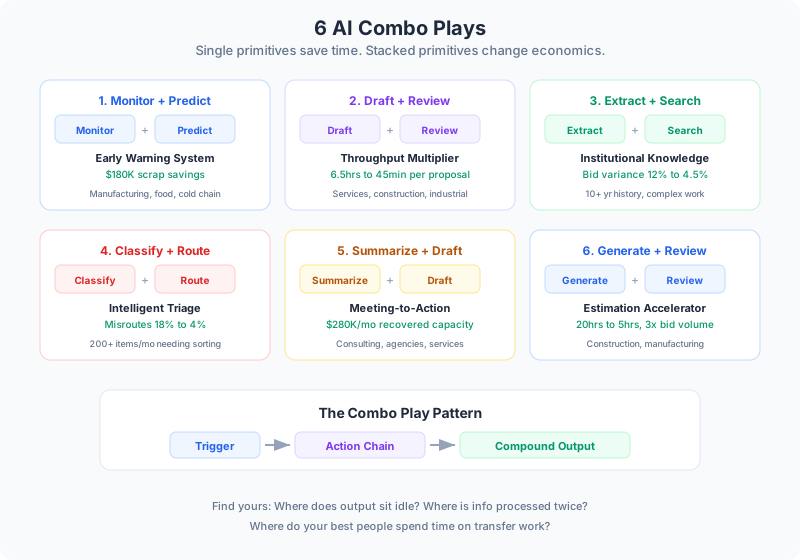
What Makes a Combo Play
Every Combo Play has three components:
- Trigger: The event or data that kicks off the sequence
- Action chain: Two or three primitives connected output-to-input
- Output: A result materially better than either primitive alone — faster, more accurate, or entirely new
The key distinction: this isn’t just using two AI tools in the same department. It’s designing the connection so the combination creates value that didn’t exist before.
1. Monitor + Predict = Early Warning System
The primitives: Monitor watches real-time data for patterns. Predict forecasts future states from what it sees.
How it works: The monitor watches incoming data for deviations — not failures, but drifts. When it detects one, it packages the anomaly data and feeds it to a prediction model. The predictor compares against historical patterns and forecasts the probability of downstream failure.
The output: Alerts that say “this pattern has an 83% chance of causing a quality failure within 72 hours” — not just “something looks off.”
What this looks like in practice
A $45M food manufacturer was catching quality issues at final inspection — after the batch was already produced. They deployed sensors on three lines monitoring temperature, humidity, and mixing speed.
The monitor alone generated too many alerts. Most deviations self-corrected. But when they connected it to a prediction model trained on 14 months of quality data, the system learned which patterns actually preceded failures. False alerts dropped 70%. They caught 23 quality issues before they became defective batches in six months. Estimated savings: $180K in scrap, rework, and customer credits.
Best for: Manufacturing, food production, cold chain distribution — any operation with equipment that degrades gradually. If you already have monitoring and you’re drowning in alerts, adding prediction is the move.
2. Draft + Review = Throughput Multiplier
The primitives: Draft generates a first version. Review evaluates against criteria and flags issues.
How it works: The drafting primitive pulls from templates, historical examples, and deal-specific data to generate a complete first draft. That draft goes directly to a review primitive that checks against your quality standards — correct pricing, consistent terms, required sections, compliance language.
The output: A near-final document in minutes, with quality issues already caught before a human touches it.
What this looks like in practice
A $32M industrial services company spent 6.5 hours per proposal. After deploying Draft + Review:
- Proposal time dropped from 6.5 hours to 45 minutes of human review
- Errors dropped 60%
- 40% more proposals per month with the same team
- Win rate held steady — AI proposals were indistinguishable from hand-crafted
👉 Tip: Start with your highest-volume document type. Proposals, quotes, and inspection reports are usually the best candidates — high volume, structured format, and currently eating senior people’s time.
Best for: Professional services, construction, industrial services. The higher the volume and more standardized the structure, the bigger the impact.
3. Extract + Search = Institutional Knowledge System
The primitives: Extract pulls structured data from unstructured sources. Search finds relevant information via natural language queries.
How it works: Extraction processes your document archive — past project files, specs, maintenance records, client comms — and creates structured, searchable data. The search primitive lets anyone query it naturally: “What was the torque spec on the Model 7 installation for Acme in 2023?”
The output: Answers that previously required calling the one person who remembered — or digging through file cabinets for an hour.
What this looks like in practice
A $60M mechanical contractor had 18 years of project files locked in PDFs, scanned documents, and email threads. When the lead estimator retired, they lost the human search engine.
They processed 140,000 documents over three months, then layered search on top. The estimating team could query past projects by equipment type, building type, region, and scope. Bid-to-actual cost variance dropped from 12% to 4.5%. On $800K average projects, that’s the difference between making money and losing money on tight-margin jobs.
Best for: Any company with 10+ years of operational history, significant turnover, or complex work where past experience informs current decisions. Anywhere “the person who knows” is a single point of failure.
4. Classify + Route = Intelligent Triage
The primitives: Classify assigns categories based on content, urgency, and characteristics. Route directs items to the right handler.
How it works: Classification reads incoming items and assigns multiple labels — category, urgency, complexity. Routing applies your business rules: urgent billing issues go to senior AR, simple technical questions go to the auto-responder, complex issues go to engineering with account history attached.
The output: Incoming work arrives pre-sorted, pre-prioritized, and directed to the right handler with context. No human triage step.
What this looks like in practice
A $25M IT managed services provider handling 800+ tickets per month:
- Manual triage: 4 minutes per ticket, 18% misroute rate
- After Classify + Route: 73% of tickets fully automated, 27% flagged for human triage
- Misroute rate dropped from 18% to 4%
- Average resolution time decreased 35%
- The former dispatcher got redeployed to client account management
Best for: Any business with 200+ incoming items per month needing sorting — support desks, intake processes, claims, order management with exceptions.
5. Summarize + Draft = Meeting-to-Action Pipeline
The primitives: Summarize condenses unstructured content into key points. Draft generates structured documents from those points.
How it works: Summarize processes a meeting transcript — extracting decisions, commitments, deadlines, and risks. That structured summary feeds the drafting primitive, which generates meeting notes, action items with owners, follow-up emails, and updated status reports.
The output: Within minutes of a meeting ending, every attendee has structured notes, every action item has an owner, and follow-ups are drafted.
What this looks like in practice
A $38M consulting firm tracked partner time on post-meeting admin: 45 minutes per client meeting, 12 meetings per week firm-wide. That’s 540 partner-hours per month billed at $0.
After Summarize + Draft, post-meeting time dropped from 45 minutes to 8 minutes of review. Roughly 400 hours of senior capacity freed per month. Half converted to billable work — about $280K/month in recovered revenue capacity.
👉 Tip: If your highest-paid people spend more than 20% of their meeting time on follow-up documentation, this combo play likely pays for itself in 60 days.
Best for: Professional services, consulting, agencies — any business where senior people generate significant admin after every client interaction.
6. Generate + Review = Estimation Accelerator
The primitives: Generate creates estimates or quotes from parameters and historical data. Review checks against standards and historical norms.
How it works: Generation takes scope inputs and builds a complete estimate from historical costs, current material pricing, labor rates, and standard durations. Review checks the output — are costs in line with similar projects? Any anomalies? Commonly forgotten items missing?
The output: A complete, sanity-checked estimate that arrives 80% finished, with errors caught before a human reviews it.
What this looks like in practice
A $50M general contractor spending 20+ hours per major bid. Their estimators were systematically under-estimating concrete and electrical rough-in by 8-15%.
After Generate + Review: estimating time dropped from 20 hours to 5 hours per bid. They could submit 3x the bids per month. The review AI caught the under-estimation pattern immediately from historical data. Bid accuracy improved from 88% to 96% — meaning fewer margin surprises on won projects.
Best for: Construction, industrial services, custom manufacturing. Impact scales with complexity. If your estimating team is a bottleneck limiting bid volume, this directly increases revenue capacity.
Finding Your Own Combo Plays
These six are templates. The principle behind all of them: when the output of one primitive becomes the input of another, the combination creates value neither achieves alone.
Three questions to find yours:
- Where does output sit idle? If an AI system generates data and a human manually carries it to the next step, that’s a connection waiting to be made.
- Where does the same information get processed twice? That’s a candidate for an extract or classify primitive that does it once and routes to both consumers.
- Where do your best people spend time on transfer work? Moving information between formats, systems, or people. Every hour eliminated is expert capacity recovered.
Benefits of thinking in combo plays rather than individual tools:
- You design systems, not point solutions
- Each connection makes the next one easier — you’ve solved data flow and change management patterns
- Compound value: monitoring data improves prediction, classification improves routing, extraction makes search more accurate over time
- You build operational infrastructure that survives tool changes — the architecture matters more than any single vendor
The operators who build the best combo plays aren’t the most technically sophisticated. They’re the ones who understand their operations deeply enough to see where connections should exist.
Start with one combo. Measure the result. Build the next connection.
Continue reading:
- The 11 Things AI Actually Does for Business (A Reference for Operators) — the building blocks you’ll stack
- How to Implement AI Without Wasting Six Figures on the Wrong Vendor — the broader implementation framework
- Stop Talking to AI Like It’s a Person — Start Compiling Your Expertise — why architecture beats prompts at scale
Related AI Articles
Which of These 4 AI Adoption Profiles Is Holding Your Company Back?
Most companies stall at the same AI adoption stage. A framework for finding where you are, why you're stuck, and what actually moves you forward.
Read moreThe AEC Firm's Guide to Recovering 30% of Lost Billable Hours
A practical how-to for architecture and engineering firms that want to stop losing billable capacity to proposals, RFIs, spec coordination, and reporting.
Read moreThe Real Money in Your Dental Practice Isn't in the Chair
Most dental AI marketing focuses on imaging and diagnostics. That's not what's killing your margins. Here's what is — and how to fix it.
Read moreFinancial Advisors: Double Client Capacity, Same Staff
A guide for advisors and RIAs who want more clients without more staff — by cutting the admin that eats 40% of the week.
Read more