
The 11 Things AI Actually Does for Business (A Reference for Operators)
Strip away the hype. AI does exactly 11 things for business — here's what they are, what they replace, and what they're worth. A reference guide for operators.
A $12M logistics company spent $85,000 on an AI vendor last year. They wanted “AI for operations.” What they got was a chatbot that answered employee questions about PTO policy.
The problem wasn’t the vendor. It was the question. “What can AI do for us?” is too vague — it’s like asking “what can electricity do for us?” You’d get lightbulbs, not refrigeration, computing, or MRI machines.
Here’s what I tell every operator I work with: AI isn’t one thing. It’s a set of discrete capabilities — primitives — that combine to solve different operational problems. There are eleven of them. Every AI application you’ve ever seen is built from some combination of these eleven.
Once you know the 11 primitives, you can look at any process in your business and see exactly where AI fits, what it replaces, and what it’s worth.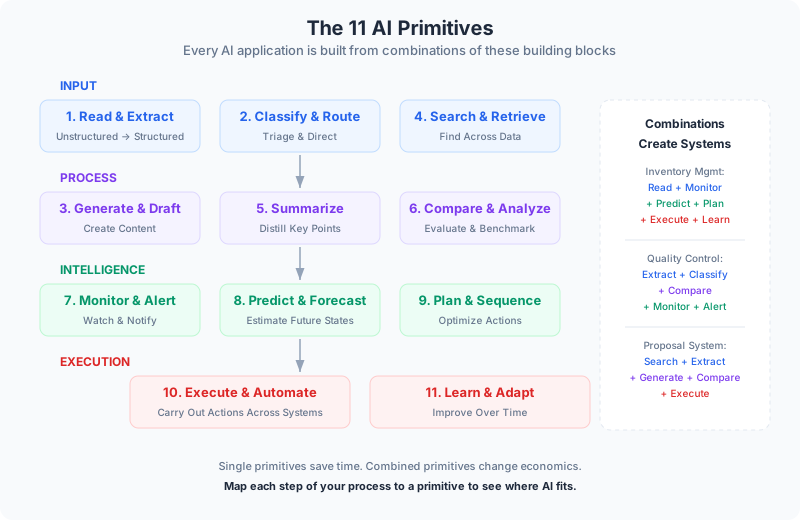
1. Read & Extract
What it does: Takes unstructured input — documents, emails, images, PDFs, handwritten forms — and pulls out structured data.
What it replaces: Manual data entry. The person who opens every invoice and types line items into accounting. The person reviewing contracts for key dates. The person entering email information into the CRM.
What it’s worth: A property management company receiving 300+ maintenance requests per month across email, voicemail, portal, and handwritten notes. Human processing: 8 minutes per request = 40 hours/month of skilled labor doing data entry. AI processing: seconds per request, 2 hours/month of edge-case review. At $28/hour loaded: $10,640/year recovered from one process.
2. Classify & Route
What it does: Takes an input and assigns it to the right category, priority, person, or workflow.
What it replaces: The triage step in every process — someone looks at the incoming item, decides what it is, and sends it to the right place.
What it’s worth: A B2B distributor with 200+ daily inquiries and three people triaging. 15% misroute rate adding 4 hours average to resolution. AI classification hits 95%+ accuracy, drops misroutes to under 3%, and three FTEs get redeployed from sorting to resolving.
3. Generate & Draft
What it does: Creates new content — text, responses, documents, reports — based on context, templates, and instructions.
What it replaces: First drafts. Every time someone writes something that follows a pattern they’ve written a hundred times before.
What it’s worth: An environmental services company writing 25-30 site assessment reports per month. Senior scientist: 3-4 hours per initial draft. AI generates the draft in minutes — lab results, template sections, narrative summaries, regulatory citations. Turnaround drops from 5 days to 2. Output increases 40%.
4. Search & Retrieve
What it does: Finds specific information across large, unstructured data sets. Not keyword matching — understanding what you’re looking for.
What it replaces: “Ask Janet, she knows where that is.” The 20 minutes searching shared drives. Tribal knowledge about which folder has the latest pricing sheet.
What it’s worth: A commercial GC with 15 years of project files across three storage systems. “Show me school renovations $2-5M, last five years, steel framing” returns cost data, change order history, and lessons learned in seconds. Estimating prep drops 60%.
5. Summarize & Condense
What it does: Distills large volumes of information into key points, trends, or decisions that matter.
What it replaces: The 40-page report nobody reads. The weekly status update that takes two hours to compile. Every time a senior person says “just give me the bottom line.”
What it’s worth: A PE-backed healthcare platform with 11 clinics reporting weekly metrics — roughly 80 pages total. VP of Operations reads them every Monday to identify which clinics need attention. AI summarizes all 11 into a two-page brief. Reading time drops from 3 hours to 15 minutes. Problems get caught faster.
6. Compare & Analyze
What it does: Evaluates multiple inputs against each other or against a standard — finding discrepancies, patterns, or optimal choices.
What it replaces: Spreadsheet analysis. Manual comparison of bids, invoices against contracts, actual vs. budget.
What it’s worth: A food service distributor renegotiating 40+ supplier contracts annually. AI compares new terms against existing contracts, flags every change, benchmarks against purchase history, calculates net impact. The company caught $47,000 in unfavorable term changes in the first cycle that would’ve been missed manually.
7. Monitor & Alert
What it does: Continuously watches data streams and notifies the right person when something deviates from expected parameters.
What it replaces: Manual checking. The plant walk-through. The daily login to check system status. Every process depending on a human remembering to look.
What it’s worth: A multi-location HVAC company managing 200+ commercial service contracts. AI monitors every open ticket, dispatch, and equipment sensor in real time. SLA breach rate drops from 8% to under 2%. Two contracts ($180,000 annual revenue) retained that were at risk.
8. Predict & Forecast
What it does: Uses historical patterns and current conditions to estimate what happens next.
What it replaces: Gut-feel forecasting. “I think we’ll be busy next month.” The spreadsheet that takes last year’s numbers and adds 5%.
What it’s worth: A regional staffing agency placing 400+ temp workers per week. AI incorporates client schedules, employment trends, weather patterns, and leading indicators. Accuracy improves from plus or minus 25% to plus or minus 8%. Over-recruitment costs drop $12,000/month.
9. Plan & Sequence
What it does: Takes a goal, constraints, and available resources — produces an optimized sequence of actions.
What it replaces: Manual scheduling, routing, project planning. Anytime someone juggles competing priorities to figure out the best order.
What it’s worth: A commercial cleaning company with 85 accounts and 12 crews. AI optimizes routes and crew assignments simultaneously. Weekly scheduling drops from 6 hours to 30 minutes. Drive time decreases 18%. Annual fuel savings: $23,000.
10. Execute & Automate
What it does: Carries out defined actions across systems — sending emails, creating records, updating databases, triggering workflows.
What it replaces: The human middleware. The person whose job is taking output from one system and entering it into another.
What it’s worth: A mid-market insurance agency processing 150+ policy renewals per month. AI handles the mechanical steps: pulling data, generating documents, tracking responses, updating systems. Account manager role shrinks from 45 minutes of processing to 10 minutes of relationship. Administrative time drops 60%.
11. Learn & Adapt
What it does: Improves its own performance over time based on outcomes, feedback, and new data.
What it replaces: Static systems. Software that works exactly the same on day one and day one thousand.
What it’s worth: A regional auto parts distributor using AI to forecast demand across 8 locations. Month one accuracy: 78%. Month six: 91%. The AI learned that Location 3’s demand correlates with a nearby fleet maintenance company’s schedule. Location 7’s SKUs are seasonal to a boat repair cluster. Carrying cost decreases $140,000 annually. A competitor buying the same software starts at 78% with no shortcut to 91%.
How the Primitives Combine
No real-world AI application uses just one primitive. An inventory management system might use Read & Extract (processing POs), Monitor & Alert (watching stock levels), Predict & Forecast (demand planning), Compare & Analyze (vendor evaluation), Plan & Sequence (reorder optimization), Execute & Automate (placing orders), and Learn & Adapt (improving over time).
👉 Tip: When evaluating an AI opportunity, map each step of the human process to a primitive. Reading? Classifying? Generating? Comparing? This tells you exactly which capabilities you need — and which vendor claims to ignore.
The Primitive Most Companies Miss
Most businesses start with Generate & Draft and Search & Retrieve. Those are valuable but table stakes — every competitor has the same capability.
The operators building durable advantage combine primitives into systems: Monitor feeding Predict feeding Plan feeding Execute, with Learn improving every layer. That’s not a chatbot. That’s an operational intelligence layer that compounds.
👉 Tip: Don’t start with the sexiest primitive. Start with the one mapped to your most expensive manual process. The boring automation that saves $140K/year beats the impressive demo that saves nothing.
Benefits of thinking in primitives rather than tools:
- You evaluate vendors against specific capabilities, not marketing claims
- You see exactly where AI fits in your existing workflows
- You can calculate ROI before buying anything
- You avoid overpaying for capabilities you don’t need
- You build a technology-agnostic roadmap that survives vendor changes
The eleven primitives don’t change. But how you combine them — which processes, what sequence, what data, how long you let them learn — that’s where the advantage lives.
Continue reading:
- AI Combo Plays: 6 Ways to Stack Primitives for 10x Results — what happens when you wire primitives together
- How to Implement AI Without Wasting Six Figures on the Wrong Vendor — the implementation framework built on primitives
- AI for Small Business Operations — primitives applied to smaller companies
- Mastering the 3 Machines of Business — the operational framework AI plugs into
Related AI Articles
The 12-Month AI Roadmap: From First Agent to Compounding Intelligence
A phased AI implementation roadmap for $5-500M companies — from first agent to compounding intelligence in 12 months. No 50-slide strategy decks.
Read moreHow to Implement AI Without Wasting Six Figures on the Wrong Vendor
A practical framework for implementing AI — start with your P&L, not a vendor pitch deck. Discovery questions, scoring, and a 90-day playbook.
Read moreWhat Your Senior Accountants Wish You Knew About AI
Most AI-for-accounting pitches miss the point. Here's what matters and the myths keeping firms from recovering senior capacity.
Read moreThe AEC Firm's Guide to Recovering 30% of Lost Billable Hours
A practical how-to for architecture and engineering firms that want to stop losing billable capacity to proposals, RFIs, spec coordination, and reporting.
Read more