
Your Hotel's RevPAR Problem Isn't Pricing — It's Operations
Most hotel operators obsess over rate strategy while operational waste silently eats their margins. Here's where the real RevPAR gains are hiding.
Every hotel GM I talk to wants to talk about rate strategy. Should we be more aggressive on OTAs? Is our comp set right? Are we leaving money on the table with our weekend pricing?
Those are fine questions. But they’re usually not the real problem.
I’ve walked through enough hotel operations to know that most independent properties are bleeding margin through operational inefficiency — not bad pricing. Your front desk team answers the same 15 questions 200 times a day. Your housekeeping coordinator spends 90 minutes every morning on a room assignment puzzle that changes by noon. Your maintenance team lives in permanent reactive mode. And your “revenue manager” is also your GM, who last touched rate strategy six weeks ago.
The biggest RevPAR gains for independent hotels aren’t in pricing algorithms — they’re in eliminating the operational drag that prevents your team from doing high-value work.The Problem: Death by a Thousand Repetitive Tasks
Let’s look at a 120-room boutique hotel running 68% average occupancy. That’s 38 empty rooms per night at $149 ADR — $5,662 in perishable inventory evaporating every 24 hours.
The GM knows this. She also knows her labor sits at 33-45% of total revenue and that every hour of staff time spent on repetitive, low-value work is an hour not spent on guest experience, upselling, or operational improvement.
Here’s where the time actually goes:
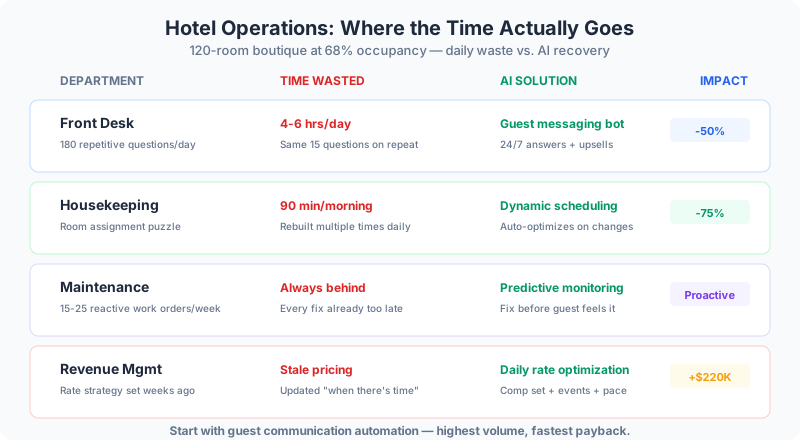
Front desk: 60-80% of guest interactions are the same 12-15 questions on repeat. WiFi password. Checkout time. Parking location. Breakfast hours. Late checkout. Each takes 45-90 seconds in person, 2-3 minutes by phone. At 180 of these daily, that’s 4-6 hours of labor on questions with identical answers every single time.
Housekeeping: The morning room assignment puzzle — checkout rooms, stayovers, late checkouts, early check-in priorities, deep cleans, maintenance holds — takes 60-90 minutes to build. Then it changes throughout the day and needs rebuilding.
Maintenance: 15-25 work orders weekly from guest complaints alone, all handled reactively. The tech is always behind because every fix was already too late when it was reported.
Revenue management: Rate strategy updated “when there’s time” — which means it’s stale, set weeks ago under conditions that no longer apply.
The Solution: AI for Each Operational Bottleneck
Guest Communication Automation
A guest texts asking about checkout time. The response is immediate: “Checkout is 11:00 AM. Late checkout until 1:00 PM is available for $25, subject to availability. Want me to set that up?”
No front desk agent involved. No hold time. The system pulls from a property-specific knowledge base covering your top 20 questions and handles them instantly.
Benefits of automated guest messaging:
- 40-60% reduction in front desk call volume
- Consistent, accurate answers 24/7
- Staff redirected from reciting WiFi passwords to solving real guest problems
- Lower front desk turnover (the job becomes less mind-numbing)
That last point matters more than people think. Front desk turnover runs 70-80% annually — partly because answering the same questions 200 times a day is soul-crushing work.
👉 Tip: Build your knowledge base by tracking every front desk question for one week. You’ll find 12-15 questions covering 80% of volume. Start there — don’t try to automate everything at once.
Housekeeping Intelligence
Instead of a coordinator spending 90 minutes building assignments from scratch, AI builds initial assignments in minutes using PMS data plus historical cleaning times, checkout patterns, and housekeeper performance by floor.
When a guest requests early check-in at noon, the system re-optimizes without disrupting the rest of the schedule. The coordinator approves a change instead of rebuilding the entire puzzle.
Bonus: amenity restocking triggers based on consumption patterns. Room 412 is a five-night business traveler using two coffee pods daily and requesting extra towels. The restocking list generates before housekeeping enters. No return trips.
Predictive Maintenance
Here’s where the real money hides. Reactive maintenance on a sold room costs room revenue plus repair. Preventive maintenance on a vacant room during slow season costs just the repair.
AI watches HVAC performance data — compressor cycling, temperature differential, refrigerant pressure. An AC unit losing efficiency shows it in data before the guest feels it. The PTAC units on the fourth floor are 11 years old, three of twelve replaced in the last 18 months. Units 403 and 409 are next based on the pattern. Schedule replacement in January instead of emergency replacement in peak July.
👉 Tip: Start with a simple maintenance log in a structured format — equipment ID, location, issue, resolution, parts used. Even six months of clean data gives AI enough to start identifying failure patterns.
Revenue Management That Actually Happens
A 120-room independent competing against branded properties with dedicated revenue management teams needs AI just to level the playing field. The branded property adjusts rates daily based on booking pace, comp set pricing, local events, and demand forecasts. Your GM checks competitor rates on OTAs “when she has time.”
AI-driven revenue management watches competitive pricing, local events, historical demand, and booking pace — then produces recommended rates for each room type, each night, updated daily. The GM reviews and approves instead of building the analysis.
Impact: 3-8% RevPAR improvement. On a 120-room hotel at $149 ADR and 68% occupancy, a 5% improvement is roughly $220,000 in additional annual revenue. Same rooms. Same staff. Better pricing — because someone is actually managing it daily.
The Fix Nobody Talks About: F&B Waste
A hotel restaurant that preps for 120 covers and serves 45 just threw away food. At $800K in annual F&B revenue with 32% food cost, overproduction waste alone runs $12,800-$38,400 per year.
AI synthesizes occupancy by guest segment, day of week, local events, weather, and historical covers to produce accurate prep numbers. Tuesday dinner with 78 occupied rooms, 60% business segment, no events, and a 22% historical in-house dining rate means prep for 52 covers, not 120.
Small savings per meal period compound across 365 days.
Where to Start
The highest-leverage starting point is guest communication automation. It’s the highest volume of repetitive interactions, the fastest to implement, and the most immediate impact on both labor costs and satisfaction scores.
Implementation sequence:
- Build a knowledge base of your 20 most-asked questions
- Connect to an AI-assisted messaging channel
- Measure front desk call volume after 30 days
- Add revenue management intelligence — even simple daily rate recommendations
The 120-room independent that figures this out competes with branded properties that have corporate infrastructure and dedicated revenue teams. Not by matching their resources — by matching their operational precision with a fraction of the overhead.
Continue reading:
Related AI Articles
7 Places AI Saves Money in a Dealership (Not the Pitch)
Forget the chatbot demos. Here are the seven areas where AI produces measurable ROI in auto dealerships — from the service lane to the used car lot.
Read moreFirst-Call Resolution Is Killing Field Service Margins
Every failed first visit costs $250. For a 20-tech operation, that's $100K/month in lost margin. Here's the operational fix.
Read moreWhy Franchises Are the Perfect AI Starting Point (And Most Don't Know It)
Franchises have what every AI project needs: standardized processes. Most multi-unit operators are sitting on an AI gold mine.
Read moreHow One Regional Agency Cut Claims Processing Time in Half Without Hiring
How a 40-person regional agency used AI to transform claims throughput and adjuster capacity — without adding headcount.
Read more