
What Most Supply Chain Leaders Get Wrong About AI
Supply chain AI isn't about demand forecasting first. It's about PO exceptions, supplier risk, and clean data — in that order. Here's what actually works.
I keep seeing supply chain leaders make the same mistake: they hear “AI” and immediately think demand forecasting. It’s the sexiest use case, it’s the one the vendors demo, and it’s almost always the wrong place to start.
A $90M industrial distributor I worked with had 14 buyers, 3,200 SKUs, 6 warehouses, and 8 years of ERP history. Also: $4.2M in excess inventory, a 6.8% stockout rate on their top 200 SKUs, and 31 hours per week spent on PO exceptions that buyers fixed manually, one at a time.
The data existed. The decisions were still gut-feel. And the instinct was to start with forecasting — the use case that requires the cleanest data and the longest feedback loop.
The biggest myth in supply chain AI: you need to start with demand forecasting. In reality, it should be your third deployment, not your first.Myth 1: “Start with Demand Forecasting”
Everyone wants this one first. The vendors love demoing it. But demand forecasting requires clean item master data, 18+ months of historical purchase orders, and a planning team willing to trust a model over their own judgment.
That last part is the killer. If your first AI experience is the most complex, longest-feedback-loop system — and it takes six months before the model outperforms your spreadsheet — you’ve burned organizational trust before you’ve built it.
What to do instead: Start with PO exception handling. It’s the single highest-ROI starting point for most supply chain teams. Every supply chain runs on POs, and 12-18% have problems — price doesn’t match contract, quantity doesn’t match requisition, ship date changed. Each exception takes a buyer 15-30 minutes to research and resolve.
AI reads the incoming confirmation, compares every field against the original PO and contract, categorizes exceptions by type and severity, and drafts the resolution. One building materials distributor cut exception resolution from 22 minutes to 6 minutes. Buyers recovered 18 hours per week. That’s $142K in labor reallocation plus $67K in caught pricing errors that would have flowed through to AP unnoticed.
Myth 2: “You Need Perfect Data Before Starting”
This one has delayed more implementations than any technology limitation. Yes, AI needs data. No, it doesn’t need perfect data.
What you actually need:
- Clean item master data — every SKU with accurate descriptions, UOMs, vendor assignments, lead times, and category codes. If 20% of SKUs have missing lead times, forecasting produces garbage. Cleanup typically takes 4-8 weeks.
- Historical PO data — at least 18 months, ideally 3+ years. Dates, quantities, prices, promised vs. actual delivery.
- Actual lead time history — not the item master lead time, but the real gap between PO date and receipt date. Your master says “14 days” but actuals range 9-38.
- Customer order history — dates, quantities, items, ship-to locations.
Here’s the thing: if your data isn’t clean, you don’t delay AI — you start with AI on PO exceptions, which itself generates clean data that feeds everything downstream.
👉 Tip: Don’t let “our data isn’t ready” be the reason you wait another quarter. Start with the use case that cleans your data as a byproduct. PO exception handling does exactly this.
Myth 3: “AI Replaces Experienced Supply Chain People”
It doesn’t. Not even close. AI can score supplier performance and flag risks. It can’t build the relationship that gets you priority allocation during a shortage. When capacity is limited, suppliers prioritize the customer they trust and the buyer they’ve worked with for 15 years.
Same with contract negotiation. AI can analyze contracts, compare against benchmarks, and arm your buyers with better data than they’ve ever had. But reading the room, knowing when to push, building a deal that works for both sides — that’s judgment work.
And when a port closes or a supplier’s factory burns down, AI can model scenarios and calculate response costs. But the decision to airfreight at 4x cost versus telling the customer to wait depends on relationship value, strategic positioning, and risk tolerance that don’t reduce to data.
What AI actually does: It processes data at a scale and speed experienced people can’t, surfaces patterns they’d miss, and frees them for the judgment calls that actually require experience.
Myth 4: “You Can Deploy Capabilities in Any Order”
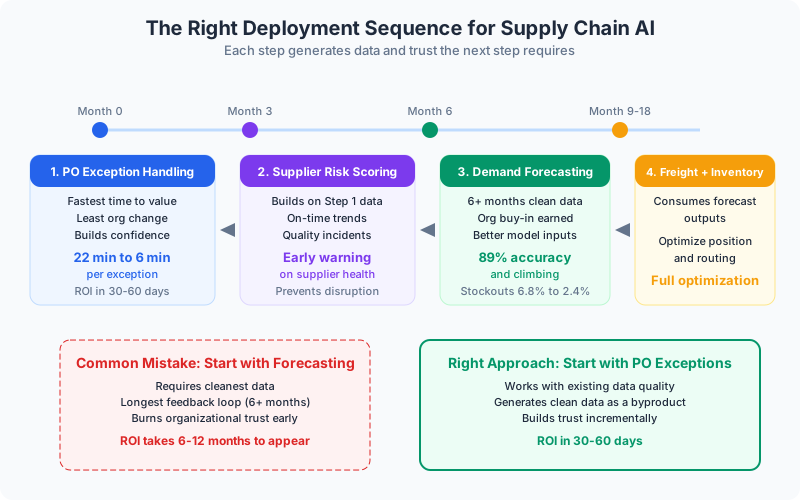
Sequence matters because each step generates data and trust that the next step requires.
The right sequence:
- PO Exception Handling (months 1-3) — Fastest time to value. Least organizational change. Builds confidence, produces immediate ROI, generates clean data.
- Supplier Risk Scoring (months 3-6) — Builds on exception data from Step 1. Monitors on-time delivery trends, quality incidents, lead time variability, and financial health. One food manufacturer caught a tier-1 supplier’s deteriorating finances three months before Chapter 11.
- Demand Forecasting (months 6-12) — By now you have 6+ months of clean operational data. The model starts with better inputs. And you have organizational buy-in from two successful deployments.
- Freight Optimization and Inventory Positioning (months 9-18) — These consume forecasting outputs. Deploy in parallel if you have bandwidth.
Benefits of following this sequence:
- Each deployment generates training data for the next one
- You build organizational trust incrementally — small wins before big bets
- Your most complex deployment (forecasting) starts with the cleanest data
- ROI shows up in 30-60 days, not 6-12 months
- The planning team has seen AI work before they’re asked to trust a forecast model
👉 Tip: If you want to know where AI fits in your specific supply chain, start by mapping PO exceptions for one week. Count them, categorize them, time them. That exercise alone usually justifies the first deployment.
What Compounding Looks Like
The $90M distributor I mentioned? Fourteen months in:
- Excess inventory down $2.1M
- Top 200 SKU stockouts: 6.8% to 2.4%
- Buyer exception hours: 31/week to 9/week
- Demand forecast accuracy: 89% and climbing
They didn’t buy “AI for supply chain.” They deployed specific capabilities in a specific sequence, on clean-enough data, with clear metrics. And every month their systems run, they learn patterns no general-purpose tool can approximate — their specific supplier behaviors, seasonal demand, exception types, and carrier performance by lane.
A competitor deploying the same technology eighteen months later starts at zero. That gap doesn’t close by writing a check.
Continue reading:
- The 12-Month AI Roadmap: From First Agent to Compounding Intelligence — The phased plan that applies this sequencing across any operation
- The 5 Discovery Questions for AI — Find the highest-value starting point for your supply chain
- Smart Cost Management for Business Success — Where supply chain savings hit the P&L
- Scaling a Business: Building a System That Grows Sustainably — Why sequence and systems matter more than speed
Related AI Articles
5 Ways AI Cuts Deadhead Miles and Driver Turnover at the Same Time
Trucking margins live and die on loaded miles, driver utilization, and maintenance timing. Here are five specific ways AI moves the needle.
Read moreThe Real Cost of Manual Procurement (And How AI Fixes It)
Manual procurement burns buyer time on data entry while strategic decisions get ignored. Here's what it costs and how AI fixes it.
Read more7 Places AI Saves Money in a Dealership (Not the Pitch)
Forget the chatbot demos. Here are the seven areas where AI produces measurable ROI in auto dealerships — from the service lane to the used car lot.
Read moreFirst-Call Resolution Is Killing Field Service Margins
Every failed first visit costs $250. For a 20-tech operation, that's $100K/month in lost margin. Here's the operational fix.
Read more