
What Mid-Market HR Teams Actually Use AI For (It's Not What LinkedIn Says)
LinkedIn is full of AI hype about replacing recruiters. Here's what mid-market HR teams actually use AI for — and what works.
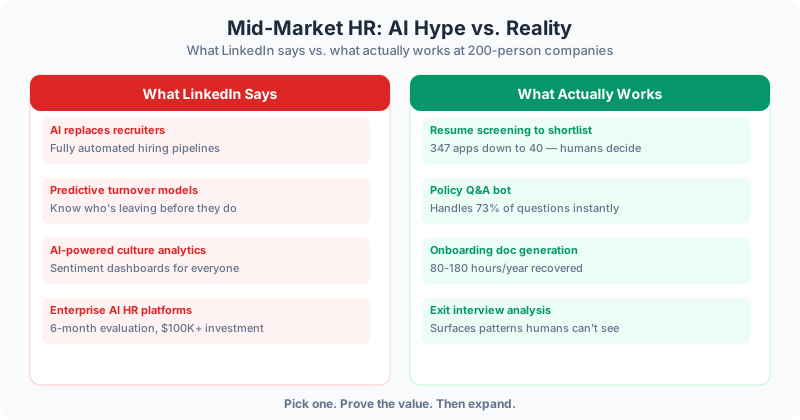
Open LinkedIn and you’d think AI is about to replace every HR professional on the planet. Automated recruiting! AI-powered culture analytics! Predictive turnover models that know your employees are leaving before they do!
Here’s what’s actually happening at 200-person companies: an HR team of two is buried in administrative work, answering the same benefits questions for the 50th time this month, manually assembling onboarding packets, and drowning in 347 resumes for a warehouse supervisor role.
The AI that matters for mid-market HR isn’t sexy. It isn’t on LinkedIn thought leader posts. It’s the boring, unglamorous automation of administrative tasks that are preventing your HR team from doing the work that actually retains and develops people.
Myth #1: AI Is Going to Replace Recruiters
No, it isn’t. Not at your size.
What AI actually does for recruiting at a 200-person company: it reads the 347 applications for your warehouse supervisor role, scores them against specific criteria you define, and gives your recruiter a ranked shortlist of 40-50 candidates with notes on why each scored where they did.
Your recruiter still makes every call, conducts every interview, and makes every hiring recommendation. She just doesn’t spend 20 hours doing first-pass screening on a single role.
The Honest Part About AI Screening
AI resume screening carries real bias risk. Models trained on historical hiring data inherit the biases in that data. If your past hiring skewed toward candidates from certain schools or career paths, AI will reproduce those patterns.
What actually works:
- Use AI for the initial sort, not the final decision. Surface the top 40-60 from 300. Humans review that shortlist.
- Define criteria explicitly. Specific certifications, years of experience, technical skills. Concrete criteria means less room for bias.
- Audit regularly. Run AI screening parallel to human screening for your first 3-5 roles. Compare shortlists.
- Never auto-reject. AI produces a ranked list. A human makes the reject decision.
👉 Tip: Review the AI’s bottom 20% monthly. If you’re systematically missing qualified candidates from certain backgrounds, you have a calibration problem to fix before you rely on it.
Myth #2: You Need an “AI HR Platform” to Get Started
I’ve seen HR teams spend six months evaluating enterprise AI platforms when they could’ve solved their biggest pain point in a week with tools they already have.
The three highest-ROI AI applications for mid-market HR don’t require a new platform:
Policy Q&A Bot
Ask any HR generalist what question they answer most. It’s some variation of “What’s our policy on X?” PTO balances. Bereavement leave. FMLA process. Open enrollment dates.
These questions have definitive answers that exist in documents your employees theoretically have access to. But the documents are scattered across a shared drive, an HRIS portal, a benefits provider’s website, and a handbook PDF last updated eight months ago.
An AI bot trained on your actual handbook, benefits documents, and leave policies answers these instantly with citations to the specific policy document.
Benefits of a policy Q&A bot:
- Handles 70-75% of employee questions without human involvement
- Available 24/7 (not just when HR is at their desk)
- Consistent, accurate answers citing specific documents
- Frees HR for conversations that actually require human judgment
One HR team at a 350-person company reported their bot handled 73% of questions without human involvement. The remaining 27% genuinely required judgment — exactly what HR should spend time on.
Onboarding Document Generation
New hire onboarding involves assembling 15-30 documents: offer letters, NDAs, benefits enrollment, equipment requests, IT access, tax forms, handbook acknowledgments. Most HR teams do this manually — open template, fill in details, save, upload. For a single hire, that’s 45-90 minutes. For three starting Monday, that’s half a day.
AI document generation automates the assembly. Enter new hire information once, generate the complete packet. Every document populated, every state-specific variation selected automatically.
At 40-60 hires per year, that’s 80-180 hours annually — two to four full work weeks — on a task that requires attention but not judgment.
Exit Interview Analysis
Here’s one nobody talks about on LinkedIn. You’re conducting exit interviews, taking notes, filing them. Then doing it again. The patterns are invisible because no individual can hold 20-40 interviews in their head and spot cross-cutting themes.
AI analysis surfaces what humans miss:
- Three of the last five engineering departures mentioned “unclear promotion criteria”
- Employees at 2-3 years tenure are leaving at twice the rate, consistently citing “lack of development”
- “Micromanagement” appears in exit interviews from two specific teams and zero others
That last one gives you a management coaching conversation you can have tomorrow. Without the analysis, you’d never see it.
Myth #3: AI Performance Reviews Will Fix Your Review Process
Your review process isn’t broken because writing takes too long. It’s broken because managers avoid giving honest feedback and the process feels like a checkbox exercise.
That said — AI can help with the writing part. A manager inputs bullet points about each employee’s performance. AI generates a structured first draft following your review format. What took 60 minutes takes 20. Quality improves because editing is easier than blank-page creation.
But the critical boundary: AI drafts, humans finalize. Every word gets reviewed before it goes to the employee. An AI-generated review with inaccuracies is worse than a late review.
👉 Tip: The real fix for your review process is teaching managers to give feedback year-round, not generating better annual review documents. AI helps with the writing, but if the underlying process is broken, faster writing just gives you faster bad reviews. Check out how to run effective 1:1s for the better upstream fix.
Myth #4: “We Need to Start With Something Big”
No you don’t. Start where the time savings are largest and the risk is lowest:
- Policy Q&A if your team spends 10+ hours/month answering routine questions
- Onboarding document generation if you’re hiring 3+ people/month
- Resume screening if you’re drowning in applications — but implement with audit practices
- Exit interview analysis if you have 12+ months of data nobody has reviewed
Pick one. Prove the value. Then expand.
The HR teams I’ve seen succeed with AI aren’t the ones who bought the fanciest platform. They’re the ones who identified their single biggest time sink, automated it, and reinvested those hours into work that actually moves the needle on retention, culture, and employee development.
That’s what AI for HR actually looks like. It’s less impressive than what LinkedIn says, and about ten times more useful.
Continue reading:
Related AI Articles
The Independent Retailer's No-BS Guide to AI
Big-box stores have planning teams. You have a spreadsheet. How independent retailers use AI for inventory, scheduling, and markdowns.
Read moreWhich of These 4 AI Adoption Profiles Is Holding Your Company Back?
Most companies stall at the same AI adoption stage. A framework for finding where you are, why you're stuck, and what actually moves you forward.
Read moreWhat Your Senior Accountants Wish You Knew About AI
Most AI-for-accounting pitches miss the point. Here's what matters and the myths keeping firms from recovering senior capacity.
Read moreThe AEC Firm's Guide to Recovering 30% of Lost Billable Hours
A practical how-to for architecture and engineering firms that want to stop losing billable capacity to proposals, RFIs, spec coordination, and reporting.
Read more