
How to Implement AI Without Wasting Six Figures on the Wrong Vendor
A practical framework for implementing AI — start with your P&L, not a vendor pitch deck. Discovery questions, scoring, and a 90-day playbook.
I’ve watched companies spend $50K-$200K on AI platforms they barely use. The pattern is almost always the same: someone sees a demo, gets excited, buys the tool — then goes looking for a problem. That’s backwards. And it’s expensive.
The right question isn’t “What AI tools should we buy?” The right question is “Where is my business bleeding time and margin, and can AI stop it?”
That distinction is the difference between a six-figure science project and a system that pays for itself in 90 days.
Why Most AI Implementations Fail
Four reasons, in order of how often I see them:
They start with the tool. Vendor does a slick demo. Someone gets excited. Company buys a platform and goes looking for a use case. This is like buying a forklift before you know whether you have a warehouse.
They think too big. “We’ll build an AI-powered digital twin of our entire operation.” No. Not yet. Maybe not ever. Start with one process.
They skip the people problem. The technology works fine. The team doesn’t trust it, doesn’t understand it, and quietly routes around it. Six months later, nobody’s using it.
They have no baseline. If you don’t know how long your current process takes, you can’t measure whether AI made it faster. You’re flying blind and hoping for the best.
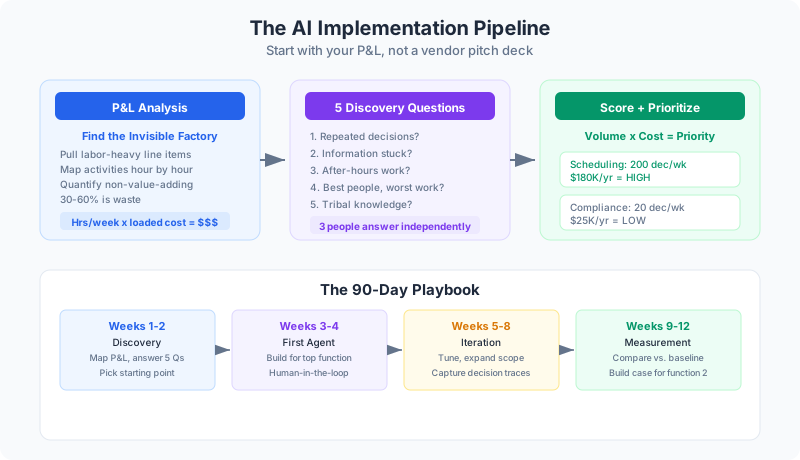
Start With Your P&L
Every line item on your P&L represents a process. Every process has steps. Some of those steps create value. Many don’t.
The non-value-adding steps — data entry, status chasing, report assembly, compliance documentation, scheduling conflicts, invoice reconciliation — are what I call the invisible factory. They consume labor hours that could go toward revenue-generating work.
AI doesn’t replace your business. It replaces the invisible factory — the non-value-adding work hiding inside every department.How to find yours
Pull your P&L. Look at every labor-heavy line item. Ask: what are people actually doing to produce this cost? Not their job title — what they do, hour by hour.
Map the activities. For each cost center, list specific tasks. You’ll find 30-60% is non-value-adding: moving data between systems, chasing approvals, reformatting reports, verifying information that should verify automatically.
Quantify the waste. Hours per week x loaded labor cost = the prize. This exercise takes a day. It’s worth more than any vendor demo.
The 5 Discovery Questions
Before touching technology, answer these five questions. They tell you where to start and what to expect.
1. What decisions do you make repeatedly?
PO approvals, schedule adjustments, quote configurations, customer routing. These follow patterns. A human making the same decision 50 times a day brings inconsistency, fatigue, and bottlenecks. An AI agent brings consistent reasoning at machine speed.
2. Where does information get stuck?
Data trapped in one system, needed in another. Customer calls for order status, rep checks three systems and calls the warehouse. AI agents query multiple sources and synthesize the answer without a human playing telephone.
3. What work happens after hours?
The 11 PM cycle count. The weekend report compilation. The Monday morning fire drill. Work outside normal hours signals your processes can’t keep up at current automation levels.
4. Where do your best people spend time on your worst work?
Your $85/hour engineer reviewing data entry. Your plant manager hand-scheduling production. High-cost people doing low-leverage work is your most expensive problem — and the easiest for AI to solve.
5. What tribal knowledge lives in one person’s head?
If Mike retires, does scheduling knowledge retire with him? If Sarah leaves, does institutional knowledge about your top customer leave too? When AI works alongside experienced operators, that knowledge gets captured as active intelligence — not documentation nobody reads.
👉 Tip: Have three different people answer these questions independently. The overlap reveals your biggest opportunities. The disagreements reveal your blind spots.
Score and Prioritize
For each candidate process, score two things:
- Volume: How many repetitive decisions or transactions per week?
- Cost: What’s the loaded labor cost of the current process?
High volume + high cost = start here. Low volume + low cost = leave it alone.
Example: A $30M manufacturer scores scheduling: 200+ decisions/week, three people at 60% of their time, $180K/year loaded. Their compliance function: 20 decisions/week, one person at 30%, $25K/year. Scheduling scores 10x higher. Start there.
Example: A dental group scores billing: 500+ claims/week, two specialists, 15 hours of denial rework weekly, $140K/year. Supply ordering: 10 orders/week, 3 hours staff time, $8K/year. Billing wins by a mile.
The exercise forces specificity. You stop talking about “AI transformation” and start talking about “reducing $180K in scheduling overhead by 40%.” That’s a conversation your CFO can engage with.
The 90-Day Playbook
Here’s what a real implementation looks like for a $10-50M company:
Weeks 1-2: Discovery. Map your P&L. Answer the 5 questions. Quantify the invisible factory. Score your candidates. Pick your starting point.
Weeks 3-4: First agent. Build one AI agent for your highest-value function. Human-in-the-loop — agent recommends, team approves. Establish baseline metrics.
Weeks 5-8: Iteration. Tune based on real-world performance. Expand scope within the function. Capture decision traces — what was decided and why.
Weeks 9-12: Measurement. Compare against baseline. Calculate time recovered, decision quality improvement, error reduction. Build the case for function two.
By day 90: one function running measurably better, a team that’s seen AI work, and a clear picture of where to go next.
👉 Tip: Start human-in-the-loop. Always. Within 60-90 days, your team will push to give the agent more autonomy, not less. That’s how you know it’s working.
The People Problem Nobody Talks About
Technology is the easy part. People are the hard part. I see four adoption profiles:
- The Oblivious — Don’t see AI as relevant. Don’t lecture them. Demonstrate what “better” looks like in their specific context.
- The Aware but Unactivated — Know AI matters but keep solving problems with more people and hours. Show them the direct connection to cost avoidance.
- The Activated Builders — Get it and are experimenting. Give them tools, structure, and support to scale.
- The Overzealous — High urgency, low grounding. Anchor their energy in real processes and measurable outcomes.
Your job: convert Aware into Activated fast, enable Builders to scale, contain the Overzealous, and systematically lift the Oblivious.
The Compounding Effect
Benefits of starting now vs. waiting:
- Month one: 50 AI-assisted decisions. Month three: 800. Month six: 3,400. Month twelve: 12,000. Each informed by every decision before it.
- You can buy the platform — you can’t buy the accumulated intelligence built on top of it
- Your competitor who starts six months later doesn’t just need the same tools — they need 12,000 decisions to catch up
- By then, you’ve made 25,000 more
Starting matters more than starting perfectly. The gap between companies that adopt AI effectively and companies that don’t isn’t going to narrow. It widens every month.
Pull your P&L. Answer the five questions. Find your invisible factory. Start.
Continue reading:
- The 5 Discovery Questions for AI — deep dive on each question with industry examples
- AI Automation for Small Business: Start Here, Not Where the Vendors Tell You — the simplified version for smaller teams
- AI Adoption Profiles — more on the people problem and how to solve it
- How to Improve EBITDA in a Middle Market Company — the financial lens for AI investments
Related AI Articles
The 12-Month AI Roadmap: From First Agent to Compounding Intelligence
A phased AI implementation roadmap for $5-500M companies — from first agent to compounding intelligence in 12 months. No 50-slide strategy decks.
Read moreThe AEC Firm's Guide to Recovering 30% of Lost Billable Hours
A practical how-to for architecture and engineering firms that want to stop losing billable capacity to proposals, RFIs, spec coordination, and reporting.
Read moreThe Real Money in Your Dental Practice Isn't in the Chair
Most dental AI marketing focuses on imaging and diagnostics. That's not what's killing your margins. Here's what is — and how to fix it.
Read moreFinancial Advisors: Double Client Capacity, Same Staff
A guide for advisors and RIAs who want more clients without more staff — by cutting the admin that eats 40% of the week.
Read more