
5 Ways AI Cuts Deadhead Miles and Driver Turnover at the Same Time
Trucking margins live and die on loaded miles, driver utilization, and maintenance timing. Here are five specific ways AI moves the needle.
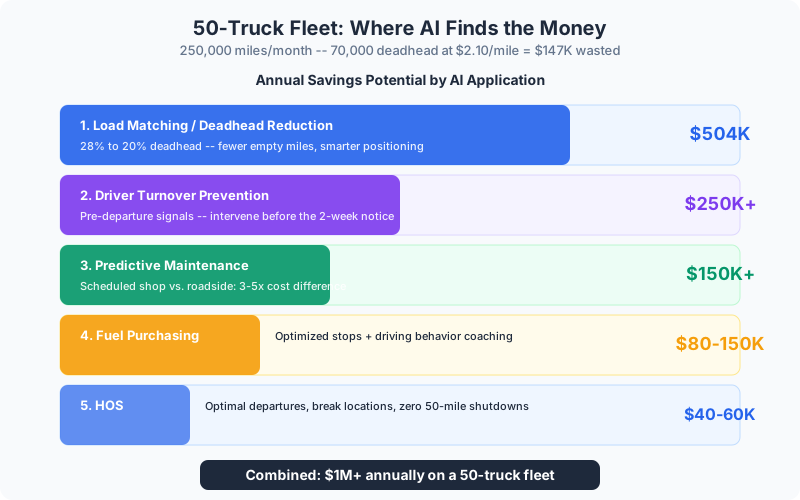
A 50-truck fleet running regional routes generates about 250,000 miles per month. Between 50,000 and 87,000 of those are deadhead — empty trailers burning fuel, wearing tires, consuming HOS hours, and producing zero revenue. At $2.10/mile operating cost, 70,000 deadhead miles per month is $147,000 in costs with nothing to show for it.
Your best dispatcher knows which lanes are one-way traps. She knows Memphis to Little Rock almost never has a profitable backhaul. She knows Friday loads out of Chicago pay well but Monday returns are a coin flip. When she quits, that knowledge walks out the door.
Trucking is a data-rich business that runs on tribal knowledge. AI closes that gap — and the math is straightforward.Here are five specific ways it works.
1. Smarter Load Matching That Sees the Full Picture
A dispatcher evaluating a broker’s load offer makes a calculation: revenue per mile minus operating cost, adjusted for deadhead to reach the origin, backhaul likelihood from the destination, and opportunity cost versus what might post next hour.
Good dispatchers do this intuitively. They know $2.40/mile Dallas to Atlanta looks good until you factor the 180 empty miles to reach Dallas and the weak Atlanta outbound market on Wednesdays.
AI makes this calculation explicit for every load opportunity:
- Load pay minus fuel, tolls, and deadhead cost to reach origin
- Probability-weighted value of best backhaul from destination
- Historical data for that lane, day of week, and season
- HOS remaining and next scheduled pickup factored in
Some loads that look good on rate per mile are bad when you run the full math. Some marginal loads are good because they position the truck in a strong market for the next load.
The dispatcher still decides. But she’s choosing from curated, fully-analyzed options instead of hunting through raw load boards with incomplete information.
Benefits of AI-assisted load matching:
- Deadhead reductions of 5-12 percentage points
- On a 50-truck fleet, cutting deadhead from 28% to 20% saves roughly $42,000/month — $504K/year straight to the bottom line
- No new trucks, no new lanes — just fewer empty miles
- Dispatcher time shifts from searching to deciding
👉 Tip: Start by tracking your actual deadhead percentage by lane and day of week. Most fleet operators know their overall number but can’t tell you which lanes are the worst offenders. That data is the foundation for AI load matching.
2. Driver Turnover Signals Before the Two-Week Notice
Large truckload carriers see annual turnover above 90%. Smaller fleets do better at 60-70%, but that still means replacing more than half your drivers every year. Each replacement costs $5,000-$15,000 when you factor recruiting, orientation, training, and lost productivity.
The reasons drivers leave are well documented: home time, pay, equipment condition, dispatch relationship. Most show behavioral signals before they actually quit:
- Refusing loads more often
- Fuel efficiency dropping (not the truck — the driver stopped caring)
- Calling in sick on Fridays
- Slower response times to dispatch messages
- Increased idle time at truck stops
None individually mean anything. Together, they form a pattern. AI surfaces it: this driver’s last 30 days match the pre-departure pattern of drivers who left in the previous 12 months.
The fleet manager who gets that signal has options — a conversation about home time, a route adjustment, an equipment upgrade, a $2,000 retention bonus instead of a $10,000 replacement. The fleet manager who doesn’t get the signal finds out when the driver turns in his keys on a Friday with a load scheduled Monday morning.
3. Predictive Maintenance That Prevents the Roadside Call
A roadside breakdown costs $500-$2,000 in tow and repair. The real cost is the late load, detention fees, customer damage, and the dispatcher scrambling to cover the next pickup.
Calendar-based PM catches some failures. It misses the ones that don’t follow a calendar. A degrading fuel injector shows up in efficiency data weeks before failure. A developing transmission problem appears in fault codes before it strands the driver.
Most fleets already generate this data. The ELD, engine ECM, and telematics system collect it. It sits in dashboards nobody has time to review for 50 trucks every day.
AI watches the data stream continuously:
- Truck 37’s fuel efficiency dropped 8% over 2,000 miles with no route change
- Truck 12’s DPF regeneration cycles are 40% more frequent than fleet average
- Truck 22’s turbo actuator shows the same fault code progression that preceded replacement in three other fleet trucks
The math: a scheduled shop visit costs $200-$800. The same repair as a roadside breakdown costs 3-5x that, plus all downstream costs. The challenge was always knowing which trucks needed attention before they told you by breaking down. AI solves that.
👉 Tip: If you’re already collecting telematics data and not doing anything with it, you’re sitting on the easiest AI win in your operation. The data pipeline already exists — you just need the analysis layer.
4. Fuel Purchasing That Stops Leaving Money on the Road
Fuel is 25-35% of operating cost. A 50-truck fleet spending $180K/month has savings from two sources: where drivers buy and how they drive.
The spread between cheapest and most expensive diesel within 50 miles can be $0.40-$0.80/gallon. At 120 gallons per fill-up, that’s $48-$96 per stop. Across 50 trucks filling 3-4 times weekly, optimized fuel purchasing alone saves $80,000-$150,000 annually.
AI recommends fuel stops balancing price, location relative to route, and driver amenities — not the cheapest fuel requiring a 30-mile detour, but the best value on the truck’s actual path.
On the driving behavior side: hard braking, excessive idling, speeding, and aggressive acceleration all increase consumption. A driver averaging 6.2 MPG versus the fleet average of 6.8 MPG costs an extra $800/month on the same routes. AI identifies specific patterns for coaching — not “drive better,” but “your idle time at the Stockton yard averaged 47 minutes per stop last week versus fleet average of 18.”
5. HOS Planning That Eliminates the 50-Mile Shutdown
ELDs automated the logging. They didn’t handle the planning side — ensuring available hours align with delivery windows, accounting for break requirements, and minimizing unproductive reset time.
A dispatcher planning a three-day route juggles drive time, on-duty time, break requirements, and delivery appointments for multiple drivers simultaneously. A miscalculation means a late delivery or a driver shutting down 50 miles from the destination.
Given the load, route, current HOS clock, traffic patterns, and congestion windows, AI produces optimal departure times, break locations, fuel stops, and delivery timelines with hours to spare. If conditions change mid-route — traffic, weather, a shipper holding the driver three hours at the dock — the plan recalculates.
And audit prep that used to mean a full day pulling logs and cross-referencing trip reports? Automated. Fleet managers who spent a day preparing for a DOT audit now spend an hour reviewing.
Where to Start
The highest-leverage starting point for most small fleet operators: deadhead reduction and load matching intelligence. It’s the biggest single cost AI can directly address, the data is already available on load boards and in your TMS, and improvement shows up in the P&L within 30 days.
From there, add predictive maintenance monitoring. Your trucks are already generating fault code data — you just need to start listening to it systematically.
Trucking margins are thin and getting thinner. The operators who survive on 5-8% net margins are the ones who find every dollar hiding in their operation. Deadhead miles, preventable breakdowns, and avoidable turnover are where those dollars hide.
Continue reading:
- AI for Supply Chain Management — Where AI fits in the broader logistics picture
- The 5 Discovery Questions for AI — Find your highest-value starting point in one conversation
- The 10 Commandments of a Profitable Operation — The operational fundamentals that AI amplifies
- How to Improve EBITDA at a Middle Market Company — Where fleet savings hit the bottom line
Related AI Articles
What Most Supply Chain Leaders Get Wrong About AI
Supply chain AI isn't about demand forecasting first. It's about PO exceptions, supplier risk, and clean data — in that order. Here's what actually works.
Read moreThe Distributor's Playbook: Where AI Actually Works on the Dock
A practical framework for distribution operators — receiving accuracy, inventory positioning, carrier audit, and dock scheduling.
Read more7 Places AI Saves Money in a Dealership (Not the Pitch)
Forget the chatbot demos. Here are the seven areas where AI produces measurable ROI in auto dealerships — from the service lane to the used car lot.
Read moreFirst-Call Resolution Is Killing Field Service Margins
Every failed first visit costs $250. For a 20-tech operation, that's $100K/month in lost margin. Here's the operational fix.
Read more