
The Invisible Factory: Finding the Hidden Operation That's Eating Your Margins
Every business runs two operations — the one you see and the one you don't. The Invisible Factory framework finds and eliminates the hidden one.
Every business I’ve ever walked into has two operations. There’s the one the owner talks about — products, services, customers, revenue. And then there’s the one nobody sees.
I call it the Invisible Factory.
It’s the rework loop that costs three times the original production run. It’s the Monday morning meeting where ten people spend 90 minutes sharing information that already exists in three different systems. It’s the AP clerk spending 15 hours a week on invoice exceptions. It’s the shadow Excel reports your department heads build every week because the ERP report doesn’t quite cut it.
In a typical $20M company, the Invisible Factory consumes 25-40% of total SG&A labor costs — that’s $1M to $1.6M a year on work that creates zero customer value.And because it’s distributed across every department and baked into “how we’ve always done things,” nobody sees it as a single, fixable problem. Until you make it visible.
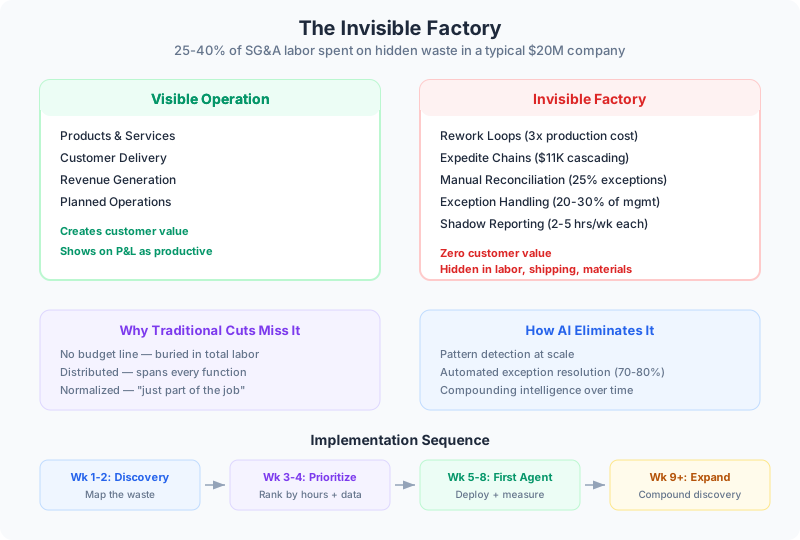
What the Invisible Factory Actually Looks Like
This isn’t a metaphor. It’s a measurable operation with real inputs and real outputs — except the outputs are waste, not value. Here’s what I find in almost every mid-market company:
Rework
An order ships with the wrong configuration. Eight touchpoints. Three departments. Two weeks to resolve. The original manufacturing cost was $200. The rework cost was $600. But that $600 doesn’t show up as “rework” on your P&L — it shows up as labor, shipping, and materials, completely indistinguishable from productive work.
Expedite Chains
A customer moves up a delivery date. Vendor charges a 30% premium. Freight doubles. Three other jobs get pushed, triggering their own expedite chains. The original fee was $2,000. The total disruption cost across the operation: $11,000. None of it shows up as “expedite costs.”
Manual Reconciliation
Your AP team matches invoices to POs to receiving records. When there’s a three-way match, it takes 30 seconds. When there isn’t — and that’s 25% of the time — it takes 20-45 minutes per exception. You’ve got a full-time employee doing nothing but resolving exceptions that shouldn’t exist.
Exception Handling
Every process has a happy path and an exception path. The happy path is designed. The exception path is improvised. Individually, exceptions are small. Collectively, they eat 20-30% of management time.
Shadow Reporting
Your ERP produces reports. Your BI tool produces dashboards. And your department managers still build their own Excel spreadsheets every week. Each one represents a failure of your information systems. Each one costs 2-5 hours per week to maintain.
👉 Tip: Ask each department head this question: “What reports do you build manually that you wish the system just gave you?” Every answer is an Invisible Factory line item.
Why Traditional Cost-Cutting Doesn’t Touch It
I’ve done cost reduction with dozens of companies — headcount freezes, vendor renegotiation, lean initiatives, Six Sigma projects. Those approaches work on the visible factory. They miss the Invisible Factory for four reasons:
- No budget line. Nobody budgets for rework or exception handling. You see “warehouse labor: $800K,” not “warehouse labor spent on rework: $120K.”
- It’s distributed. It spans every function. No single person sees the whole picture.
- It’s normalized. “That’s just part of the job” and “it’s always been that way” are comfortable statements, not true ones.
- Each piece is small. Any individual waste activity is ignorable. But 1,200 exceptions per year at 30 minutes each is 600 hours — a full-time employee.
Traditional process improvement can chip away at pieces, but each project takes months. With hundreds of waste sources and capacity for maybe 3-5 improvement projects at a time, the backlog never clears.
AI changes the math entirely.
The Discovery Framework: 5 Questions That Map Your Invisible Factory
Before you can eliminate it, you have to find it. I use five questions in every discovery session — ask them of every department head, supervisor, and process owner.
”What do you do when things go wrong?”
The happy path is documented. The exception path is where the Invisible Factory lives. Map exception paths, count frequency, multiply by time. You’ll find exception handling consumes 15-25% of total operational labor.
”What information do you re-enter or re-create?”
Every time someone types the same data into a second system, that’s waste. In a typical mid-market company, the same data point gets entered an average of 2.7 times. Each redundant entry is cost and error risk.
”What would break if [person] left?”
This identifies tribal knowledge — institutional understanding that lives in someone’s head instead of a system. Tribal knowledge creates single points of failure and walks out the door with the person.
”What meetings exist only to share information?”
A 10-person weekly meeting costs 520 person-hours per year including prep. If the information could be delivered automatically, those hours go back to productive work.
”What do you do that your customer would never pay for?”
Your customer pays for the product or service. Not your internal reconciliation, scheduling conflicts, or ERP data entry. Any activity a customer would never pay for — if they saw it on an itemized invoice — is a candidate for elimination.
👉 Tip: Run these five questions across every department in one week. Build a simple spreadsheet: activity, frequency, time per occurrence, annual hours. The total will surprise you. I’ve never seen it come in under 20% of SG&A labor.
How AI Actually Eliminates the Invisible Factory
The Invisible Factory has persisted because the cost of finding and fixing each waste instance exceeded the cost of living with it. AI inverts that equation in three ways.
Pattern Detection at Scale
AI agents can monitor process data across your entire operation simultaneously — every ERP transaction, support email, quality exception, manual data entry. They surface patterns humans can’t see:
- “28% of orders require manual requoting because initial quotes didn’t account for current material pricing. Monthly cost: 78 hours.”
- “Invoice exceptions cluster around three vendors who consistently ship partial orders. Fix: confirmed-quantity POs would eliminate 85%.”
Specific. Quantified. Actionable.
Automated Exception Resolution
Once identified, many Invisible Factory activities can be handled directly:
- Reconciliation — agent performs three-way matching, investigates exceptions, resolves clear cases. Typical result: 70-80% of exceptions handled without a human.
- Rework prevention — agent reviews orders against configuration rules before production. One manufacturer I worked with cut rework 60% in the first quarter.
- Schedule optimization — agent continuously adjusts based on real-time inputs instead of a planner spending 4 hours daily on manual rescheduling.
- Report generation — shadow reports generated automatically from all relevant systems. The spreadsheets disappear because the need is finally met.
Compounding Intelligence
Here’s what makes this different from traditional automation: AI agents learn. Every exception resolved teaches the agent something. Every correction a human makes refines its judgment. Over 12 months, an AP reconciliation agent doesn’t just process faster — it learns which vendors cause problems, which discrepancies actually matter, and which are rounding errors.
The Invisible Factory shrinks over time because agents don’t just handle waste — they address root causes.
Benefits of mapping and attacking the Invisible Factory:
- Recoverable capacity of 50-70% of Invisible Factory labor (that’s $625K-$1.4M on a $5M SG&A base)
- Growth without proportional headcount — the company that needed 5 new hires for 20% growth now handles it with 1-2
- Your best people stop spending their worst hours on exception handling and start doing the strategic work you hired them for
- Each AI deployment reveals the next layer of hidden waste, creating a compounding improvement cycle
The Implementation Sequence
Here’s how I sequence it with clients:
Weeks 1-2: Discovery. Ask the five questions across every department. Map exception paths. Quantify hours. Build the Invisible Factory inventory.
Weeks 3-4: Prioritization. Rank each activity by annual hours consumed, data availability (can an agent access what it needs?), and decision complexity (pattern matching vs. genuine judgment?). The sweet spot: high hours, high data availability, low complexity.
Weeks 5-8: First agent. Deploy on the top-priority item — usually AP reconciliation, order verification, or report automation. Measure hours recovered, error rates, and processing speed.
Weeks 9-16: Expansion. Roll out to the next 2-3 priorities. Each deployment gets faster because infrastructure is in place and the team knows the playbook.
Ongoing: Continuous discovery. The agents themselves become discovery tools. As they process transactions and handle exceptions, they surface new waste patterns that were invisible in the initial assessment.
The Choice
Every business has an Invisible Factory. The question is whether you choose to see it.
Most owners accept rework as “part of the business,” manual reconciliation as “how things work,” and status meetings as “necessary communication.” These aren’t facts. They’re defaults. And defaults can be changed.
The companies that find and eliminate their Invisible Factory create a structural advantage — growth without proportional overhead, complexity without proportional headcount, speed without dragging 30% dead weight through every process.
Make it visible. Then make it disappear.
Continue reading: