
The 12-Month AI Roadmap: From First Agent to Compounding Intelligence
A phased AI implementation roadmap for $5-500M companies — from first agent to compounding intelligence in 12 months. No 50-slide strategy decks.
You don’t need a 50-slide AI strategy deck. You need a roadmap that tells you what to do this month, next quarter, and at month twelve.
I’ve built this roadmap for operators running $5-500M companies who want AI working in their business, not just talked about in their boardroom. Three phases: Foundation, Coordination, Intelligence. Each builds on the last. You can’t skip ahead — companies that jump to Phase 3 without Phase 1 end up with expensive technology nobody uses.
The gap between companies using AI effectively and companies still evaluating widens every month — not because the technology moves fast, but because companies that started are building intelligence that compounds daily.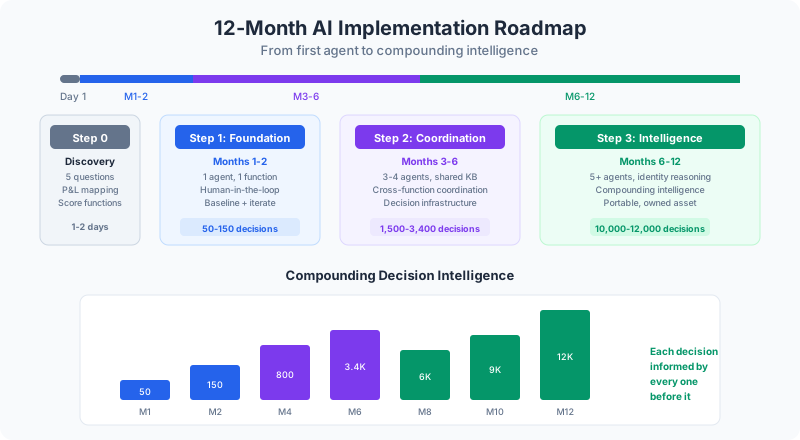
Step 0: The Discovery Work (Day 1-2)
Before spending a dollar on implementation, answer five questions. These take a day, maybe two. They’re worth more than any consultant engagement.
1. What decisions do you make repeatedly? PO approvals, schedule adjustments, quote configurations, inventory reorder points. Repetitive decisions follow patterns AI can learn.
2. Where does information get stuck? Your customer calls for an order status and your rep checks three systems. Every time a human plays telephone between systems, you’ve found an AI opportunity.
3. What work happens after hours? The 11 PM cycle count, the weekend report compilation, the Monday morning scramble. Work outside normal hours signals your processes can’t keep up.
4. Where do your best people spend time on your worst work? Your $85/hour engineer reviewing data entry. Your plant manager hand-scheduling production. High-cost people doing low-leverage work is the most expensive problem in your business.
5. What tribal knowledge lives in one person’s head? If your best scheduler retires, does three decades of knowledge retire too?
Then pull your P&L. Every labor-heavy line item represents a process with value-adding and non-value-adding steps. Score each function by decision volume times labor cost. Highest-scoring functions are where you start.
👉 Tip: Don’t skip the P&L mapping. When your scheduling function consumes $180K in annual labor and 40% is non-value-adding, the ROI conversation gets specific fast. Abstract “AI could help” doesn’t get budget. “$72K in recoverable labor cost” does.
Step 1: Foundation — Months 1-2
One objective: get one AI agent working in one function, with measurable results, and your team comfortable with the concept.
Month 1: First Agent
Week 1-2: Select and scope. Pick your highest-scoring function. Don’t pick the most complex — pick the one with the clearest win: high volume of repetitive decisions, quantifiable cost, and a team open to trying something new. Define the agent’s scope narrowly. Starting with scheduling? Don’t automate the entire process. Start with one task: filling cancellation gaps, managing recare outreach, or optimizing next-day schedules.
Week 3-4: Build and deploy. Build with human-in-the-loop from day one — agent recommends, human approves. This isn’t the long-term architecture. It’s a trust-building mechanism. Set up your knowledge base: decision traces (what and why), process notes, edge cases. Establish baseline metrics: time per task, error rate, throughput, cost per transaction.
Month 2: Iterate and Measure
Week 5-6: Tune. Your first agent won’t be perfect. When the team overrides a bad recommendation, that override becomes training data. After 50-100 overrides, recommendations start reflecting your business’s specific context.
Week 7-8: Expand within function. Started with cancellation gap-filling? Add recare outreach. Started with PO approvals? Add spend analysis. Depth before breadth.
Navigating the People Challenge
Four adoption profiles you’ll encounter:
- The Oblivious — don’t see AI as relevant. Pair them with the agent on one task. One good experience converts more than ten presentations.
- The Aware but Unactivated — know AI matters but haven’t connected it to daily work. Show them the math: “This saves you 6 hours per week.”
- The Activated Builders — get it and want more. Give them ownership of performance metrics.
- The Overzealous — high urgency, low grounding. Give them an evaluation role, but keep implementation pace disciplined.
Phase 1 targets: One agent with >90% acceptance rate. 10-20 hours/week saved. 100+ decision traces. Team comfort established.
Step 2: Coordination — Months 3-6
Two objectives: add agents in related functions and enable them to work together.
Months 3-4: Second and Third Agents
Deploy agents in the next two highest-scoring functions. Apply Phase 1 lessons — narrow scope, human-in-the-loop, baseline metrics, iterative tuning.
Now something new happens: agents start sharing information. Your scheduling agent knows the production plan. Your inventory agent knows material availability. Your procurement agent knows vendor lead times. When they share a common knowledge base, coordination emerges:
- Scheduling adjusts based on material availability without being asked
- Procurement pre-positions orders based on the production schedule
- Inventory adjusts safety stock based on schedule volatility
This coordination isn’t programmed. It emerges from shared infrastructure and aligned objectives. This is where ROI multiplies.
Months 5-6: Decision Infrastructure
Establish formal communication: shared knowledge base (all agents read and write to the same system), decision traces (every agent documents what it decided and why), and escalation protocols (clear rules for when agents escalate to humans).
Benefits of the coordination phase:
- Three agents producing 40-80 hours/week in total time savings
- Cross-functional coordination that no single human could maintain
- 500+ decision traces that become organizational memory
- Reduced human-in-the-loop — approval needed for exceptions only
- Data quality improving as agents clean and structure information
👉 Tip: The shared knowledge base is the most underrated piece of this entire roadmap. Agents without memory are brilliant new hires with amnesia. Every decision trace, every override, every edge case — captured once, available forever.
Step 3: Intelligence — Months 6-12
AI transforms from a tool into a strategic asset. Objective: build compounding intelligence that becomes a competitive moat.
Months 6-8: Identity-Based Reasoning
An identity defines how an agent makes decisions. A “Conservative Buyer” prioritizes reliability and safety stock. An “Aggressive Buyer” optimizes for cost and just-in-time. Same data, different decisions — both rational. You can run the same decision through different identities to compare outcomes, or shift identities based on business conditions.
This codifies the judgment your experienced people already apply. It makes it consistent, transparent, and transferable.
Months 9-12: Compounding Intelligence
By month nine, your agents have made thousands of decisions. Your procurement agent doesn’t just know vendor pricing — it knows Vendor A’s lead times slip 15% in Q4, Vendor B’s quality is better on small lots, and switching vendors mid-order on this part family costs $1,200 in requalification.
That accumulated intelligence is your asset. You own it. It’s not locked in a vendor’s platform or dependent on a single employee. Change ERP vendors? Intelligence comes with you. Acquire a new facility? Intelligence deploys day one.
The 12-Month View
| Month | Phase | Agents | Decisions | Key Milestone |
|---|---|---|---|---|
| 1-2 | Foundation | 1 | 50-150 | First agent live, baseline measured |
| 3-4 | Coordination | 3 | 400-800 | Multi-agent coordination emerging |
| 5-6 | Coordination | 3-4 | 1,500-3,400 | Shared knowledge, decision traces |
| 7-8 | Intelligence | 4-5 | 4,000-6,000 | Identity-based reasoning deployed |
| 9-10 | Intelligence | 5+ | 7,500-9,000 | Compounding visible in metrics |
| 11-12 | Intelligence | 5+ | 10,000-12,000 | Emergent coordination, portable intelligence |
Common Mistakes
- Starting too broad. One function. One agent. One metric. Expand from strength.
- Ignoring the people. Budget as much time for change management as technology deployment.
- Skipping the knowledge base. Agents without memory are brilliant new hires with amnesia.
- Buying instead of building intelligence. You can buy platforms. You can’t buy 12,000 decisions of accumulated intelligence specific to your business.
- Waiting for perfect. An imperfect implementation today outperforms a perfect plan next quarter. Compounding starts when you start.
What to Do This Week
- Pull your P&L and identify every labor-heavy line item
- Answer the 5 discovery questions — write the answers down
- Map non-value-adding work and quantify it
- Score your functions: volume x cost = priority
- Pick one — the highest-scoring function with an open-minded team
That gap between companies using AI and companies still evaluating? It doesn’t close by writing a check later. It closes by starting now.
Continue reading:
- Run Your Own AI Readiness Assessment in One Day — Score yourself on five signals before you start
- The 5 Discovery Questions for AI — The questions behind Step 0
- Operational Thinking: From Theory to Practice — The operational mindset that makes AI deployments stick
- The Alignment Blueprint — How to get your team pulling in the same direction during implementation
Related AI Articles
How to Implement AI Without Wasting Six Figures on the Wrong Vendor
A practical framework for implementing AI — start with your P&L, not a vendor pitch deck. Discovery questions, scoring, and a 90-day playbook.
Read moreThe AEC Firm's Guide to Recovering 30% of Lost Billable Hours
A practical how-to for architecture and engineering firms that want to stop losing billable capacity to proposals, RFIs, spec coordination, and reporting.
Read moreThe Real Money in Your Dental Practice Isn't in the Chair
Most dental AI marketing focuses on imaging and diagnostics. That's not what's killing your margins. Here's what is — and how to fix it.
Read moreFinancial Advisors: Double Client Capacity, Same Staff
A guide for advisors and RIAs who want more clients without more staff — by cutting the admin that eats 40% of the week.
Read more