
What Your Senior Accountants Wish You Knew About AI
Most AI-for-accounting pitches miss the point. Here's what matters and the myths keeping firms from recovering senior capacity.
Here’s what I hear from managing partners at CPA firms: “We looked at AI, but it’s not ready for accounting.” And here’s what I hear from their senior accountants: “I spent three hours yesterday entering W-2 data into tax software. Please, for the love of God, automate something.”
The disconnect isn’t about technology readiness. It’s about where people are looking. Most “AI for accounting” marketing focuses on clinical-sounding stuff — anomaly detection, predictive analytics, advanced audit procedures. That’s not where your firm is bleeding. Your firm is bleeding because your $185/hour seniors spend 40% of their time on work that doesn’t require their license.
Let’s bust some myths.
Myth 1: “AI Isn’t Accurate Enough for Accounting”
This is the big one, and it’s wrong in a specific way.
AI isn’t replacing your senior’s judgment on a complex tax position. Nobody’s claiming it should. But document extraction — pulling numbers from W-2s, 1099s, brokerage statements, and K-1s into your tax software? That’s pattern matching. And AI is already better at pattern matching than a tired staff accountant in February.
Modern document extraction tools hit 98%+ accuracy on standard tax documents. Your humans aren’t at 100% either — they’re just better at catching their own mistakes because they understand context. The right approach: AI extracts, flags low-confidence items, and a human reviews exceptions.
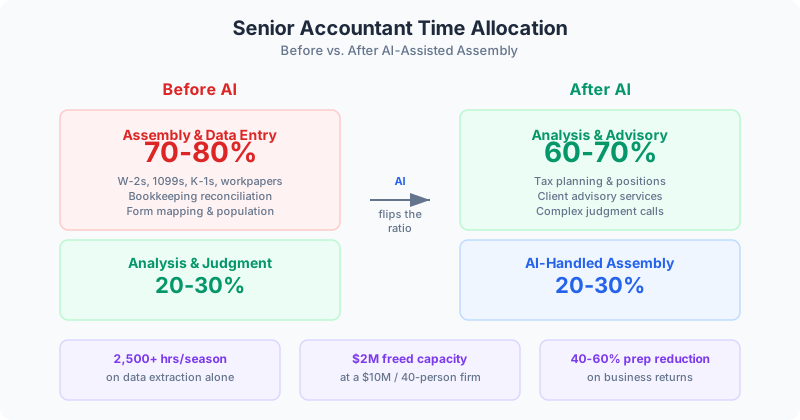
During peak season, a 50-person firm processes 25,000-35,000 source documents. At 4 minutes per routine item, that’s 2,500+ hours of data extraction alone. That’s two to three full-time professionals doing nothing but typing numbers from one format into another for four months.
👉 Tip: Don’t compare AI accuracy to perfection. Compare it to your current error rate during week 10 of busy season, when your best people are running on coffee and resentment.
Myth 2: “Our Work Is Too Complex to Automate”
Your work is complex. Your data entry isn’t.
Here’s the dirty secret of tax preparation: actual analysis — reviewing positions, identifying planning opportunities, making judgment calls — takes 20-30% of total time. The other 70-80% is assembly. Mapping source documents to correct forms. Populating software. Tying current year to prior year. Generating workpapers showing where every number came from.
An AI agent handles the assembly. Your senior receives a substantially complete draft with a workpaper trail instead of a stack of source documents. Review time drops from 3-4 hours to 45-90 minutes for a typical 1040. Business returns see 40-60% prep time reduction.
The same applies to bookkeeping. Monthly reconciliation for 80 clients is almost entirely pattern matching — download bank feed, categorize transactions, match against invoices, reconcile, prepare financials. Same client. Same accounts. Every month. After two months of supervised processing, AI categorizes 85-90% of transactions automatically.
That’s not replacing complexity. That’s eliminating the non-complex work so your people can focus on the complex work.
Myth 3: “We Tried AI and It Didn’t Work”
I hear this from firms that bought a tool, pointed it at something, and didn’t see transformation. That’s a sequencing problem, not a technology problem.
Where most firms go wrong
- They pilot on something low-stakes (transcription, blog content) that doesn’t connect to operations
- They don’t measure the result with a number
- Nobody’s workflow actually changes
The right sequence matters:
Start with document ingestion. Highest volume, lowest risk. The AI processes and presents results for human review. You build trust while recovering immediate capacity.
Then layer in tax prep assembly and bookkeeping automation. Connect document extraction to your tax software and accounting platforms. Now you’re changing workflows.
Then add billing automation and client onboarding. Most CPA firms carry $200-500K in unbilled WIP — not because work isn’t done, but because partners haven’t reviewed and released invoices. An AI agent drafts invoices at engagement milestones, applies standard billing adjustments, and queues for partner approval. A 30-second review instead of a monthly ordeal.
👉 Tip: If your AI pilot didn’t change anyone’s Monday morning, it wasn’t a real pilot. It was a demo that lasted too long.
Myth 4: “AI Will Replace Our People”
This is the one your team worries about and your partners quietly hope for. Both are wrong.
AI replaces the parts of the job everyone hates — data entry, insurance hold music equivalent (chasing client documents), manual form processing. Your front office becomes a client service team instead of a document processing center.
Here’s the actual math for a $10M firm with 40 professionals:
- Theoretical capacity: $10.08M (40 people × 1,800 hours × $140 avg rate)
- Invisible factory consumption: ~40%, or $4M in billable time on work that doesn’t require professional judgment
- Recovering half of that: $2M in freed capacity
That $2M goes to advisory work at higher rates, or capacity you give back so people stop quitting every April. You don’t fire anyone. You stop losing them.
What Compounding Intelligence Actually Means
Here’s where it gets interesting. After one tax season, your AI knows that Client #4472 always sends their K-1 three weeks late, the Schwab brokerage statement needs manual wash sale adjustment, and charitable deductions over $5,000 need substantiation letters.
After two seasons, it’s learned which partners want detailed workpaper notes versus summary-only, which positions the firm takes aggressively, and which patterns create the most review notes — addressing them in the draft before the reviewer sees them.
Benefits of starting now rather than waiting:
- Every return processed makes the system more accurate
- Every review note addressed improves the next draft
- A competitor starting next year needs two full tax seasons to reach your intelligence level
- The knowledge doesn’t retire when your people do
That last point matters. When your best billing specialist leaves, the institutional knowledge of how to code for each payer, which adjustments partners always make, and which clients need special handling — all of it stays in the system.
The Real Question for Your Next Partner Meeting
Don’t ask “should we use AI?” Ask these instead:
-
What percentage of senior time goes to work that doesn’t require their license? Track it for one week during busy season. That percentage times senior payroll equals what the invisible factory costs you.
-
How many hours does your firm spend on document processing per return? Multiply by return volume. That’s the labor pool AI recovers first.
-
What’s your average days from work completion to cash collection? Over 50 days means your billing process alone is costing real money in carrying costs and write-offs.
Your seniors are entering W-2 data right now. They don’t wish you knew about some revolutionary AI platform. They wish you knew how much of their expertise you’re wasting on work a machine handles better.
Continue reading:
- The 5 Discovery Questions for AI — the framework for finding the right process to automate first
- The Invisible Factory: Hidden Costs of AI — the concept behind all that non-value-adding admin work
- How to Write a Procedure — because AI can’t automate what isn’t documented
- Building Effective Business Systems — the foundation that makes automation possible
Related AI Articles
The AEC Firm's Guide to Recovering 30% of Lost Billable Hours
A practical how-to for architecture and engineering firms that want to stop losing billable capacity to proposals, RFIs, spec coordination, and reporting.
Read moreHow a Mid-Size GC Cut Bid Prep Time by 60% Without Adding Estimators
How one general contractor used AI to fix estimating bottlenecks, catch cost overruns weeks earlier, and stop losing tribal knowledge to turnover.
Read moreStop Firefighting Ecommerce: Let AI Run the Boring Ops
A framework for ecommerce operators tired of stockout alerts, ad spend blowouts, and unresolved tickets. Hand the pattern recognition to AI.
Read moreFinancial Advisors: Double Client Capacity, Same Staff
A guide for advisors and RIAs who want more clients without more staff — by cutting the admin that eats 40% of the week.
Read more