
How a Mid-Size GC Cut Bid Prep Time by 60% Without Adding Estimators
How one general contractor used AI to fix estimating bottlenecks, catch cost overruns weeks earlier, and stop losing tribal knowledge to turnover.
A $35M general contractor in the Southeast had a problem every mid-size GC knows: their best estimator was 14 months from retirement, and the knowledge in his head was worth more than any software license they’d ever bought.
He knew the soil in the Riverside corridor runs heavy clay — add 15% to excavation. He knew the mechanical sub who quotes $340K will come in at $360K because they always miss roof penetrations. He knew which lumber yards actually deliver on time in Q4 and which ones don’t. None of this was written down.
They also had a second problem: three bids due every Friday, and the capacity to do maybe two well. So they’d rush the third, underbid it, win it, and bleed margin for nine months. Or they’d pass on it entirely and watch a competitor take the work.
The real bottleneck in construction isn’t the jobsite — it’s the trailer. The back office. The estimating department. That’s where AI creates the most value.Here’s what they did.
The Starting Point: Where the Hours Actually Went
Before touching any technology, they audited their estimating process. The breakdown wasn’t surprising, but the ratios were:
- 60-70% of estimator time: Data assembly — pulling historical costs, organizing sub quotes from email, building spreadsheets, cross-referencing specs
- 20-25% of estimator time: Judgment calls — site conditions, constructability, sub reliability adjustments
- 10-15% of estimator time: Review and finalization
The judgment is irreplaceable. The assembly isn’t. And the assembly was eating three days out of every five.
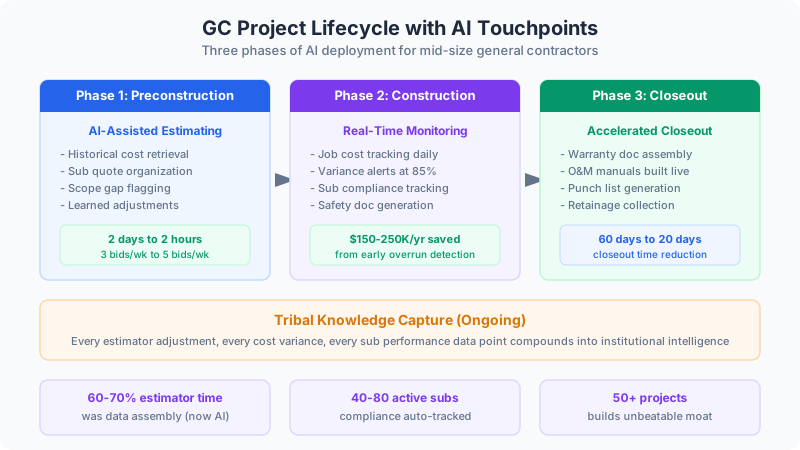
What They Built: AI-Assisted Estimating
They didn’t replace their estimator. They gave him a research assistant that never sleeps.
The AI agent handles the assembly work:
- Pulls historical costs from their completed jobs — not generic databases, their actual costs on their actual projects
- Organizes incoming sub quotes by CSI division
- Flags scope gaps between plans and sub proposals
- Identifies where the last three similar projects had overruns
- Applies learned adjustments (the 15% clay soil markup, the mechanical sub’s consistent underquoting)
The result: What used to take two days of spreadsheet building now takes two hours of review. Their estimator spends his time on what he’s actually good at — the judgment calls. They went from three bids per week to five without adding headcount.
But the bigger win was what happened to the tribal knowledge.
Capturing What’s in His Head
Every time their estimator makes an adjustment — adds 15% for clay soil, discounts a sub’s quote, flags a specification gap — the system captures it. Not as a note buried in a file. As a structured, searchable adjustment that gets applied to every future estimate in that context.
When he retires next year, the knowledge doesn’t walk out the door. It’s baked into the system. The next estimator starts with 30 years of institutional intelligence instead of a stack of old spreadsheets.
👉 Tip: If you have an experienced estimator approaching retirement, this is the single highest-value AI initiative you can run. Every month you wait is institutional knowledge you’ll never capture.
The Second Win: Catching Cost Overruns in Real Time
The typical GC reviews job costs monthly. This company was no different. And the problem with monthly reviews is that by the time you see a labor overrun, it’s been bleeding for weeks. Cascading costs have already started.
On one project, their framing crew billed 340 hours against a 280-hour budget. The PM didn’t find this until the monthly cost report — two weeks after the overrun started. By then, drywall had started on schedule against a frame that took three extra weeks, and they were paying overtime to hold the completion date.
What AI Changed
They deployed a monitoring agent on job costs. Every transaction, every day. When the framing crew crossed 85% of labor budget with only 70% of work complete, the agent flagged it immediately — not in two weeks.
It calculated the projected overrun, identified the cause (weather delays plus a crew substitution), and drafted a variance report for the PM. She made the call to adjust the drywall schedule before it became a crisis.
The math: On a $5M project, catching a 5% labor overrun two weeks earlier saves $15-25K in cascading costs. Across ten projects per year, that’s $150-250K in recovered margin. That’s not a technology investment. That’s a margin recovery program.
The Third Win: Sub Coordination Without the Paper Chase
This GC manages 40-80 active subs across 15-20 projects. Each sub has their own schedule, billing cycle, documentation requirements, and tendency to forget about expired insurance certificates.
The coordination overhead was enormous — 15-20 hours per week chasing compliance docs, tracking billings against schedule of values, reconciling change orders.
What AI handles:
- Tracks compliance status (insurance, licenses, safety certs) and sends reminders before expiration
- Matches sub pay applications against schedule of values and flags discrepancies
- Cross-references sub change orders against the prime contract
The PM manages the relationship. The agent manages the paper. That’s the right division of labor.
👉 Tip: Start with compliance tracking — it’s the lowest-risk, highest-nuisance sub coordination task. Insurance lapses are both expensive and entirely preventable with automated monitoring.
Supporting Wins: Safety Docs, Daily Reports, and Closeout
Once the core systems were running, they layered on three supporting workflows:
Safety Documentation
Their supers were spending 30-60 minutes per day on OSHA documentation. Across ten active projects, that’s 5-10 superintendent-hours daily on paperwork. The AI agent turns a 3-minute voice memo into a formatted toolbox talk record, daily observation report, updated site safety log, and training record. The super’s job is to run a safe jobsite. The agent’s job is to prove it.
Daily Reporting
Twelve active projects. Twelve daily reports. Same format, same fields, every day. The AI agent processes reports from voice memos, photos, and structured inputs. Updates the PM system, flags schedule deviations, tracks installed quantities against the estimate. The coordinator stopped being a data entry clerk and started being a project analyst.
Project Closeout
The average GC takes 45-90 days to close out after substantial completion. Retainage sits uncollected, warranty docs get assembled piecemeal. This company’s AI starts building the closeout package from day one — tracking warranty documents as they arrive, assembling O&M manuals as equipment gets installed, generating punch lists from inspection notes. They cut closeout time from 60 days to 20.
Benefits across the portfolio:
- Retainage collected 40 days faster on average
- Cash flow improved by six figures annually from faster closeout
- Superintendent time recovered for actual site management
- Daily reports generated in minutes instead of hours
- Audit-ready safety files without Friday afternoon scrambles
The Compounding Intelligence Effect
After 50 projects, their estimating database knows things no human could track across that volume:
- Concrete pours in December run 12% over budget in their region
- Sub A’s mechanical rough-in consistently takes 8% longer than scheduled
- Their best framing crew hits 94% of budget on wood-frame multifamily but only 87% on commercial TI
You can buy the software. You can’t buy that intelligence. A competitor starting next year needs 50 projects to reach parity. That’s the moat.
If You’re a GC Thinking About This
Here’s the honest implementation path:
Phase 1 (Month 1-2): Start with job cost monitoring. Read-only. The agent watches committed costs vs. budget in real time and flags variances. Highest value, lowest risk. Builds trust.
Phase 2 (Month 3-6): Add estimating support and sub compliance tracking. Connect job cost intelligence to preconstruction so estimates reflect actual performance.
Phase 3 (Month 6-12): Layer in daily reporting, safety docs, and closeout assembly. Let the compounding intelligence develop through a full project cycle.
Three questions for your next leadership meeting:
-
How much margin are you losing to late variance detection? Pull your last ten completed projects. Compare final cost to the last estimate-at-completion. The gap is the cost of slow information.
-
How many superintendent-hours per week go to paperwork? That number times loaded hourly rate tells you what you’re paying for the invisible back office per jobsite.
-
What happens to your estimating knowledge when your senior estimator leaves? If the answer involves “a lot of spreadsheets” and “hopefully they train someone,” you have a tribal knowledge problem AI solves permanently.
Continue reading:
- AI Implementation Roadmap — the phased approach that works for construction and other project-based businesses
- The Invisible Factory: Hidden Costs of AI — the framework for identifying where your back office is eating margin
- Scaling a Business: Building a System That Grows Sustainably — why capturing tribal knowledge is essential for growth
- The 10 Commandments of a Profitable Operation — the operational principles that make AI implementation stick
Related AI Articles
The AEC Firm's Guide to Recovering 30% of Lost Billable Hours
A practical how-to for architecture and engineering firms that want to stop losing billable capacity to proposals, RFIs, spec coordination, and reporting.
Read moreWhat Your Senior Accountants Wish You Knew About AI
Most AI-for-accounting pitches miss the point. Here's what matters and the myths keeping firms from recovering senior capacity.
Read moreStop Firefighting Ecommerce: Let AI Run the Boring Ops
A framework for ecommerce operators tired of stockout alerts, ad spend blowouts, and unresolved tickets. Hand the pattern recognition to AI.
Read moreFinancial Advisors: Double Client Capacity, Same Staff
A guide for advisors and RIAs who want more clients without more staff — by cutting the admin that eats 40% of the week.
Read more