
Small Business AI: The $5-20M Operator's Unfair Advantage
Small businesses between $5M and $20M have a structural speed advantage in AI adoption. Here's the framework for using it before enterprises catch up.
I’ve worked with companies from $5M to $500M. And the thing nobody talks about is that the smaller operators are winning the AI race right now — not because they’re smarter, but because they’re faster.
A $200M manufacturer I know spent fourteen months getting approval to pilot one AI scheduling tool. Steering committees, vendor evaluations, IT security reviews. Meanwhile, a $6M job shop deployed the same capability in a week. Owner said yes on Tuesday, they were running by Friday. Late deliveries dropped 35%.
If you’re running a $5-20M business, your speed is a structural advantage that compounds daily — and it’s disappearing fast.The Speed-to-Intelligence Framework
Here’s how I think about the small business AI advantage. It comes down to three layers that build on each other.
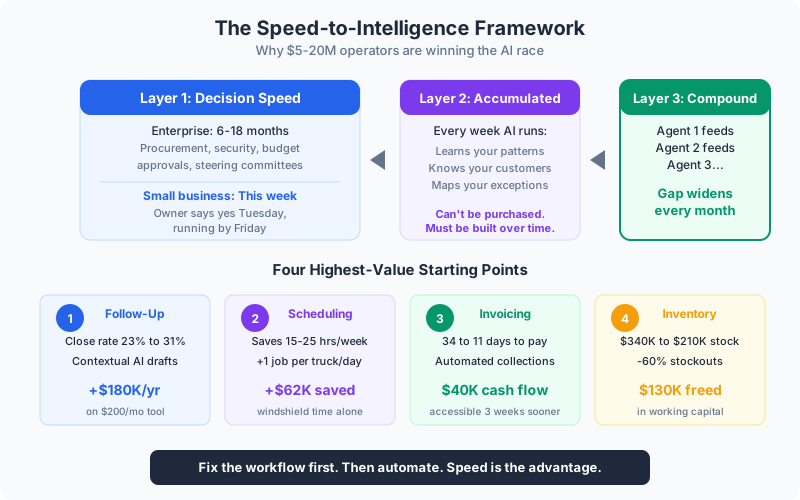
Layer 1: Decision Speed
Enterprise AI adoption is slow because enterprises are slow. Procurement cycles, security reviews, budget approvals requiring three signatures and a board presentation. Average time from interest to first deployment? Six to eighteen months.
You don’t have that problem. You’re the owner, or you report to the owner. The decision loop is one person, maybe two. When you find a workflow AI can improve, you move on it this week — not next quarter.
Layer 2: Accumulated Intelligence
Every week your AI runs, it learns your patterns, your customers, your exceptions. The enterprise starting eighteen months from now can’t buy that accumulated intelligence. It doesn’t exist in a software package. You’re building it right now, one decision at a time.
Layer 3: Compounding Returns
Speed plus accumulation equals compounding. Your first AI agent handles follow-up. The data it generates feeds your second agent on scheduling. That feeds your third on invoicing. Each layer makes the next one smarter. Enterprises starting from zero can’t shortcut this sequence.
👉 Tip: Don’t think of AI as a tool purchase. Think of it as building an asset that appreciates. Every month of operation adds intelligence your competitors can’t replicate.
Where to Start: The Workflow-First Approach
Here’s where small business owners get it wrong: they start with the tool. They see a demo, get excited, and buy a $500/month subscription before mapping what’s broken.
Don’t do that. Start with the workflow.
Walk through your actual week. Where did you waste time? Where did something fall through the cracks? Where did you do the same task for the twentieth time?
The Four Highest-Value Starting Points
Customer Follow-Up. You’re losing deals because follow-up is inconsistent. AI handles this with contextual drafts that reference the specific conversation. One HVAC company saw close rates jump from 23% to 31% — worth roughly $180K annually on a $200/month tool.
Scheduling and Dispatching. If you run a service business, scheduling probably eats 15-25 hours per week. AI scheduling reasons about drive time, certifications, customer preferences, and time windows simultaneously. One plumbing company saved $62K in windshield time plus one extra job per truck per day.
Invoicing and Collections. Small businesses are terrible at getting paid on time — not because they don’t want to, but because invoicing is manual and always the last priority. One landscaping company cut days-to-payment from 34 to 11. That’s $40K in cash flow accessible three weeks earlier every month.
Inventory and Reordering. If you carry inventory, you’re probably ordering too much or too little. One $8M machine shop dropped raw material from $340K to $210K while reducing stockouts by 60%.
Benefits of starting with workflows instead of tools:
- You fix the broken process before automating it
- You define clear inputs and outputs AI can actually work with
- You establish baseline metrics so you can measure real ROI
- You avoid the expensive mistake of automating brokenness
👉 Tip: Before pointing AI at any workflow, ask: “Could a smart new hire follow written instructions for this?” If no, simplify the process first. AI won’t fix a workflow that humans can’t describe clearly.
Fix First, Then Automate
The biggest mistake I see: automating a broken workflow. If your invoicing requires three people to touch the same data in two systems, AI won’t fix that. It’ll automate the brokenness. You’ll get wrong invoices faster.
Before each automation, run three checks:
- Clear inputs and outputs? If you can’t define what triggers the workflow and what “done” looks like, AI can’t either.
- Documented steps? Not necessarily written down, but clear enough that someone new could follow them with minimal guidance.
- Is the process actually right? Sometimes the best move before automating is eliminating steps that shouldn’t exist.
Fix first. Automate second. This is the same principle behind starting manual before automating — and it applies even harder with AI.
The Three Mistakes That Kill Small Business AI Projects
Mistake 1: Buying Tools Before Understanding Workflows
A tool is only as good as the workflow it supports. Spend one day mapping your top three most time-consuming workflows before spending a dollar on AI. One day.
Mistake 2: Trying to Automate Everything at Once
Pick one workflow. Get it working. Measure the result. Then move to the next. The owner who nails invoicing and shows the team they’re getting paid 23 days faster builds trust and momentum for everything after.
Mistake 3: Ignoring the Team
Your team determines whether AI succeeds. If they see it as a threat, they’ll route around it. Best introduction I’ve seen: an owner told his team, “Write down the three tasks you hate most — the ones that waste your time and don’t use your skills. Those are what we’re giving to AI.” The team went from defensive to eager overnight.
Your Move This Week
- Pull up last week’s calendar
- Find three activities where you spent the most time on repetitive, non-value-creating work
- Pick the one with the clearest inputs and outputs
- Fix the workflow if it’s messy
- Automate it
Your size is your advantage — but not forever. Within two to three years, the large companies in your space will have AI across their operations. When that happens, you don’t want to be starting. You want to be twelve months ahead with accumulated intelligence they can’t replicate.
Continue reading:
- The 12-Month AI Roadmap: From First Agent to Compounding Intelligence — The phased plan for building on your first deployment
- The 5 Discovery Questions for AI — Find your highest-value starting point in one conversation
- Why Smart Businesses Start Manual Before Automating — The principle behind fix-first, automate-second
- How to Improve EBITDA at a Middle Market Company — Where AI savings hit the bottom line
Related AI Articles
The AEC Firm's Guide to Recovering 30% of Lost Billable Hours
A practical how-to for architecture and engineering firms that want to stop losing billable capacity to proposals, RFIs, spec coordination, and reporting.
Read moreFinancial Advisors: Double Client Capacity, Same Staff
A guide for advisors and RIAs who want more clients without more staff — by cutting the admin that eats 40% of the week.
Read more5 Compliance-Safe AI Wins for Banks, RIAs, and Insurance Firms
Financial services firms think compliance blocks AI. It doesn't. Five automation wins that improve operations without regulatory risk.
Read moreWhy Your Law Firm's AI Strategy Is Probably Wrong
Most law firms focus AI on legal research. The real ROI is in billing, intake, calendaring, and compliance — the work that drains partner hours every day.
Read more