
The Real Money in Your Dental Practice Isn't in the Chair
Most dental AI marketing focuses on imaging and diagnostics. That's not what's killing your margins. Here's what is — and how to fix it.
If you run a dental practice, you already know where the money leaks. Open chair time. Denied claims that take 45 minutes to rework. Intake forms someone has to manually enter into your PMS. Supply orders that are never quite right.
These aren’t technology problems. They’re operations problems. And the gap between a practice making 15% margins and one making 35% margins almost never comes down to clinical skill. It comes down to how well the business side runs.
Most “AI for dental” marketing focuses on clinical imaging and diagnostics. That’s not what’s killing your profitability. What’s killing your profitability is the admin work behind your front desk — consuming 30-40% of staff time without producing a dollar of revenue.Here’s the problem, and exactly how to solve it.
The Problem: Your Practice Runs Two Businesses
Every dental practice has two operations:
- Clinical — exams, cleanings, restorations, procedures. This generates revenue.
- Administrative — scheduling, billing, intake, insurance verification, supply ordering, compliance. This generates none.
When your office manager goes on vacation, the wheels wobble. When your billing specialist leaves, denied claims pile up. When the front desk is slammed, the phone rolls to voicemail and new patients go elsewhere.
The admin side doesn’t just cost payroll. It costs opportunity. Every hour your team spends on data entry is an hour they aren’t improving patient experience, following up on treatment plans, or handling the phone call that becomes a $3,000 case.
Most practice owners know this intuitively but haven’t done the math. So let’s do it.
The math on open chair time
A hygiene chair sitting empty for an hour costs $150-300 in lost production. Multiply across multiple operatories and you’re looking at $100K+ in annual lost revenue per location. Not because you don’t have patients — because your scheduling process can’t optimize the variables fast enough:
- Patient preferences and availability
- Provider schedules and procedure preferences
- Operatory equipment requirements
- Insurance verification status
- Procedure time estimates based on patient history
- Cancellation and no-show probability
- Overdue hygiene patients who need outreach
No human can process all of those simultaneously for every slot, every day.
The math on denied claims
If you’re running above a 5% denial rate, you’re leaving money on the table. A practice producing $1.5M annually with a 7% denial rate loses $105K in claims. Not all of that is recoverable, but most of it is preventable.
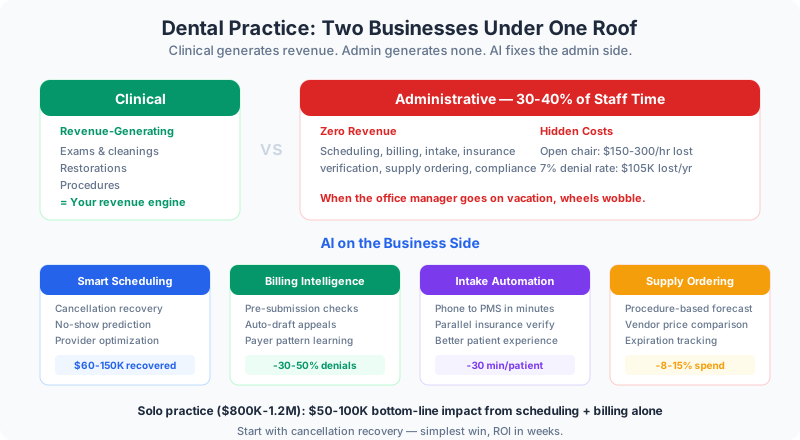
The Solution: AI on the Business Side
I’m not talking about AI reading X-rays. I’m talking about AI doing the work your front desk dreads.
Scheduling That Fills Itself
When a cancellation comes in, the AI agent identifies the best candidates — overdue hygiene patients, waitlisted patients, patients with expiring insurance benefits. It reaches out via text, handles confirmation, and updates the schedule. No staff time required.
It also predicts no-shows based on prior history, appointment lead time, day of week, and other patterns. High-risk appointments trigger confirmation sequences or strategic double-booking.
And it finds patterns your team can’t see at scale. Maybe Dr. Chen produces 20% more on crown preps before 11 AM. That insight exists in your data. An AI agent finds it and schedules accordingly.
Typical result: 15-25% reduction in open chair time within 90 days. On a four-operatory practice, that’s $60-150K in recovered annual revenue.
👉 Tip: Start with cancellation recovery. It’s the simplest AI scheduling win — the patient already has an appointment, they just cancelled it. Fill that hole automatically and you’ll see ROI in weeks, not months.
Billing That Catches Denials Before They Happen
Pre-submission verification is where AI shines in dental billing. It checks claims against the patient’s specific plan benefits, frequency limitations, waiting periods, and historical denial patterns. Catches wrong CDT codes, missing narratives, and bundling issues before you submit.
When denials do happen, the AI categorizes them, identifies reasons, pulls documentation, and drafts appeals. The 20-minute manual analysis takes seconds.
The real power is pattern recognition across payers. The system learns which payers deny which procedures under which circumstances. That institutional knowledge usually lives in your billing person’s head — and leaves when they do.
Typical result: 30-50% reduction in denial rates and 10-20 hours per week of recovered staff time.
Intake That Doesn’t Bottleneck Your Morning
Each new patient requires 25-45 minutes of administrative time before they sit in a chair. Patient completes intake on their phone. The AI agent processes the information, populates the PMS, identifies inconsistencies, and resolves what it can. Insurance verification runs in parallel, not sequentially.
The bigger impact is on patient experience and conversion. A seamless first interaction drives treatment acceptance and referrals. A frustrated patient who filled out the same information three times on paper forms does not.
Typical savings: 15-30 minutes per new patient, 5-10 minutes per returning patient.
Supply Ordering That Matches Reality
Most practices order supplies reactively (when something runs low) or on fixed schedules (regardless of actual usage). Both waste money.
AI monitors consumption relative to procedures performed. Six crown preps next week? Materials are ensured without over-ordering. It tracks pricing across vendors, identifies consolidation opportunities, flags pricing creep, and manages expiration dates to prevent waste (typically 2-5% of total supply spend).
Typical savings: 8-15% of total supply spend.
👉 Tip: The supply ordering win is often the easiest to quantify and the hardest to argue against. Pull your supply spend for the last 12 months, compare it to procedure volume, and look for the disconnect. That’s your savings opportunity.
Why Compounding Intelligence Matters Here
Your practice management software does the same thing on day one and day one thousand. AI agents learn.
- Month 1: A handful of scheduling and billing decisions with significant oversight
- Month 6: Hundreds of decisions reflecting months of pattern recognition
- Month 12: Thousands of scheduling, billing, and inventory decisions informed by accumulated practice intelligence
For multi-location groups, intelligence learned at one location applies across all locations immediately. A billing strategy that reduces Delta Dental denials at your Scottsdale office works at your Mesa office tomorrow morning.
Benefits of implementing now rather than later:
- Every month of data makes the system smarter
- Competitors who start first build an intelligence advantage you can’t shortcut
- Staff retention improves when you eliminate the work people hate most
- Patient experience gets better without adding headcount
The People Side
Your team is going to ask: “Is this going to replace me?” The answer is no. It replaces the parts of the job everyone hates — data entry, insurance hold music, manual form processing. Your front desk becomes a patient experience team instead of a document processing center.
Start human-in-the-loop. The agent recommends; your team approves. Most teams go from skeptical to dependent within 60 days.
The biggest risk isn’t adoption resistance. It’s overzealous advocates pushing too hard, too fast. Move deliberately. Show results. Let the results do the convincing.
What This Means by Practice Size
- Solo practitioner ($800K-1.2M): AI in scheduling and billing alone can add $50-100K to your bottom line
- Multi-location group ($5-20M): Impact scales linearly, plus shared intelligence creates advantages solo practices can’t match
- DSO or DSO-aspirant: AI-driven ops is the infrastructure play that makes scalable management possible without proportionally scaling admin headcount
The invisible factory behind your front desk is running right now. The question is whether you keep staffing it at $25-35 per hour or let AI handle it while your team focuses on patient experience and production.
Continue reading:
- AI for Small Business Operations — the operational fundamentals that apply to any practice
- The 5 Discovery Questions for AI — how to find the right starting point in your practice
- How to Improve EBITDA in a Middle Market Company — the margin framework that applies to multi-location groups
- Building Effective Business Systems — why systems thinking matters before you add technology
Related AI Articles
The AEC Firm's Guide to Recovering 30% of Lost Billable Hours
A practical how-to for architecture and engineering firms that want to stop losing billable capacity to proposals, RFIs, spec coordination, and reporting.
Read moreFinancial Advisors: Double Client Capacity, Same Staff
A guide for advisors and RIAs who want more clients without more staff — by cutting the admin that eats 40% of the week.
Read more5 Compliance-Safe AI Wins for Banks, RIAs, and Insurance Firms
Financial services firms think compliance blocks AI. It doesn't. Five automation wins that improve operations without regulatory risk.
Read moreWhy Your Law Firm's AI Strategy Is Probably Wrong
Most law firms focus AI on legal research. The real ROI is in billing, intake, calendaring, and compliance — the work that drains partner hours every day.
Read more