
Financial Advisors: Double Client Capacity, Same Staff
A guide for advisors and RIAs who want more clients without more staff — by cutting the admin that eats 40% of the week.
Here’s a number that should bother every RIA owner: a typical independent advisor with 100 clients spends 790 hours per year on administrative work. At $400/hour in value, that’s $316,000 in advisor time consumed by meeting prep, CRM notes, compliance filings, client communications, and prospect proposals.
Cut that admin load in half and you free 395 hours. That’s capacity for 20-25 additional clients without adding a single staff member. Not “efficiency gains.” Not some vague productivity improvement. Twenty-five more clients at your average AUM.
The RIA model removed conflicts of interest but also removed institutional infrastructure — operations teams, compliance departments, marketing staff. The result is an invisible admin factory behind every advisory practice that eats the one resource you can’t buy more of: your time.Here’s the step-by-step playbook to get that time back.
Step 1: Document Your Current Processes (Week 1-2)
I know — you want to skip this and go straight to tools. Don’t. Most advisors who try AI start wrong: they buy a tool, use it for one task, don’t see transformation, and conclude AI isn’t for them. That’s a sequencing problem.
Before AI can assist with anything, you need to document how it actually works today:
- Meeting prep: Where do you pull data? What reports do you generate? How do you review prior notes? How long does each step take?
- CRM documentation: What do you capture after each interaction? What format? How consistently?
- Compliance calendar: What filings are due when? Who tracks them? What’s the process for each?
- Client communications: What goes out quarterly? What triggers a personal outreach? How are they written?
Write it down at a “day-one new employee” level of detail. This takes a couple of focused afternoons. It’s worth it because it tells the AI what to do and gives you a baseline to measure improvement against.
👉 Tip: If you can’t document a process, it’s not a process — it’s improvisation. AI can’t automate improvisation. Get it on paper first, even if it’s messy.
Step 2: Start with Meeting Prep (Month 1)
Meeting prep is the best starting point: high-frequency, time-intensive, predictable output requirements.
What it looks like without AI
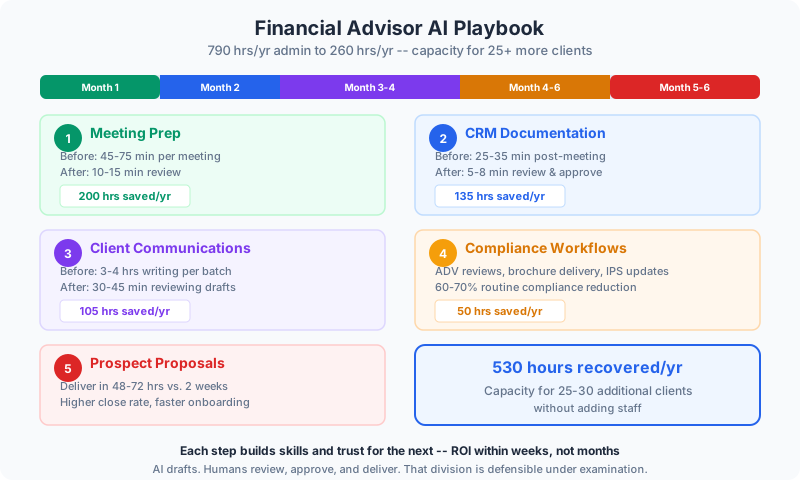
Pull account statements from your custodian. Run a performance report. Open last quarter’s notes. Check open action items. Review employer news or market events. Build the agenda. Straightforward client: 45 minutes. Complex client or major life event: two hours. Multiply by 2-3 meetings per day.
What it looks like with AI
The night before, the AI agent pulls custodian data (Schwab, Fidelity, Pershing), aggregates performance, flags significant changes, surfaces open action items from your CRM, and generates a structured briefing with agenda. You review for 10-15 minutes, add context the agent can’t know, and walk in prepared.
Setup requirements
- Custodian data feed (most major custodians support API access or automated exports)
- CRM with reasonably consistent data (doesn’t need to be perfect, but it needs to exist)
- A briefing template that defines what you want to see
What to measure
Track prep time per meeting before and after. Most advisors go from 45-75 minutes down to 10-15 minutes. That’s 30-60 minutes back per meeting, 2-3 meetings per day, 5 days a week. The math adds up fast.
The quality gain matters as much as the time gain. Advisors who walk in fully prepared build deeper relationships. They catch things. They have time to think about the conversation instead of assembling materials for it.
Step 3: Add CRM Documentation (Month 2)
CRM documentation falls into a trap: advisors know they need to document for compliance, know it’s tedious, so it gets done inconsistently. This creates compliance risk (inadequate documentation is an exam finding waiting to happen) and operational cost (if you can’t reconstruct a conversation from your notes, you’re starting fresh every meeting).
The implementation
Record client meetings with appropriate disclosure. After the meeting, the AI agent transcribes, extracts key discussion points, identifies action items, flags suitability-relevant disclosures, and generates a structured CRM entry. You review and approve.
Total post-meeting time: 5-8 minutes instead of 25-35.
The compliance benefit is significant — when an examiner asks for documentation of recommendations over three years, you have it. Structured, searchable, complete. The operational benefit compounds: every interaction captured consistently, new staff can read relationship history, and you can search for every client who discussed long-term care insurance in the past year.
Step 4: Layer in Client Communications (Month 3-4)
The math on client communications is brutal. 100 clients, meaningful contact six times per year, 30 minutes each to write and send = 300 hours annually. That’s seven and a half weeks of full-time work on outbound communication alone. Most advisors don’t hit that frequency, which means clients hear from you less than they should.
The implementation
- Create a voice document — your writing style captured for the AI to match
- Build templates for regular categories: quarterly commentary, birthdays, market volatility responses, life event follow-ups
- AI drafts and populates client-specific details from CRM
- You review a batch of drafts in 5-10 minutes, approve or edit, send
What took 3-4 hours of writing becomes 30-45 minutes of reviewing. Client contact frequency goes up. Your time on communications goes down. Referrals increase because clients feel more connected.
👉 Tip: Start with quarterly market commentary and birthday outreach — high volume, lower personalization required. Once you trust the AI’s voice matching, expand to life event follow-ups and prospect nurturing.
Step 5: Automate Compliance Workflows (Month 4-6)
Annual ADV reviews. Brochure delivery confirmations. IPS updates. Supervision logs. Marketing material reviews. The list is long and penalties for errors are real.
AI doesn’t replace your compliance consultant. It handles the workflows that should never require expert attention:
- Document generator — first drafts of routine compliance documents from your templates and client data
- Task tracker — manages compliance deadlines, sends alerts before they’re missed
- Review assistant — checks outgoing communications against compliance guidelines before they’re sent
Combined, these reduce routine compliance maintenance time by 60-70%.
Key constraint: Everything AI generates that touches client records or regulatory filings needs human approval. That’s appropriate risk management, not a technology limitation. Your compliance consultant should review AI workflows during annual review, not after an exam finding.
Step 6: Collapse Proposal Time-to-Close (Month 5-6)
Every new relationship requires documentation: financial plan, IPS, fee disclosure, account agreements. Straightforward client: 3-5 hours. Complex situation: more.
That time-to-close gap matters. A prospect with a great first meeting waits two weeks for their plan while talking to two other advisors. The one who delivers fastest with a clear, professional proposal wins.
The implementation
Complete a structured intake during discovery. AI drafts the plan framework, populates the IPS template, generates the fee schedule, assembles the package. You add specific recommendations and rationale. Deliver within 48-72 hours instead of two weeks.
More consistent proposals, delivered faster. That combination improves close rates.
The Total Impact
Here’s the full picture for an advisor with 100 clients:
| Category | Before | After | Hours Saved |
|---|---|---|---|
| Meeting prep | 300 hrs/yr | 100 hrs/yr | 200 |
| CRM documentation | 200 hrs/yr | 65 hrs/yr | 135 |
| Compliance | 80 hrs/yr | 30 hrs/yr | 50 |
| Client communications | 150 hrs/yr | 45 hrs/yr | 105 |
| Proposals | 60 hrs/yr | 20 hrs/yr | 40 |
| Total | 790 hrs/yr | 260 hrs/yr | 530 |
530 hours recovered. At 45-minute meetings with 10-15 minutes of prep, that’s capacity for 25-30 additional clients. Or the same client load with dramatically better service quality and a practice that doesn’t require 60-hour weeks.
Benefits of following this sequence:
- Each step builds skills and trust for the next
- You see ROI within weeks of starting, not months
- Compliance is addressed systematically, not as an afterthought
- Your team learns to work alongside AI gradually
- The system gets smarter with every client interaction
The Compliance Question Everyone Asks
“Will this create compliance problems?” Honest answer: it depends entirely on implementation.
AI-generated communications sent without review can create problems. Documentation nobody approves can create problems. AI tools storing client data without proper agreements can create problems.
None of these are reasons to avoid AI. They’re reasons to implement carefully. The framework: AI handles drafting, aggregation, and tracking. Humans handle review, approval, and delivery for anything client-facing or regulatory. That division of labor is both operationally efficient and defensible under examination.
Continue reading:
- AI for Financial Services — the broader financial services perspective for banks, RIAs, and insurance
- How to Implement AI in Your Business — the general implementation framework
- How to Write a Procedure — the foundation for Step 1 of this playbook
- The Alignment Blueprint — how to get your team aligned on the change
Related AI Articles
5 Compliance-Safe AI Wins for Banks, RIAs, and Insurance Firms
Financial services firms think compliance blocks AI. It doesn't. Five automation wins that improve operations without regulatory risk.
Read moreThe AEC Firm's Guide to Recovering 30% of Lost Billable Hours
A practical how-to for architecture and engineering firms that want to stop losing billable capacity to proposals, RFIs, spec coordination, and reporting.
Read moreWhy Your Law Firm's AI Strategy Is Probably Wrong
Most law firms focus AI on legal research. The real ROI is in billing, intake, calendaring, and compliance — the work that drains partner hours every day.
Read moreHow Nonprofits Are Doing 2x the Mission Work Without 2x the Budget
Nonprofit operations burn staff time on grant reporting, donor comms, and board packets. Here's how AI shifts that ratio back toward actual mission work.
Read more