
Why Your Law Firm's AI Strategy Is Probably Wrong
Most law firms focus AI on legal research. The real ROI is in billing, intake, calendaring, and compliance — the work that drains partner hours every day.
Every law firm managing partner I talk to starts the AI conversation the same way: “We’re looking at tools for legal research and contract review.” Makes sense — that’s where all the marketing dollars and conference panels point.
It’s also the wrong starting point for most firms.
I’m not saying legal research AI doesn’t work. It does. But here’s what I’ve seen over and over: the biggest ROI for mid-size law firms isn’t in legal AI — it’s in operational AI that fixes the billing leakage, intake bottlenecks, and administrative overhead consuming 30-40% of your non-attorney labor hours.
The stuff that kills your realization rate isn’t case law. It’s the invisible factory — the back office nobody talks about at legal tech conferences.
Myth #1: Legal Research AI Is Your Highest-ROI Investment
Legal research AI is impressive. An associate spends 6-10 hours on a research memo. AI cuts that to 2-3 hours of review and refinement. That’s real productivity.
But let me show you the billing math.
The ABA estimates attorneys fail to record 10-30% of billable work. At a 40-attorney firm billing $400/hour average, even a 10% gap is $1.6-3.2M in annual lost revenue. Work performed but never billed. Not because anyone decided not to bill — because entering time is annoying and attorneys do it from memory at end of day, rounding down, forgetting the 12-minute call, skipping the quick email review.
AI time capture monitors work activity — emails, documents, calendar events, calls — and drafts timesheets. The 20-minute daily chore becomes a 3-minute review. Narrative generation produces entries like “Reviewed Section 4.2 indemnification provisions of Asset Purchase Agreement; identified three material deviations from standard terms” instead of “Review contract.”
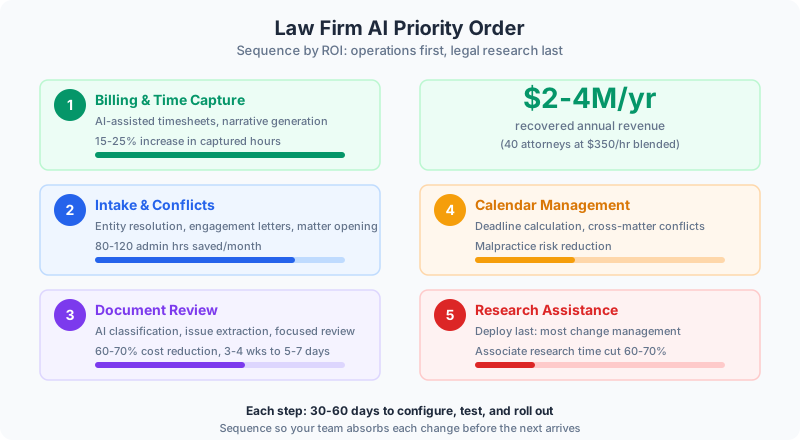
Typical result: 15-25% increase in captured hours within 90 days. On a 40-attorney firm at $350/hour blended, that’s $2-4M in recovered annual revenue.
That’s not a productivity improvement. That’s found money.
👉 Tip: Run a two-week audit. Have three attorneys track time normally AND use AI-assisted time capture. Compare the outputs. The gap between what they recorded manually and what the AI captured will make the business case for you.
Myth #2: You Need to Start With the Sexy Stuff
Contract analysis. Due diligence automation. AI-powered brief writing. These are the tools that get CLE credits and vendor booth demos.
Meanwhile, your intake process takes 2-4 hours of admin time per new matter. At 30-50 new matters per month, that’s 60-200 hours of work that doesn’t require legal judgment — just data entry, conflicts checking, document generation, and follow-up.
Intake and Conflicts: The Real Bottleneck
In a firm with 15 years of matters, the conflicts database has 50,000+ entity records. Searches must catch variations — “Smith Manufacturing” vs. “Smith Mfg.” vs. “John Smith d/b/a Smith Manufacturing.” A missed conflict isn’t embarrassing. It’s an ethics violation.
AI-powered intake does four things your current process probably doesn’t:
- Intelligent conflicts search that resolves entity variations, checks corporate family trees, and produces confidence-scored reports
- Automated engagement letters generated from approved templates based on matter type and fee arrangement
- Matter opening — billing codes, attorney assignments, calendar entries, document folders created in minutes instead of 45 minutes
- Follow-up sequences that manage document collection automatically
Benefits of AI-powered intake:
- 80-120 hours of admin time saved monthly at 40 new matters
- More thorough conflicts checking (catches what manual searches miss)
- New matters open in minutes, not days
- Reduced ethics exposure from missed conflicts
Myth #3: Document Review Is “Done” Because You Have an E-Discovery Platform
Having an e-discovery platform and using AI effectively for document review are different things. Most firms still treat AI review as a replacement for human review instead of what it actually is — a force multiplier.
Here’s how it works when done right for middle-market M&A (5,000-15,000 documents):
First pass — AI classification. The system reviews the full document set and classifies by type, relevance, and key issues (change of control, assignment restrictions, indemnification caps, IP ownership). Two weeks of reviewer work happens in hours.
Second pass — issue extraction. For relevant documents, specific provisions are extracted into structured format. Every change-of-control clause organized by counterparty, with language quoted and sections referenced.
Human review — focused and informed. Instead of reading 10,000 documents looking for issues, attorneys review 200 flagged provisions across 400 relevant documents with context. Finding issues becomes evaluating issues. Better use of a $400/hour resource.
Timeline drops from 3-4 weeks to 5-7 days. Review costs cut 60-70%.
Myth #4: Calendar Management Isn’t Worth Automating
Missed deadlines in legal practice aren’t inconvenient. They’re malpractice. A missed statute of limitations is career-ending. And calendar management at a mid-size firm is shockingly manual — triggering events require calculating downstream deadlines across federal, state, and local rules, accounting for weekends, holidays, and service method adjustments.
AI calendaring calculates all downstream deadlines from a triggering event, checks cross-matter conflicts for all required participants, and monitors whether required work product is actually progressing. Brief due in 14 days with no draft? The system flags it. Discovery deadline approaching with no responses circulated? Alert goes out.
The malpractice insurance implications alone justify this investment.
👉 Tip: Start tracking how much partner time goes into deadline-related anxiety — the checking, double-checking, and “did someone file that?” conversations. It’s higher than you think, and it’s some of the most expensive time in your firm.
The Right Priority Order
If I’m advising a managing partner or COO, here’s the sequence:
- Billing and time capture. Revenue recovery is immediate and measurable. 90-day payback.
- Intake and conflicts. Risk reduction plus time savings. Highest combined value.
- Document review. Start with one practice group and expand.
- Calendar management. Layer on as redundant protection — the cost of getting this wrong is too high.
- Research assistance. Deploy last because it requires the most change management.
Don’t do everything at once. Each takes 30-60 days to configure, test, and roll out. Sequence them so your team absorbs each change before the next arrives.
The Compounding Advantage
Firms that implement AI in operations — not just legal practice — will have structurally lower overhead. Lower overhead means better realization rates, better compensation, better talent retention, better client outcomes.
The firm that starts now will be two years ahead of the firm that starts in two years. In professional services, that gap is very difficult to close.
The question isn’t whether AI will transform law firm operations. It’s whether your firm figures it out first in your market — or is still running manual conflicts checks while your competitor’s intake system opens matters in minutes.
Continue reading:
Related AI Articles
The AEC Firm's Guide to Recovering 30% of Lost Billable Hours
A practical how-to for architecture and engineering firms that want to stop losing billable capacity to proposals, RFIs, spec coordination, and reporting.
Read moreFinancial Advisors: Double Client Capacity, Same Staff
A guide for advisors and RIAs who want more clients without more staff — by cutting the admin that eats 40% of the week.
Read more5 Compliance-Safe AI Wins for Banks, RIAs, and Insurance Firms
Financial services firms think compliance blocks AI. It doesn't. Five automation wins that improve operations without regulatory risk.
Read moreHow Nonprofits Are Doing 2x the Mission Work Without 2x the Budget
Nonprofit operations burn staff time on grant reporting, donor comms, and board packets. Here's how AI shifts that ratio back toward actual mission work.
Read more