Professional Services Firms Think AI Doesn't Apply to Them. They're Wrong.
Service firms think AI can't help because their product is thinking. That's a myth. The hidden waste in admin, billing, and reporting is massive.
I hear this constantly from partners at consulting firms, accounting practices, and agencies: “We’re not a factory. Our people are the product. AI doesn’t apply to us.”
They’re wrong. And I say that with respect — because the logic sounds right. If your product is the judgment and expertise of smart people, automating anything feels like it cheapens the offering.
But here’s what they’re missing. Professional services firms don’t have a judgment problem — they have an invisible waste problem. Their best people spend 35-45% of their time on work that has nothing to do with their expertise.
Myth #1: “Our Work Is Too Custom for AI”
This is the big one. Partners believe every engagement is unique, so nothing can be templated or automated.
Let me ask you this: How many proposals has your firm written in the last two years? And how many of them started from a blank page versus a copy-paste-modify from a previous proposal?
If you’re honest, the answer is almost all of them follow a pattern. Company overview, needs analysis, proposed approach, team bios, pricing, case studies, timeline. The structure is the same. The details change.
A $28M consulting firm I worked with cut proposal time from 8 hours to 90 minutes. The AI generates the first 80% from structured inputs — client name, engagement type, scope, timeline, team composition. It pulls relevant case studies and matches scope language from past wins.
Partners review and refine instead of creating from scratch. Proposal output increased 60% without adding headcount. Win rate stayed within 2 percentage points of historical average — meaning the AI-assisted proposals were just as good.
👉 Tip: Start by cataloging your last 20 proposals. I guarantee you’ll find that 70-80% of the content is reused across engagements. That’s your automation target.
Myth #2: “We Can’t Automate Relationships”
Nobody’s suggesting you automate relationships. But let me tell you what I see happening at most service firms: your best relationship people are buried in status reports.
Clients expect regular updates. Consultants hate writing them. So they rush through on Friday afternoon, producing mediocre reports that don’t reflect the quality of the actual work.
AI pulls from your PM system, time tracking, and milestone records to generate the report — completed milestones, upcoming work, risks, items requiring client action. The consultant reviews in 10 minutes instead of writing for 60.
A 45-person accounting and advisory firm producing 80+ reports per month dropped average time from 55 minutes to 12 minutes of review. That recovered about 57 hours per month — roughly $17K in billable capacity at their blended rate.
The irony: automated reporting improved the client relationship because reports went out on time, were more thorough, and freed up the consultant to actually talk to the client instead of writing about talking to the client.
Myth #3: “Scope Creep Is Just Part of the Business”
I hear this one a lot, usually said with a resigned sigh. “Clients ask for things. We deliver. That’s how you keep clients.”
Sure. But there’s a difference between strategic relationship investment and accidentally giving away $380K in unbilled work because nobody noticed the scope was expanding.
A $35M IT consulting firm deployed AI monitoring across 40 engagements. The system tracked hours against plan by work category and compared client communication content against the original scope document. When a client email asked for something outside scope, it flagged it before the team started working on it.
First quarter results: 67 instances of scope expansion flagged. 41 converted to change orders totaling $380K that would have been absorbed as creep. The other 26 were poorly described in the original SOW — which led to better scope definition on new work.
That’s not nickel-and-diming clients. That’s knowing what you’re giving away and making it a conscious decision instead of an accident.
👉 Tip: Pick your three highest-risk engagements and compare actual hours against planned hours by work category. If you’re consistently over, you don’t have a delivery problem — you have a scope definition problem.
Myth #4: “Our Knowledge Management Works Fine”
It doesn’t. I’m sorry, but it doesn’t.
Every engagement creates knowledge. Then the team moves on and it evaporates. Six months later, a different team starts a similar engagement from scratch. The knowledge existed — in someone’s head, in a SharePoint folder nobody can find, in email threads that got archived.
A $60M management consulting firm had 12 years of engagement history trapped in SharePoint. They processed 4,200 past engagement files into structured, searchable knowledge records. The search system averaged 340 queries per month from a 90-person firm.
That’s people asking questions like “What approach did we use for ERP selection with mid-market manufacturers?” and getting actual answers instead of spending an hour digging through folders or — more likely — just reinventing the wheel.
Reduced “reinvention time” by roughly 15% on new engagements. On average $120K engagements, that’s real margin improvement.
Myth #5: “We Track Utilization — That’s Enough”
You track utilization. But your professionals under-report time by 10-15% on average. They forget to log time, round down, or skip the 30-minute call they took while driving.
A $22M marketing agency with 35 professionals deployed AI that cross-referenced calendar events, email activity, and document editing timestamps against submitted time entries. It flagged likely gaps.
The system identified 3.2 unbilled hours per person per week. That’s $89K per month in client work that simply hadn’t been tracked. Annualized: over $1M in recovered revenue from work already being done.
Benefits of systematically addressing these myths:
- Proposal capacity increases without adding headcount
- Scope creep becomes a managed decision rather than an invisible tax
- Institutional knowledge compounds instead of evaporating
- Billable capture improves by 10-15%
- Client reporting quality goes up while time goes down
- Resource allocation gets data-driven instead of partner-gut-driven
Where the Real Utilization Improvement Lives
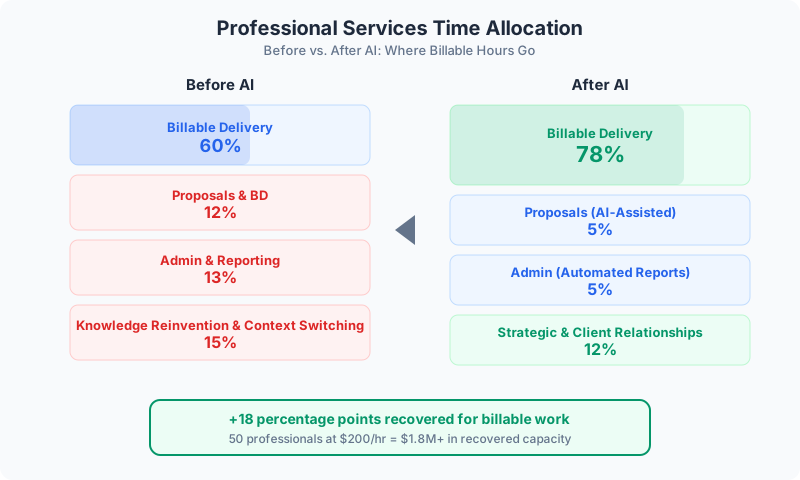
In a typical mid-market professional services firm, the utilization breakdown looks something like this:
- Billable delivery: 55-65% of available hours
- Proposal and BD: 10-15%
- Admin overhead: 10-15%
- Knowledge work that should be reusable but isn’t: 5-10%
- Context switching between engagements: 5-8%
In a firm billing at $200/hour with 50 professionals, that 35-45% non-billable time represents $3.5-4.5M per year in unbilled capacity. A meaningful chunk of that is addressable right now with AI — not by replacing professionals, but by eliminating the invisible waste that surrounds their actual expertise.
A $40M engineering consulting firm running 72% utilization with a 22-point standard deviation (some people at 95%, others at 50%) deployed AI-informed staffing. After six months: average utilization increased to 78%, standard deviation dropped to 14 points, and voluntary turnover decreased. Overworked people got relief. Underutilized people got better assignments.
The Real Question
Professional services firms don’t need AI to think for them. They need AI to stop making their best thinkers waste time on status reports, proposals that follow patterns, time tracking reconciliation, and knowledge that should have been captured three years ago.
Your people are the product. Give them better operational infrastructure so they can focus on being a better product.
Continue reading:
Related AI Articles
Which of These 4 AI Adoption Profiles Is Holding Your Company Back?
Most companies stall at the same AI adoption stage. A framework for finding where you are, why you're stuck, and what actually moves you forward.
Read moreThe AEC Firm's Guide to Recovering 30% of Lost Billable Hours
A practical how-to for architecture and engineering firms that want to stop losing billable capacity to proposals, RFIs, spec coordination, and reporting.
Read moreThe Real Money in Your Dental Practice Isn't in the Chair
Most dental AI marketing focuses on imaging and diagnostics. That's not what's killing your margins. Here's what is — and how to fix it.
Read moreFinancial Advisors: Double Client Capacity, Same Staff
A guide for advisors and RIAs who want more clients without more staff — by cutting the admin that eats 40% of the week.
Read more