
Property Managers: Triple Portfolio, Not Team Size
Property management runs on volume and repetition — exactly what AI handles best. How operators scale to 3x units without 3x staff.
I talked to a property manager last year who was handling 200 units. Smart, organized, good with tenants. She was also drowning.
Forty-five maintenance requests a week. Eighteen lease renewals next quarter. Four vacancy turns happening simultaneously. Twelve owner statements due. And a prospect who’d rescheduled the same showing four times.
When I asked where her time went, the answer was obvious to both of us: communication and documentation. Responding to tenants, updating owners, coordinating vendors, tracking leases, writing reports. Not complex work on any individual transaction — but at 200 units, the volume is relentless.
Here’s what I told her, and what I’ll tell you: property management runs on volume and repetition — which means it’s one of the highest-leverage industries for AI. The operators who figure this out first will manage 3x the units without 3x the team.
The 200-Unit Operator Who Got to 500
Let me walk you through what this looked like in practice. This was a residential PM company — one lead property manager, two assistants, handling 200 units across a mix of single-family and small multi-family.
The Maintenance Problem
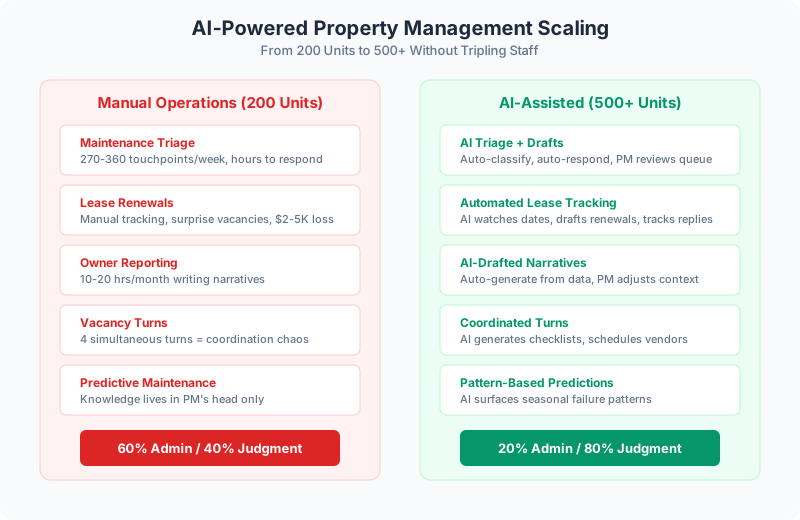
At 200 units, they were running about 45 maintenance requests per week. Each request needed a tenant response, work order creation, vendor coordination, scheduling, completion confirmation, and invoice review. That’s 6-8 touchpoints per request — 270-360 operational touchpoints per week before anyone did anything else.
Here’s the thing: most of those requests follow an identical pattern. HVAC not cooling. Garbage disposal jammed. Toilet running. Leak under sink. The response for a running toilet is the same whether it’s Unit 4B or Unit 17A.
They deployed AI on maintenance triage first. The system reads the request, classifies by urgency (emergency, urgent, routine, deferred), routes to the appropriate vendor category, and drafts the tenant acknowledgment. The property manager reviews a sorted queue rather than reading every individual request.
Results in the first 60 days:
- Triage time dropped from minutes per request to seconds of review
- Tenant response time went from hours to minutes
- The PM stopped writing the same acknowledgment email for the fifteenth time every week
👉 Tip: Start maintenance AI with just the triage and tenant communication pieces. Don’t try to automate vendor dispatch on day one — get comfortable with AI classification accuracy first, then expand.
The Lease Renewal Problem
Lease renewals follow a known cadence: 60-90 days before expiration, contact tenant, get intent, process renewal or start turnover planning. Simple in concept. At 200 units with staggered lease dates, it’s a tracking nightmare.
The cost of errors here is real:
- A tenant never contacted about renewal becomes a surprise vacancy with 4 weeks notice instead of 8
- A renewal offer sitting in someone’s inbox for 3 weeks means a tenant who assumed month-to-month and gave notice
- Each vacancy turn runs $2,000-$5,000 in lost rent plus turnover costs
AI watches lease dates and flags upcoming renewals with appropriate lead time. Drafts renewal communications. Tracks responses. The property manager reviews and approves rather than building everything from scratch.
Rent collection follows the same pattern — automated reminders on the 3rd, formal notices on the 5th, escalation for non-response. The PM’s time goes only to tenants who don’t respond to the automated sequence.
The Owner Reporting Problem
Monthly owner statements have automated number generation. But owners don’t just want numbers — they want narrative. Why was maintenance cost high this month? What’s the tenant situation in Unit 3B? How’s the rental market moving?
Writing that narrative for each owner every month was taking 10-20 hours. AI drafts from transaction data and PM notes. The PM adjusts for context only she has — tenant conversations, vendor relationships, market reads from being on the ground.
Owner communication quality went up. The Sunday evening ritual of writing 12 narratives before Monday’s statements went away.
Vacancy Turn Coordination
This is where AI shines in a less obvious way. Turning a unit involves coordinating cleaning, paint, carpet, repairs, appliance checks, photos, and listing updates. Most need to happen in sequence, some can overlap, and the goal is minimizing vacant days.
One vacancy is manageable. Four simultaneous vacancies — common when lease dates cluster — multiply the coordination load exponentially.
When a vacancy opens, AI generates a turn checklist from the unit’s maintenance history, confirms vendor availability, schedules the sequence, and tracks task completion. The PM handles exceptions: vendor cancellations, surprise repairs, units needing more work than expected.
The cognitive load of keeping four turns organized simultaneously drops dramatically.
Benefits of AI-assisted property management:
- Maintenance response time drops from hours to minutes
- Lease renewals don’t fall through cracks — every tenant gets contacted on schedule
- Owner reports go out with better narrative quality in less time
- Vacancy turns are coordinated systematically, not heroically
- Fair Housing documentation stays consistent across every screening decision
- Preventive maintenance gets flagged based on actual data patterns
The Predictive Maintenance Advantage
This one builds over time. Every maintenance request is a data point. After two years of history, patterns emerge: the HVAC units in the 1970s building fail in July and August — third week, when temperatures peak — and it’s usually the capacitor, not the compressor.
The manual version of this knowledge lives in the PM’s head. When she leaves or takes on too many properties, it’s gone.
With AI analyzing maintenance history, the system surfaces predictions: HVAC in Building C will likely need service before July. Schedule preventive maintenance in June.
Preventive maintenance costs less than emergency repairs. A Friday night in July with a tenant calling about no AC costs significantly more — parts, after-hours labor, and tenant experience damage.
👉 Tip: You don’t need years of data to start. Even 6-12 months of maintenance history will surface patterns — especially seasonal HVAC and plumbing issues. The data’s already in your PM system.
The Scaling Math
Industry average: 100-150 units per property manager. A PM handling 200 competently is doing well. But look at where the time goes.
A property manager spending 60% of her day on routine maintenance communication, lease tracking, and owner reports has 40% left for judgment work — tenant issues, vendor negotiations, market positioning, owner relationships.
AI handles the routine communication and coordination. The PM spends 70-80% on judgment work. Same person, more portfolio capacity — because judgment work scales differently than administrative work.
Getting from 200 to 400 to 600 units isn’t about working harder. It’s about what category of work fills the day. Administrative work scales linearly with units. Judgment work doesn’t.
The PM I mentioned at the beginning? She’s at 500 units now with the same team size plus one additional assistant. Revenue tripled. Headcount went up by one person. That’s the leverage.
Where to Start
Maintenance request handling. Highest volume, most repetitive, clearest data structure, immediately visible improvement.
- Deploy AI on triage — define urgency categories (emergency, urgent, routine, deferred) and let AI classify incoming requests. Review the queue instead of reading each item individually.
- Add tenant communication drafts — acknowledgments and confirmations generated automatically. Review and send.
- Measure response time over four weeks against your baseline.
The improvement is visible immediately, which builds confidence for the next phase.
Continue reading:
Related AI Articles
From Lead to Lease in Half the Time: An AI Workflow for Real Estate
A step-by-step walkthrough of how real estate teams use AI to cut lead response time, automate follow-up, streamline transactions, and reduce vacancy drag.
Read more7 Places AI Saves Money in a Dealership (Not the Pitch)
Forget the chatbot demos. Here are the seven areas where AI produces measurable ROI in auto dealerships — from the service lane to the used car lot.
Read moreFirst-Call Resolution Is Killing Field Service Margins
Every failed first visit costs $250. For a 20-tech operation, that's $100K/month in lost margin. Here's the operational fix.
Read moreWhy Franchises Are the Perfect AI Starting Point (And Most Don't Know It)
Franchises have what every AI project needs: standardized processes. Most multi-unit operators are sitting on an AI gold mine.
Read more