
Staffing Agencies: Cut Time-to-Fill Without Burnout
Staffing margins depend on time-to-fill, placement quality, and account manager retention. Here's how AI addresses all three without replacing your best people.
I worked with a mid-size staffing agency — 60 accounts, $18M in billings — that lost four accounts in one year. Not because of price. Not because of placement quality. Because a competitor filled faster.
Each of those accounts billed $250K-$400K annually. That’s over a million dollars walking out the door because of fill speed alone. The agency had 10,000 candidates in their ATS. The data was there. The problem was finding the right 23 people out of 10,000 before someone else did.
Staffing is a relationship business running on institutional knowledge that walks out the door every time an account manager quits. AI doesn’t replace the relationship — it makes the knowledge permanent and the search instant.
The Fill Speed Problem Nobody Frames Correctly
Most agencies think about time-to-fill as a recruiting metric. It isn’t. It’s a client retention metric.
Clients don’t switch agencies because of price. They switch because someone else fills faster. Competitive time-to-fill in light industrial and clerical: 3-7 days. At 14+ days, you’re actively losing clients — they’re just polite enough not to tell you until the next RFP.
What the Account Manager Actually Does
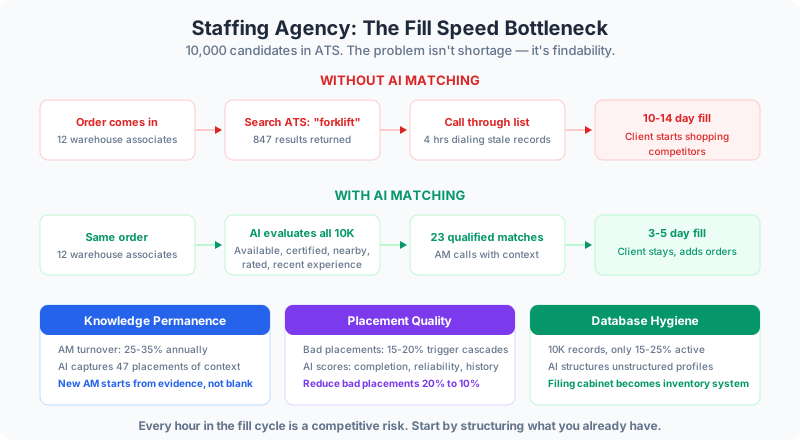
Here’s what fill speed looks like from the inside. A plant manager calls at 6:47 AM needing 12 warehouse associates by Thursday — forklift certified, first shift, steel toes. Your account manager knows this client: strict dock supervisor, and “forklift certified” means sit-down only because the aisles can’t handle stand-ups.
She opens the ATS, searches “forklift,” gets 847 results. Half were placed six months ago with outdated availability. A third don’t answer their phones anymore. She’ll spend four hours calling through the list hoping to piece together 12 people by tomorrow.
That’s the bottleneck. Not candidate shortage — candidate findability.
How AI Changes the Search
AI evaluates every open order against every available candidate simultaneously. Instead of “847 people with forklift on their profile,” the account manager gets “23 people who are available this week, within 20 miles, have active sit-down certification, worked warehouse in the last 90 days, and rated satisfactory or above.”
She still makes the calls and uses her judgment. But she’s calling 23 qualified candidates instead of dialing through 847 stale records.
Benefits of AI-assisted matching:
- Time-to-fill reductions of 30-50% — in a business measured in days, cutting from 10 to 5 is a competitive repositioning
- Account managers spend time on relationship building instead of database hunting
- Fill quality improves because the match criteria go beyond keyword searches
- Clients notice faster fills before you even tell them you changed anything
The Account Manager Retention Crisis
Your best account manager carries 15-20 accounts with context no CRM captures. She knows the warehouse on Industrial Boulevard runs cold in winter. She knows the insurance company office manager prefers quiet types. She knows Marcus always says he’s available for overtime but never stays.
That mental model is the core asset of your agency. And account manager turnover runs 25-35% annually. On a team of 10, that’s 3-4 departures per year — each meaning 3-6 months of degraded service while the replacement rebuilds the mental model from scratch.
Making Knowledge Permanent
AI captures the operational data that informs judgment. Every placement outcome, client interaction, candidate note, and pattern — structured and searchable. When the new account manager picks up the insurance company:
“This client has received 47 placements in the last 18 months. Highest satisfaction: candidates with administrative experience and introverted behavioral indicators. Three early terminations — all candidates with less than one year of prior clerical experience.”
She still has to build the relationship. But she’s starting from 47 placements of evidence instead of a blank page.
👉 Tip: Start capturing placement outcomes today — even in a spreadsheet. Did the candidate complete the assignment? What was the client feedback? This data becomes training material for AI matching later, and it’s valuable whether or not you deploy AI.
The Bad Placement Cascade
A bad placement doesn’t just cost you the replacement. It triggers a cascade:
- Direct cost — you guaranteed the placement, now you’re eating recruiting cost twice
- Relationship cost — the plant manager starts splitting orders, sending easy fills to you and premium orders to the competitor he trusts more
- Ripple cost — your account manager manages fallout instead of filling new orders, and the badly placed candidate tells others in your pool about the experience
One bad placement at a $400K account doesn’t lose it. Three in six months does. Reducing bad placements from 20% to 10% doesn’t just save replacement costs — it protects the accounts that fund your operation.
AI scores candidates beyond skills matching: completion rates, client-specific performance history, schedule reliability, and attendance patterns across prior placements. This information already lives in your system. Nobody synthesizes it at the point of placement. The account manager works from memory, and she’s right most of the time — but the 15-20% of the time she’s wrong costs disproportionately.
The 10,000-Record Filing Cabinet
Every agency has this problem: a database growing by hundreds monthly, becoming less useful as it grows. After three years you have 10,000 profiles. Maybe 2,000 are active and reachable. Maybe 5,000 have outdated contact info. Maybe 1,000 never responded after initial application.
The difference between a filing cabinet and an inventory system: a filing cabinet holds information. An inventory system tells you what you have, where it is, and what’s available right now.
AI structures the unstructured — resumes, intake notes, assessments — into consistent, searchable fields. Not “forklift” as a keyword, but “forklift certification: sit-down, certified 2024, last verified November 2025, used in 3 prior placements.” And it tracks status in real time: who just completed an assignment, who hasn’t responded in 90 days, who’s approaching end of their current placement.
👉 Tip: Run an audit of your ATS this week. How many of your “10,000 candidates” are actually active and reachable? Most agencies discover the real number is 15-25% of total records. Knowing your actual available pool is the first step toward making it useful.
Where to Start
The highest-leverage starting point: matching intelligence on the existing candidate database. It addresses the core bottleneck (time-to-fill) using data you already have.
Start by structuring the unstructured — parse resumes into consistent fields, flag stale records, identify your actual available pool. Then layer in placement outcome tracking: which placements complete, which fail early, what distinguishes the two. That data feeds future match scoring.
Every hour in the fill cycle is a competitive risk. The agencies filling in 3-5 days with 90%+ completion rates aren’t just better at recruiting — they’re better at using the data they already collect.
Continue reading:
- The 11 AI Primitives — The building blocks that map to staffing workflows like Match, Classify, and Monitor
- AI for Small Business Operations — The speed advantage that applies to staffing agencies under $20M
- Building Effective Business Systems — How to document the workflows AI will eventually automate
Related AI Articles
7 Places AI Saves Money in a Dealership (Not the Pitch)
Forget the chatbot demos. Here are the seven areas where AI produces measurable ROI in auto dealerships — from the service lane to the used car lot.
Read moreFirst-Call Resolution Is Killing Field Service Margins
Every failed first visit costs $250. For a 20-tech operation, that's $100K/month in lost margin. Here's the operational fix.
Read moreWhy Franchises Are the Perfect AI Starting Point (And Most Don't Know It)
Franchises have what every AI project needs: standardized processes. Most multi-unit operators are sitting on an AI gold mine.
Read moreYour Hotel's RevPAR Problem Isn't Pricing — It's Operations
Most hotel operators obsess over rate strategy while operational waste silently eats their margins. Here's where the real RevPAR gains are hiding.
Read more