
The AEC Firm's Guide to Recovering 30% of Lost Billable Hours
A practical how-to for architecture and engineering firms that want to stop losing billable capacity to proposals, RFIs, spec coordination, and reporting.
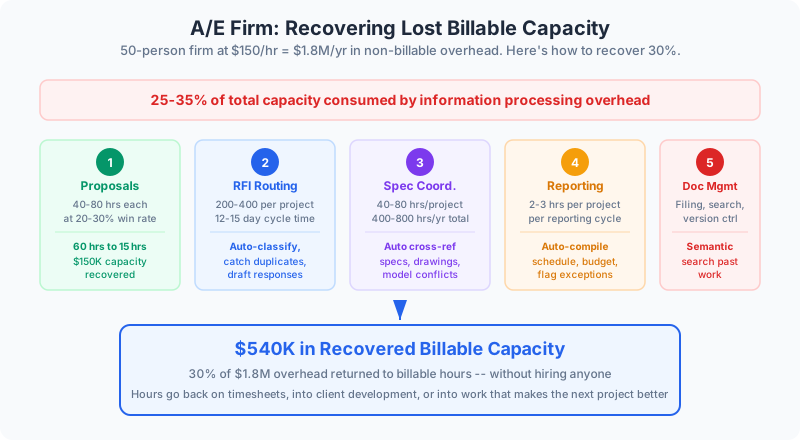
I’ve talked to enough A/E firm principals to know the math by heart. At a 50-person firm with a $150/hour loaded rate, one hour per person per day of non-billable overhead is $1.8M per year in lost capacity. Nobody budgets for that. But everyone pays it.
The overhead isn’t design work. It’s the back office — proposal assembly, RFI tracking, spec coordination, meeting minutes, project status reporting, and endless reconciliation. Information processing done by people whose value is engineering judgment, not data entry.
The question isn’t “can AI design a building?” — it can’t. The question is: what percentage of your total labor goes to information processing that doesn’t require a PE license? In most firms I’ve assessed, it’s substantial. And it’s recoverable.
Here’s how to get it back, step by step.
Step 1: Quantify Your Actual Overhead
Before you touch any AI tool, you need to know where the hours go. Most firms have a general sense that “proposals take too long” or “RFIs are a mess,” but they haven’t measured it.
How to run the audit
Pick two weeks. Have every project-facing employee track their time across these categories:
- Proposal assembly — writing, formatting, chasing resumes, updating project descriptions
- RFI/submittal processing — reading, routing, tracking, logging, following up
- Spec coordination — cross-referencing documents, checking consistency, manual markups
- Reporting — compiling status updates, budget-to-actual, schedule updates from multiple sources
- Document management — filing, organizing, searching for past work, version control
Add it up. In most 50-person firms, the total comes to 25-35% of total capacity. That’s your target.
👉 Tip: Don’t trust gut estimates. I’ve had principals tell me overhead was “maybe 15%” and then the audit showed 32%. The work is invisible precisely because nobody tracks it.
Step 2: Start with Proposals (Your Biggest Single Win)
Most A/E firms spend 3-5% of annual revenue on business development. At a 20-30% win rate, most proposals produce no revenue. They still cost the same to write.
Here’s what the typical proposal process actually involves:
- RFP comes in. Principal decides to pursue
- BD coordinator hunts for the last similar proposal — probably a year old, somewhere on an unorganized shared drive
- Updates project descriptions (requires chasing PMs for current info)
- Tracks down latest resumes from each proposed team member
- Assembles everything into a layout document
- Principal rewrites the approach section the night before it’s due
Total: 40-80 hours for a competitive proposal. The person who should spend the most time on it — the principal with the relationships and strategic thinking — spends the least.
How to implement AI here
What the AI agent does: Maintains current project descriptions, pulls relevant resumes, searches past proposals for analogous approach language, and generates a structured first draft from the RFP requirements.
What changes: Instead of 60 hours of assembly, you spend 15 hours of strategic refinement. The principal’s time goes to the approach narrative and relationship strategy — the parts that actually win work.
Expected result: At 3% pursuit cost on $10M revenue ($300K/year on proposals), cutting assembly cost by half returns $150K in capacity. More importantly, it’s principal time back on work that wins.
Setup requirements
- Centralize your proposal archive (even if it’s just a well-organized shared drive)
- Standardize resume formats across the firm
- Create a living project description document updated quarterly
That data organization work is the real effort. The AI part is straightforward once the data is clean.
Step 3: Fix RFI Routing (Stop Paying PEs to Sort Mail)
An active construction project generates 200-400 RFIs during CA. Each needs routing, tracking, and logging. Your discipline leads spend time reading RFIs that should’ve gone elsewhere, answering procedural questions that don’t need their judgment, and responding to questions already answered by previous RFIs.
When RFI cycle times run 12-15 days instead of the spec requirement of 7, the instinct is to add staff or tighten process. Usually, the real bottleneck is routing and triage.
How to implement AI here
What the AI agent does: Reads incoming RFIs, classifies by discipline, checks whether the question has been answered previously, drafts a response template if the answer is clear, and escalates with full context when it isn’t.
What changes: The discipline lead reviews and approves rather than reading from scratch. Duplicate questions get caught automatically. Routing happens in minutes, not days.
Expected result: RFI cycle time drops to within spec requirements. Engineers spend time on engineering judgment, not sorting mail.
👉 Tip: The same logic applies to submittals. Technical review requires professional judgment. Routing, tracking, log maintenance, and overdue notifications don’t. Automate the second category completely.
Step 4: Automate Spec Coordination
On complex spec books, coordination is ongoing. Divisions update, products get substituted, sections reference each other. When a mechanical system changes, someone has to verify affected spec sections haven’t become inconsistent.
In most firms, this is done manually — a project architect going section by section with hand markups. On a $5M commercial project, that’s 40-80 hours across the lifecycle. Across ten simultaneous projects: 400-800 hours per year on spec reconciliation alone.
How to implement AI here
What the AI agent does: Ingests the spec book, drawings, and model. Surfaces consistency conflicts automatically:
- A spec section referencing a product that’s been value-engineered out
- A structural element in drawings but not in the specification
- A room number mismatch between finish schedule and architectural drawings
What changes: Your project architect isn’t doing the Friday afternoon manual check that catches maybe 60% of issues. The AI does a systematic review in minutes and flags items needing judgment.
Expected result: Coordination errors caught earlier, rework reduced, and your most experienced architects spending time on design decisions instead of cross-reference exercises.
Step 5: Streamline Project Reporting
Every project has a reporting cadence. Preparing for each one means compiling schedule status, budget-to-actual, outstanding items, and next steps from multiple sources. It’s not hard work. It’s time-consuming work that repeats on every active project.
How to implement AI here
What the AI agent does: Pulls data from your PM software, financial systems, and project files. Generates a structured draft report. Flags items that need PM attention — budget overruns, schedule slippage, outstanding client decisions.
What changes: The PM reviews and adds narrative instead of building the report from scratch. What took 2-3 hours per project per reporting cycle takes 30 minutes.
Benefits of this approach across the firm:
- PMs get hours back every week for actual project management
- Reports are more consistent across projects
- Issues surface faster because the data assembly isn’t the bottleneck
- Principals get better visibility without adding meetings
The Compounding Effect
Here’s why starting matters more than starting perfectly. Administrative overhead in A/E compounds. The project engineer spending two hours on manual cross-checks is also the one staying late to hit the fee budget, getting pulled into the next project before closing the current one, writing meeting minutes at 7 PM.
The invisible work doesn’t disappear when utilization is high. It gets absorbed into overtime, weekend catch-up, and perpetually being behind. It shows up in turnover when your best PEs leave. It shows up in fee erosion when project budgets get consumed by untracked overhead.
AI doesn’t solve the talent shortage or fix broken project management. What it does is return hours to your most expensive people. Every hour of admin overhead removed from a senior engineer’s week goes back on a timesheet, into client development, or into work that makes the next project better.
At a 50-person firm, if AI returns 30% of that $1.8M in non-billable overhead, you’ve added $540K in available billable time without hiring anyone. That’s the case for AI in AEC — not transformation, not disruption. Recovered capacity.
Continue reading:
- How to Implement AI in Your Business — the general implementation framework that applies across industries
- The 5 Discovery Questions for AI — how to identify the right starting point for your firm
- Why Smart Businesses Start Manual Before Automating — the principle behind getting your data organized first
- Operational Thinking: From Theory to Practice — how to think about operations before layering on technology
Related AI Articles
Financial Advisors: Double Client Capacity, Same Staff
A guide for advisors and RIAs who want more clients without more staff — by cutting the admin that eats 40% of the week.
Read more5 Compliance-Safe AI Wins for Banks, RIAs, and Insurance Firms
Financial services firms think compliance blocks AI. It doesn't. Five automation wins that improve operations without regulatory risk.
Read moreWhy Your Law Firm's AI Strategy Is Probably Wrong
Most law firms focus AI on legal research. The real ROI is in billing, intake, calendaring, and compliance — the work that drains partner hours every day.
Read moreHow Nonprofits Are Doing 2x the Mission Work Without 2x the Budget
Nonprofit operations burn staff time on grant reporting, donor comms, and board packets. Here's how AI shifts that ratio back toward actual mission work.
Read more