
7 Places AI Saves Money in a Dealership (Not the Pitch)
Forget the chatbot demos. Here are the seven areas where AI produces measurable ROI in auto dealerships — from the service lane to the used car lot.
Every dealer conference has a row of vendors promising AI will revolutionize your business. Most of them are selling chatbots, lead scoring, or some vague “digital retailing experience.” And most dealers I talk to have the same reaction: “We tried one of those. It didn’t do much.”
They’re right. The flashy demos don’t address where dealerships actually lose money. A dealership is a documentation factory that happens to sell and service cars — and the real AI wins are in eliminating the documentation burden, not adding another widget to your website.
Here are the seven places that actually move the needle. I’ve ranked them by typical ROI speed — fastest payback first.
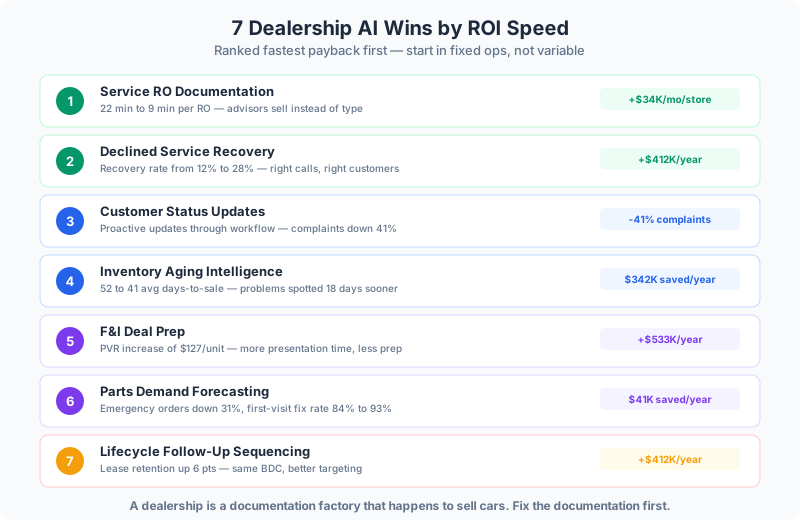
1. Service RO Documentation
Your service advisors spend roughly 35% of their time on documentation. Not diagnosing, not selling, not building relationships — typing. Writing up customer concerns, coding labor operations, documenting MPI results, recording declined services, tracking authorizations.
What AI does: Maps customer concerns to likely complaint codes based on year/make/model and known TSBs. Suggests labor operations and times from historical data. Pre-populates the RO so the writer reviews and adjusts rather than building from scratch.
Real result: A 4-rooftop dealer group cut documentation time per RO from 22 minutes to 9 minutes. Monthly service revenue increased $34,000 per store — not from new traffic, but from better execution on existing traffic. When your advisors aren’t buried in paperwork, they sell.
👉 Tip: Start in fixed ops, not variable. Service is your steadiest revenue stream, most documentation-intensive, and the staff is most receptive to tools that reduce paperwork.
2. Declined Service Recovery
Here’s revenue you already earned but didn’t collect. Every MPI generates recommended services. Some get sold. Many get declined. And in most dealerships, declined service follow-up is inconsistent at best.
What AI does: Prioritizes declined service outreach based on revenue opportunity and customer engagement patterns. Generates customer-specific communications with the technician’s findings. Sequences follow-up across channels.
Real result: One dealer group improved declined service recovery from 12% to 28%. Same number of BDC calls — just the right calls, to the right customers, with the right message. Annual incremental revenue: $412,000 across service and sales.
3. Customer Status Updates
Three customers called for updates your advisor hadn’t had time to provide. One $1,800 brake job walked because nobody could reach anyone. This happens every day in every dealership.
What AI does: Monitors RO status across the workflow and sends specific, proactive updates: “Your 2021 Camry is with our technician now. Brake inspection complete. We’ve started the timing belt replacement. Estimated completion: 3:30 PM today.”
Real result: Customer communication complaints dropped 41% at the same 4-rooftop group. That’s fewer negative reviews, fewer manager interventions, and fewer lost jobs — all without adding headcount.
4. Inventory Aging Intelligence
Every dealer knows the 60-day rule. Floor plan interest runs $15-25 per vehicle per day. At 90 days, you’re $900-$1,500 underwater on carrying costs before touching the price.
The problem with weekly pricing meetings: they’re reactive and uniform. Every 60-day unit gets the same treatment regardless of demand characteristics.
What AI does: Tracks each unit’s online performance — views, click-through rates, lead generation, market day supply for that specific year/make/model/trim/color/mileage combination. Tells you which units will sell at current pricing and which have flatlined and will hit 90 days without intervention.
Real result: A 3-location group with 400 combined used units dropped average days-to-sale from 52 to 41 days. Units reaching 90 days fell 38%. Annual floor plan savings: $127,000. Gross profit improvement from earlier sales: $215,000.
👉 Tip: The biggest win here is early intervention — AI identifies problem units 18 days sooner than weekly pricing meetings. That’s 18 days of floor plan cost you don’t eat.
5. F&I Deal Prep
Your F&I office is your highest per-transaction profit center. It runs almost entirely on the finance manager’s experience and instinct. The constraint isn’t their ability to sell — it’s the 15 minutes per customer they burn on deal prep instead of presentation.
What AI does: Given the customer profile and deal structure, AI analyzes historical data to identify which lender is most likely to approve at the best rate for this credit tier, which product combination produces the highest PVR, and what payment presentation sequence has the highest acceptance rate.
Real result: A 6-store dealer group saw F&I PVR increase $127 per unit. On 350 units/month, that’s $533,400 in additional annual gross. The biggest driver: eliminating prep time gave finance managers more time to present and build rapport.
6. Parts Demand Forecasting
Your DMS reorder points are based on rolling 12-month averages. They don’t account for seasonal patterns, recall waves, TSB-driven spikes, or the fact that you just hired a transmission specialist.
What AI does: Connects multiple data sources — service appointment scheduling, historical repair patterns by season and vehicle age, recall announcements, technician specialization changes, and regional driving patterns. Forecasts demand from multiple signals rather than simple historical averaging.
Real result: A single-point franchise dealer reduced emergency orders by 31%, improved first-visit parts availability from 84% to 93%, and saved $41,000 annually in expedited shipping. Better first-visit fix rates also lifted CSI scores.
Benefits of better parts forecasting:
- Fewer lost jobs from parts unavailability
- Lower expedited shipping costs
- Higher first-visit fix rates (drives CSI and retention)
- Better technician utilization (less waiting, more wrenching)
- More accurate inventory investment
7. Lifecycle Follow-Up Sequencing
Dealerships lose revenue at every lifecycle stage to follow-up failures:
- Declined service recommendations nobody calls about in 30 days
- Lease maturities that don’t trigger outreach until 60 days out
- Orphan customers whose salesperson left
- Service customers past their next recommended visit
CRM tools exist for this. The problem is that follow-up tasks are created manually, prioritized generically, and executed inconsistently.
What AI does: Prioritizes based on revenue opportunity and defection probability — analyzing service history, purchase history, vehicle equity, engagement patterns, and comparable customer behavior. Determines who to contact, when, through which channel, with what offer.
Real result: Lease retention improved 6 percentage points. Same BDC headcount, better targeting. Annual incremental revenue: $412,000 across service and sales.
What AI Can’t Do at Your Dealership
I want to be honest about the limits, because the vendors won’t be:
- Close a deal. Rapport is human. AI prepares and optimizes. The handshake is yours.
- Diagnose an intermittent problem. Your master tech’s 20 years of listening to engines at specific RPM ranges isn’t getting automated anytime soon.
- Manage a manufacturer relationship. Allocation, co-op, warranty audit negotiations — these depend on understanding your district manager’s personality and the factory’s priorities.
- Handle a truly angry customer. The empathy, judgment, and authority for a goodwill decision that retains them (or avoids a 1-star review) is human work.
The Right Sequence
Don’t try to do all seven at once. Here’s the order that produces the fastest learning curve and compounding returns:
- RO documentation + status updates (months 1-3) — Immediate ROI, low risk, builds team confidence
- Declined service recovery + lifecycle follow-up (months 2-5) — Captures revenue already in your data
- Inventory aging intelligence (months 4-8) — Requires platform integration, longer feedback loop
- F&I deal prep (months 6-10) — Highest complexity, deploy after the team has AI experience
- Parts forecasting (months 8-14) — Cleanest data requirements, predictions improve over time
The compounding advantage is real. After 12 months, your system knows things like: 2019-2021 Tacomas in your market need water pumps at 18% above national average, customers who buy maintenance plans at delivery retain at 73% vs. 34% without, and silver SUVs in the $28K-$35K range sell 11 days faster than white. That intelligence is built from your operation, your market, your customers. A competing dealer starting the same tools starts at zero.
Continue reading:
- AI for Small Business Operations — the fundamentals that apply whether you’re a single point or a 20-rooftop group
- The 11 AI Primitives — the building blocks behind every use case listed above
- Smart Cost Management for Business Success — how to think about cost reduction beyond just cutting heads
Related AI Articles
First-Call Resolution Is Killing Field Service Margins
Every failed first visit costs $250. For a 20-tech operation, that's $100K/month in lost margin. Here's the operational fix.
Read moreWhy Franchises Are the Perfect AI Starting Point (And Most Don't Know It)
Franchises have what every AI project needs: standardized processes. Most multi-unit operators are sitting on an AI gold mine.
Read moreYour Hotel's RevPAR Problem Isn't Pricing — It's Operations
Most hotel operators obsess over rate strategy while operational waste silently eats their margins. Here's where the real RevPAR gains are hiding.
Read moreHow One Regional Agency Cut Claims Processing Time in Half Without Hiring
How a 40-person regional agency used AI to transform claims throughput and adjuster capacity — without adding headcount.
Read more