
How One Regional Agency Cut Claims Processing Time in Half Without Hiring
How a 40-person regional agency used AI to transform claims throughput and adjuster capacity — without adding headcount.
I worked with a 40-person regional insurance agency that was stuck in a familiar bind. Their senior adjuster was running 280 open claim files against a 110-file target. The hiring req for a second adjuster had been open four months. And every time a storm rolled through, the backlog got worse, customer satisfaction dropped, and DOI complaint risk went up.
The owner didn’t want to hear about AI strategy. She wanted to know one thing: can you help my adjuster handle the volume without burning out or missing something important?
The answer turned out to be yes — but not the way most people imagine.
The Starting Point: Where Time Actually Went
Before we touched any technology, we mapped where the adjuster’s time actually went on a typical claim. The breakdown was revealing:
- Reading and extracting data from loss notices: 12-18 minutes per FNOL
- Cross-referencing against policy records: 5-8 minutes per claim
- Status calls and communication: 8-10 interruptions per hour during storm surges
- Document routing and filing: Scattered throughout the day
- Actual adjuster judgment work (coverage determination, liability assessment, reserve setting, negotiation): About 30% of total time
That 70% was the target.
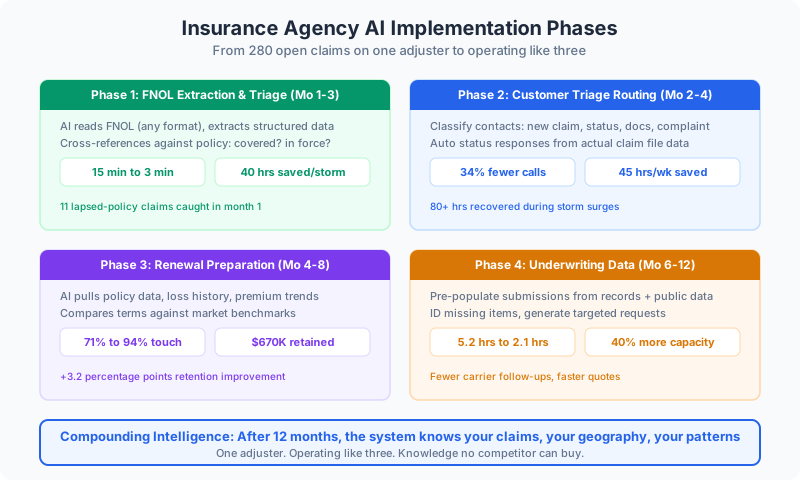
Phase 1: FNOL Extraction and Triage (Months 1-3)
The first notice of loss is where every claim begins — and where the most time gets wasted before any real work starts.
A FNOL arrives as a phone transcript, online form, email, or scanned handwritten form. It contains facts buried in unstructured narrative: date, location, damage type, parties involved. The adjuster reads it, maps to the policy, identifies coverage, determines needed documentation, and creates a task list.
We deployed AI extraction on FNOL processing. The system reads the FNOL regardless of format and pulls structured data — date of loss, peril type, property address, claimant information, damage description. It cross-references against the policy record: Is the property covered? Is the peril included? Is the policy in force?
The Results
- Intake time dropped from 15 minutes to 3 minutes of adjuster review per claim
- On a 200-claim storm day, that’s 40 adjuster-hours recovered
- 11 claims flagged in the first month where the policy had lapsed or the peril wasn’t covered — avoiding weeks of wasted investigation on each
👉 Tip: FNOL extraction is the single highest-ROI starting point for any insurance operation. Every claim touches it, the data is already structured enough for AI to work with, and the time savings are immediate and measurable.
Phase 2: Customer Triage Routing (Months 2-4)
When claim volume spikes, every phone call interrupts an adjuster working files. Policyholders want status updates. Contractors want authorization. Attorneys want to put you on notice. New claimants want to file.
We deployed triage routing in parallel with FNOL extraction:
- Incoming contacts classified by type (new claim, status inquiry, document submission, vendor coordination, complaint)
- Priority assigned (standard, urgent, attorney-represented, DOI inquiry)
- Automated status responses pulled from the actual file — not generic templates
- Document submissions routed directly to the correct claim file
The Results
- 34% reduction in inbound calls reaching the adjuster
- At 8 minutes average per interruption: 45 adjuster-hours per week recovered during normal volume
- Over 80 hours recovered during storm surges
The compounding effect matters here. An adjuster who processes claims faster AND gets interrupted less has dramatically more capacity than either improvement alone.
Phase 3: Renewal Preparation (Months 4-8)
With claims stabilized, we turned to revenue. This agency renewed 60-70% of its book annually — about $18-21M in renewal premium on a $30M book. The process involved generating a 60-day pre-expiration list, reviewing each policy for exposure changes, pulling loss history, comparing pricing, and preparing a renewal proposal.
The problem: renewals worked too late, too generically, or not at all. Their 90-day touch rate was 71%.
AI renewal automation now pulls policy data, loss history, premium trends, and exposure changes. It compares current terms against market benchmarks, identifies risk changes, and drafts renewal summaries — flagging accounts that need human attention.
The Results
- 90-day touch rate went from 71% to 94%
- Retention improved 3.2 percentage points
- Approximately $670,000 in annual retained premium that would have walked
Benefits of AI-assisted renewal preparation:
- Every policy gets worked on time with complete information
- Accounts needing human attention are surfaced early (adverse loss history, coverage gaps, premium spikes)
- Producers spend time on retention conversations, not data assembly
- Consistent quality regardless of workload volume
Phase 4: Underwriting Data Gathering (Months 6-12)
The final phase tackled the commercial lines submission bottleneck. Gathering ACORD applications, loss runs, financial statements, inspection reports, and carrier-specific supplementals for a single mid-market account was taking 3-8 hours of back-and-forth.
AI now pre-populates submission data from existing records and public sources, identifies what’s missing, generates targeted requests, and monitors for responses.
The Results
- Submission prep time dropped from 5.2 hours to 2.1 hours
- Submission volume capacity increased 40% without adding staff
- Fewer follow-up requests from carriers, faster quotes, better hit ratios
👉 Tip: Don’t start with underwriting automation. It’s the highest complexity and requires the most integration. Build organizational comfort with AI-assisted workflows on claims first, then expand to underwriting when your team trusts the technology.
What AI Can’t Do in Insurance
Limits matter more in insurance than most industries because consequences are regulated and litigated:
- Coverage determination on complex claims — AI can verify policy status and peril coverage but can’t interpret concurrent causation scenarios
- Bad faith exposure assessment — every claim handling decision carries potential liability that no AI can evaluate
- Settlement negotiation — knowing when to increase, hold firm, or involve coverage counsel requires human judgment
- Regulatory compliance decisions — state regulations vary enormously, and AI should track deadlines but not make judgment calls
The Compounding Effect
After 12 months of AI-assisted processing, the agency’s system knows things no off-the-shelf software could tell them:
- Hail claims in specific zip codes average $8,400 and close in 16 days
- Water damage claims with plumber invoices at FNOL close 40% faster
- Claims from a specific contractor network have 15% fewer supplement requests
That intelligence is built from their data, their claim history, their geographic footprint. A competitor deploying the same technology six months later starts with none of it.
The senior adjuster from the beginning? Six months after deployment, she handles the same 280 post-storm files. She reviews pre-processed summaries instead of raw loss notices. Status calls are handled automatically. She focuses judgment on the 60 files that actually need it. The other 220 move through a structured workflow that surfaces them only when a human decision is required.
She’s still one adjuster. She just operates like three.
Continue reading:
Related AI Articles
The AEC Firm's Guide to Recovering 30% of Lost Billable Hours
A practical how-to for architecture and engineering firms that want to stop losing billable capacity to proposals, RFIs, spec coordination, and reporting.
Read moreWhat Your Senior Accountants Wish You Knew About AI
Most AI-for-accounting pitches miss the point. Here's what matters and the myths keeping firms from recovering senior capacity.
Read moreHow a Mid-Size GC Cut Bid Prep Time by 60% Without Adding Estimators
How one general contractor used AI to fix estimating bottlenecks, catch cost overruns weeks earlier, and stop losing tribal knowledge to turnover.
Read moreStop Firefighting Ecommerce: Let AI Run the Boring Ops
A framework for ecommerce operators tired of stockout alerts, ad spend blowouts, and unresolved tickets. Hand the pattern recognition to AI.
Read more