
The Operator's Guide to AI on the Shop Floor
A step-by-step guide for manufacturing operators — from mapping hidden waste to deploying AI agents that compound over time.
If you run a manufacturing operation, you’ve probably heard someone at a conference say “AI is the future of manufacturing.” Then they showed a slide about a $500M automotive plant with robots and computer vision, and you thought: that’s not my world.
You’re right. That isn’t your world. But AI absolutely belongs on your shop floor — just not the version the conference speaker was selling.
I’m going to walk you through exactly how to implement AI in a $10-50M manufacturing operation. Not theory. Not the robot-and-camera version. The practical version that fixes the scheduling chaos, captures the tribal knowledge walking out the door, and eliminates the fire drills eating your first shift alive.
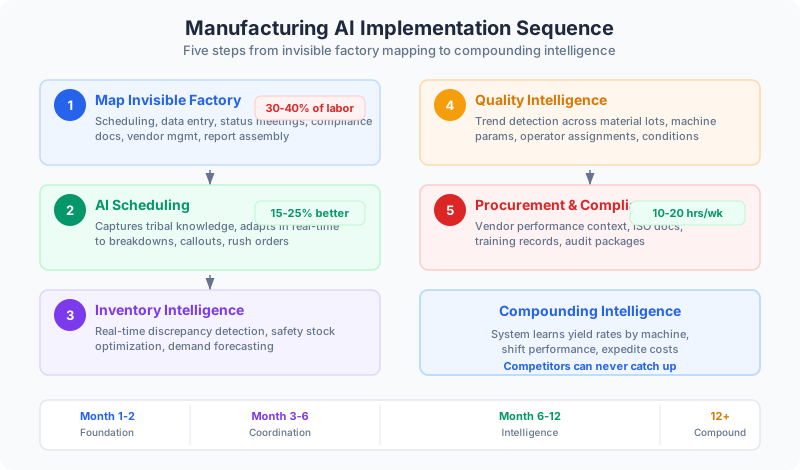
Step 1: Map Your Invisible Factory
Every manufacturing operation runs two factories. There’s the visible one — machines, materials, labor, product flowing from raw to finished. Then there’s the invisible one — scheduling, data entry, status meetings, compliance documentation, vendor management, report assembly.
In a typical $20-50M operation, the invisible factory consumes 30-40% of salaried labor hours — and those aren’t productive hours. They’re overhead disguised as operations.Before you deploy any AI, you need to know where those hours go. Pull your salaried payroll. List every recurring task that doesn’t directly make product or serve a customer. Estimate hours per week. Multiply by loaded cost.
I’ve done this exercise with dozens of operators. The number is always bigger than they expect. Usually $200K-$500K annually in a mid-size plant, just in non-value-adding labor on the salaried side.
Common invisible factory tasks in manufacturing:
- Production scheduling and rescheduling (5-15 hours/week)
- Data entry across systems that don’t talk to each other (10-20 hours/week)
- Status meetings to share information that should be visible (5-10 hours/week)
- Compliance documentation — ISO, OSHA, customer certifications (5-15 hours/week)
- Vendor follow-up and procurement coordination (5-10 hours/week)
👉 Tip: Don’t estimate these numbers from a conference room. Shadow your planners, buyers, and quality managers for a week. Track what they actually do hour by hour. The gap between what they’re supposed to do and what they actually spend time on is your AI opportunity map.
Step 2: Start With Scheduling (It’s Always Scheduling)
I’ve asked hundreds of manufacturing operators what their biggest daily headache is. The answer is always some version of: “The schedule blew up again.”
Traditional production scheduling combines software and tribal knowledge. The software handles math — capacity, lead times, routings. The tribal knowledge handles everything else — which operator fits which machine, which customer tolerates a day’s slip, which jobs share a setup, which material substitution actually works despite what the BOM says.
The problem: that tribal knowledge lives in one person’s head. When Mike the planner is out sick, the schedule suffers. When Mike retires, thirty years of scheduling intuition walks out the door.
How AI Scheduling Works
AI scheduling doesn’t replace Mike. It captures what Mike knows and applies it consistently.
The system learns through interaction — Mike corrects a machine assignment because the new operator on L2 isn’t ready for tight-tolerance work. That correction becomes permanent organizational knowledge. Next time, the system knows. And the time after that. And when Mike retires, his knowledge stays.
Benefits of AI-assisted scheduling:
- 15-25% improvement in schedule adherence within 90 days
- Tribal knowledge captured and applied consistently
- Real-time adaptation when conditions change (breakdowns, callouts, rush orders)
- Reduced dependency on individual planners
Step 3: Deploy Inventory Intelligence
Cycle count discrepancies are the bane of every manufacturing operation. In most plants, a discrepancy triggers a fire drill — six people pulled off their jobs, half a day lost, eleven touchpoints across departments.
AI inventory agents catch discrepancies the moment they appear. When a cycle count variance surfaces at 11 PM, the agent traces root cause, evaluates impact on the production schedule, identifies material substitutions, and initiates corrective action — all before first shift walks in.
The real value isn’t just speed. It’s that your highest-paid people stop spending their mornings on fire drills and start spending them on the work they were actually hired to do.
What AI Inventory Management Handles
- Real-time discrepancy detection and root cause tracing
- Safety stock optimization based on actual demand patterns (not just reorder points)
- Dead stock identification before it sits for a full quarter
- Demand forecasting that improves as it learns your patterns
👉 Tip: Before you deploy inventory AI, clean up your BOMs. Inaccurate bills of material create phantom variances that waste AI capacity just like they waste human capacity. Get your BOMs to 98%+ accuracy first — then let AI handle the remaining variance.
Step 4: Add Quality Intelligence
Quality management in most mid-size plants is reactive. Something fails inspection, you investigate, you find a root cause (maybe), you write a corrective action, and you move on. The pattern repeats.
AI quality agents monitor quality data in real time and identify trends before they become nonconformances. They connect quality issues to root causes across multiple data sources — material lots, machine parameters, operator assignments, environmental conditions.
A pattern that would take a quality engineer weeks to identify through manual analysis — “dimensional variance on Part X increases 0.003” when Machine M3 has been running for more than 4 hours continuously” — surfaces in days.
Fewer escapes. Faster resolution. Audit prep in hours instead of weeks.
Step 5: Layer in Procurement and Compliance
Once scheduling, inventory, and quality are running on AI, procurement and compliance become natural extensions.
Procurement AI integrates vendor performance data, cost trends, lead time reliability, and quality history into every purchasing decision. It doesn’t replace your buyer’s relationships. It arms your buyer with complete context for every conversation. When a vendor is three days late and your buyer calls them, she knows their on-time rate is 67% over the last 90 days, their last three shipments to you had quality holds, and their competitor quoted 8% lower last month. That’s a different conversation.
Compliance AI maintains ISO documentation, tracks training records, prepares audit packages, and flags compliance gaps before they become findings. This alone recovers 10-20 hours per week in a typical operation — pure invisible factory work that nobody enjoys and everyone dreads.
The Compounding Effect
Here’s what separates AI from traditional software: it gets better over time.
Your scheduling agent at month 12 has learned that Job 4472 always has a 2% yield loss on Machine M3. That Tuesday second shift runs 4% faster than Monday first shift on a specific part family. That the last three expedites for a certain customer cost an average of $2,300 in overtime.
You can buy the platform. You can’t buy the intelligence. Every month you run it, the moat gets deeper. Your competitor who starts a year from now will never catch up to the institutional knowledge your system has already accumulated.
The Implementation Timeline
Phase 1 — Foundation (Months 1-2): Map the invisible factory. Deploy scheduling AI. Establish human-in-the-loop review. Set baseline metrics.
Phase 2 — Coordination (Months 3-6): Add inventory and quality intelligence. Build cross-system knowledge sharing. Implement decision traces for auditability.
Phase 3 — Intelligence (Months 6-12): Layer in procurement and compliance. Let compounding intelligence develop. Watch for emergent coordination between systems.
The invisible factory in your plant is running right now. The question is whether you keep staffing it with your most experienced people — or let AI handle the overhead while your team does work that actually creates value.
Continue reading:
Related AI Articles
The AEC Firm's Guide to Recovering 30% of Lost Billable Hours
A practical how-to for architecture and engineering firms that want to stop losing billable capacity to proposals, RFIs, spec coordination, and reporting.
Read moreFinancial Advisors: Double Client Capacity, Same Staff
A guide for advisors and RIAs who want more clients without more staff — by cutting the admin that eats 40% of the week.
Read more5 Compliance-Safe AI Wins for Banks, RIAs, and Insurance Firms
Financial services firms think compliance blocks AI. It doesn't. Five automation wins that improve operations without regulatory risk.
Read moreWhy Your Law Firm's AI Strategy Is Probably Wrong
Most law firms focus AI on legal research. The real ROI is in billing, intake, calendaring, and compliance — the work that drains partner hours every day.
Read more