
Your Sales Forecast Is Wrong — Here's How AI Makes It Honest
Sales forecasts miss by 20-40% because they rely on rep self-reporting. AI builds forecasts from observed behavior instead.
I’ll tell you exactly what your VP of Sales does before every board meeting. She opens the CRM, looks at the $14M pipeline, mentally discounts 40% of it because she knows which reps inflate stages and which ones forget to update, and presents a number based on gut feel wrapped in a spreadsheet.
The board thinks they’re getting a forecast. They’re getting an educated guess.
The average B2B sales forecast is off by 20-40%. Both directions are bad — a miss triggers cost cuts, a beat means you under-hired and under-invested. Neither is a forecast. It’s a guess with formatting.
The core problem isn’t your sales team — it’s that forecasting relies on self-reported data from people with incentives to be optimistic. A rep who commits $300K doesn’t want to downgrade. It feels like admitting failure. So deals stay in commit past the point where every behavioral signal says otherwise.
AI doesn’t fix your reps. It builds the forecast from observed behavior instead of self-reported stages. That changes everything.
The Problem: Your CRM Is Lying to You
Let me paint the picture. A 40-person sales team generates about 2,400 CRM activities per week. Between 30-50% of those records are incomplete, outdated, or wrong. Contacts marked “engaged” with no activity in 90 days. Deals at proposal stage with no meeting in six weeks. Revenue amounts unchanged since discovery.
A RevOps team at a $50M company audited their Salesforce and found:
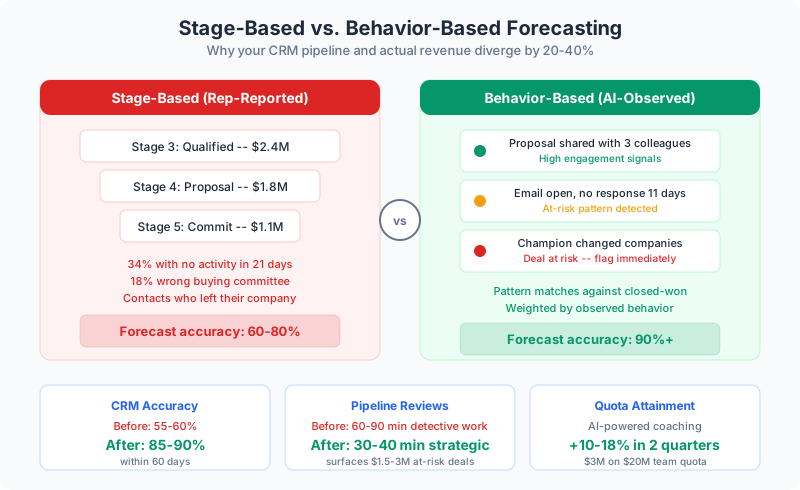
- 34% of stage 3-5 opportunities had no activity in 21 days
- 18% had contact roles that didn’t match the actual buying committee
- Economic buyers who’d left the company months ago were still listed as primary contacts
This isn’t a training problem. It’s a friction problem. Logging a detailed call note takes 4-6 minutes. A rep making 30 calls daily would spend 2-3 hours just on documentation. So “good call, moving forward” becomes the universal note. And your pipeline review, territory plan, and forecast are all built on top of that.
How AI fixes CRM hygiene
AI watches the gap between what’s happening in email, calendar, and call recordings versus what’s in the CRM:
- Three meetings this week but stage hasn’t moved since last month — flagged
- Primary contact’s LinkedIn shows they changed companies — flagged
- Prospect’s last email said “pushing to Q3” but close date still says this quarter — flagged
The output isn’t automatic CRM updates. It’s a daily digest for each rep: here are five records that don’t match reality. Update them or explain why they’re correct.
CRM accuracy improves from 55-60% to 85-90% within 60 days. That’s not administrative cleanup — it’s the foundation for everything else to actually work.
👉 Tip: Measure your CRM accuracy before doing anything else. Pull stage 3-5 opportunities and check how many have activity in the last 14 days. If it’s below 70%, no analytical tool on top will produce trustworthy outputs.
The Solution: Behavior-Based Forecasting
Here’s the key insight. A Stage 4 deal where the prospect opened the proposal once and hasn’t responded in 11 days is fundamentally different from a Stage 4 deal where the prospect shared the proposal with three colleagues, two of them visited the pricing page, and the champion emailed asking about implementation timelines.
Both show as “Stage 4 — $85,000 — Close Date: April 30” in your pipeline report. AI sees the difference.
What behavior-based forecasting actually does:
AI builds a forecast from observed signals rather than rep-entered stage:
- Historical pattern matching: What did deals that actually closed look like at 30, 60, and 90 days before close? Email engagement, meeting cadence, stakeholder expansion, document sharing patterns.
- Current deal comparison: Each active deal gets compared against those patterns in real time.
- Weighted probability: Deals matching closed-won patterns get weighted higher. Deals matching closed-lost patterns get weighted lower — regardless of what stage the rep entered.
A $40M company ran this for three consecutive quarters. The AI forecast was within 8% of actual close. The rep-reported forecast was off by 22-35%. The VP started using the AI number for operational planning — hiring, capacity, and vendor commitments.
Think about what that means downstream. A CFO who can trust revenue forecasts within 10% makes fundamentally different decisions about cash, hiring, and investment than one building a 30% buffer into every plan.
Benefits of behavior-based forecasting:
- Forecast accuracy improves from 60-80% to 90%+ within two quarters
- At-risk deals surface 3-4 weeks earlier than stage-based reviews catch them
- Pipeline reviews shift from “what’s happening?” to “why does the system think this deal is at risk?”
- Territory and capacity planning become reliable instead of aspirational
- Board conversations shift from defending the number to discussing strategy
What AI Does for the Rest of Sales Ops
Forecasting is the headline, but AI fixes several other problems once the data foundation is clean.
Pipeline Visibility
The weekly pipeline review — VP pulls the report, goes rep by rep, asks “where are we on this one?” — becomes obsolete. AI builds a health score underneath the stage model, watching email engagement, document views, meeting frequency, and response latency.
Pipeline reviews drop from 60-90 minutes to 30-40. More importantly, they surface $1.5-3M in at-risk deals that the stage model showed as healthy. Deals the VP can now act on instead of discovering they were dead two weeks before quarter-end.
Rep Coaching
A sales manager with 8-10 reps has time to listen to 2-3 call recordings per rep per month — a 3-5% sample. AI processes every recorded call and identifies patterns that correlate with outcomes:
- Reps above 65% talk time close at roughly half the rate of those at 40-50%
- Three or more follow-up questions per discovery topic converts at 2x
- Reps who acknowledge competitors and redirect to business outcomes outperform those who disparage
Quota attainment improves 10-18% within two quarters. On a team carrying $20M in annual quota, a 15% improvement is $3M in incremental revenue. The coaching didn’t change — the manager’s ability to know what to coach on did.
👉 Tip: Don’t use AI call analysis as a surveillance tool. Use it to identify coaching patterns across the team. The fastest adoption happens when reps see it helping them hit quota, not monitoring their behavior.
Proposal Speed
A complex B2B proposal takes 3-6 hours. AI generates first drafts from CRM data, call recordings, and pricing engines in 8-12 minutes. The rep edits — because AI doesn’t know the political dynamics or what the champion cares about versus the CFO. But starting from 75% complete is fundamentally different from starting blank.
Rep time per proposal drops from 4-5 hours to 40-60 minutes. That’s 45-75 hours per week returned to selling across a 40-person team.
Where Sales Ops Starts
The highest-leverage starting point is CRM data quality. Everything else — forecasting, pipeline visibility, territory planning, compensation accuracy — depends on reliable underlying data.
The sequence:
- Deploy AI monitoring on the gap between communication data and CRM records
- Build the daily hygiene digest for reps
- Get CRM accuracy above 85%
- Layer on behavioral deal scoring and behavior-based forecasting
Don’t skip to forecasting with dirty data. You’ll get a precise answer to the wrong question.
When 40% of your team’s time goes to admin, your forecast is routinely off by 25%, and pipeline reviews are detective work — the problem isn’t your people. It’s the operational infrastructure underneath them. Fix the infrastructure and your people can actually sell.
Continue reading:
Related AI Articles
7 Places AI Saves Money in a Dealership (Not the Pitch)
Forget the chatbot demos. Here are the seven areas where AI produces measurable ROI in auto dealerships — from the service lane to the used car lot.
Read moreFirst-Call Resolution Is Killing Field Service Margins
Every failed first visit costs $250. For a 20-tech operation, that's $100K/month in lost margin. Here's the operational fix.
Read moreWhy Franchises Are the Perfect AI Starting Point (And Most Don't Know It)
Franchises have what every AI project needs: standardized processes. Most multi-unit operators are sitting on an AI gold mine.
Read moreYour Hotel's RevPAR Problem Isn't Pricing — It's Operations
Most hotel operators obsess over rate strategy while operational waste silently eats their margins. Here's where the real RevPAR gains are hiding.
Read more