
Why Franchises Are the Perfect AI Starting Point (And Most Don't Know It)
Franchises have what every AI project needs: standardized processes. Most multi-unit operators are sitting on an AI gold mine.
I’ve talked to hundreds of operators about AI readiness. The conversation usually starts the same way — they want to know what data infrastructure they need, what tools to buy, how long it takes to “get ready.” Reasonable questions.
But when I talk to franchise operators, the conversation is different. They already have what everyone else is trying to build. They just don’t know it yet.
Franchises are the single best starting point for AI in operations because the hardest part — standardized, documented processes — is already done. The franchisor did it for you. The operations manual, the SOPs, the training protocols, the brand standards. That’s the foundation every AI implementation needs, and most businesses spend months building it from scratch.
Myth #1: “AI Requires Cutting-Edge Tech Infrastructure”
This is the biggest misconception I hear from franchise operators. They assume AI means million-dollar platforms, data science teams, and some kind of futuristic setup that only enterprise companies can afford.
Here’s the reality: your POS system, your scheduling software, your inventory tracker — they’re already generating the data AI needs. Every transaction, every labor hour, every food cost entry is a data point. You’re sitting on years of it.
The gap isn’t technology. It’s that nobody’s connecting the dots between what your systems already capture and what AI can do with it.
👉 Tip: Before you evaluate any AI tool, export 90 days of data from your POS and scheduling system. If you can get it into a spreadsheet, AI can work with it. That’s the only infrastructure test that matters.
What “AI-Ready” Actually Looks Like in a Franchise
- Standardized processes documented in an operations manual
- Consistent data collection across locations (POS, scheduling, inventory)
- Defined metrics you already track (food cost, labor %, customer satisfaction)
- Multiple locations generating comparable data sets
If you’re a franchisee with 5+ locations, you check every box. An independent restaurant trying to implement the same AI would need six months of process documentation first.
Myth #2: “AI Is About Replacing People”
I hear this from franchise managers constantly. They picture robots running the fryer or an algorithm firing underperformers.
That’s not what’s happening. The real story is visibility. You have 12 locations. You can’t be in all 12 kitchens at once. Your weekly reports tell you what happened last week — not what’s happening right now.
AI closes the visibility gap. It watches the data your systems generate and tells you where to look before the problem shows up in a weekly P&L.
The Food Cost Example
Location 7 is running food cost at 34%. The system average is 28%. By the time you see that in a weekly report, you’ve already lost a week’s worth of margin.
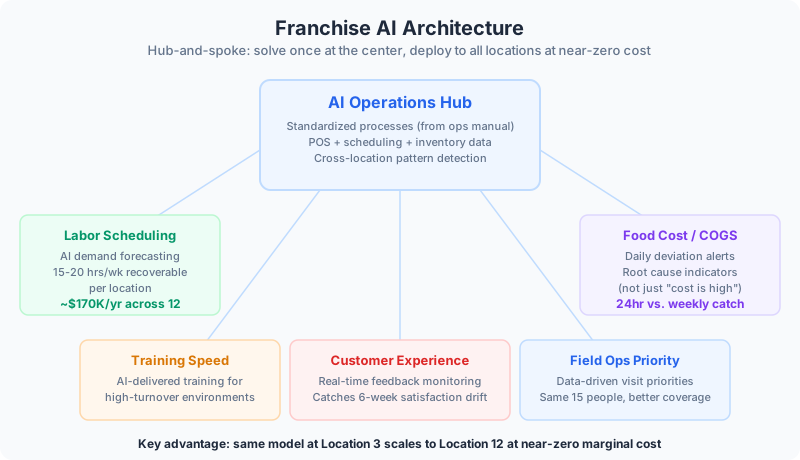
AI running daily analysis catches it in 24 hours. It can tell you that combo modifications at Location 7 are running at 40% versus 8% system-wide. That’s not a food cost problem — that’s a training problem at one location. Now you know exactly what to fix and where.
Benefits of AI-driven variance monitoring across locations:
- Daily deviation alerts instead of weekly report reviews
- Root cause indicators (not just “food cost is high” but “here’s why”)
- Automatic prioritization — which location needs attention first
- Trend tracking that catches slow drifts before they become big problems
Myth #3: “You Need to Solve Everything at Once”
Multi-unit operators love comprehensive solutions. They want a platform that handles scheduling, inventory, customer experience, training, and reporting all in one shot.
That’s the wrong approach. The franchise operators I’ve seen succeed with AI all started with one specific problem — usually the one costing them the most money.
The Labor Math That Changes Minds
Labor sits between 25% and 40% of revenue in most franchise models. Every hour scheduled against a slow shift is margin walking out the door.
Here’s what a basic AI scheduling tool does: it takes your historical transaction data, adjusts for seasonality and local events, and produces a labor recommendation your manager reviews — instead of building from a blank sheet.
- At one location: 15-20 labor hours/week in recoverable variance
- Across 12 locations: 180-240 hours/week
- At $16 average loaded cost: roughly $170,000/year in recoverable labor
- Even recovering 30-40% of that is a meaningful number
👉 Tip: Pick your highest-cost operational problem — usually labor variance or food cost — and solve that one thing first. A single win across 12 locations is worth more than a partial solution across five problem areas.
Myth #4: “Franchisors Won’t Allow It”
Some operators assume the franchise agreement locks them into specific systems with no room for AI tools. Sometimes that’s true — but less often than you’d think.
Most franchise agreements govern the customer-facing experience and core operating systems. They don’t typically restrict how you analyze your own operational data, how you build schedules, or how you monitor performance across your locations.
And increasingly, franchisors are the ones pushing AI adoption. They want network-wide visibility into brand standard compliance, and AI gives them that at scale.
The Franchisor Advantage
If you’re a franchisor watching 300 locations with 15 field ops people, the math doesn’t work without AI. You can’t visit every location every quarter. You definitely can’t spot a six-week satisfaction decline at Location 47 from a spreadsheet.
AI gives field teams data-driven visit priorities. Instead of scheduled rotations, they go where the signals say there’s a problem. Same 15 people, dramatically better coverage.
Where Smart Franchise Operators Start
The right starting point depends on what’s costing you the most:
- Labor variance — AI-powered scheduling. Highest ROI, clearest data, fastest feedback loop
- Food cost inconsistency — Daily COGS monitoring with AI-flagged deviations
- Training speed — AI-delivered training and verification for high-turnover environments
- Customer experience drift — Real-time feedback monitoring across locations
The compounding advantage is what makes franchises unique here. The same model that works at Location 3 scales to Location 12 at near-zero marginal cost. You don’t solve food cost monitoring for one location — you solve it for all of them simultaneously.
That’s the leverage most franchise operators are leaving on the table.
Continue reading:
Related AI Articles
7 Places AI Saves Money in a Dealership (Not the Pitch)
Forget the chatbot demos. Here are the seven areas where AI produces measurable ROI in auto dealerships — from the service lane to the used car lot.
Read moreFirst-Call Resolution Is Killing Field Service Margins
Every failed first visit costs $250. For a 20-tech operation, that's $100K/month in lost margin. Here's the operational fix.
Read moreYour Hotel's RevPAR Problem Isn't Pricing — It's Operations
Most hotel operators obsess over rate strategy while operational waste silently eats their margins. Here's where the real RevPAR gains are hiding.
Read moreHow One Regional Agency Cut Claims Processing Time in Half Without Hiring
How a 40-person regional agency used AI to transform claims throughput and adjuster capacity — without adding headcount.
Read more