
8 Ways Home Service Companies Use AI to Grow Without Trucks
A practical numbered list of where home services operators are finding real AI ROI — from dispatch optimization to callback reduction to guided quoting.
If you run a home services company, your growth plan probably involves adding trucks, hiring techs, and hoping the new people ramp fast enough to cover the overhead. That model works — until labor costs eat your margin and you can’t find qualified techs anyway.
There’s another way to grow. Not by adding capacity, but by getting dramatically more out of the capacity you already have. I’ve worked with operators who’ve added $100K+ in annual revenue without a single new hire, just by fixing the operational waste hiding inside their existing business.
The average home services business loses 8-15% of revenue to invisible operational waste — callbacks, bad routing, inconsistent quoting, and communication failures. On a $5M company, that’s $400K-$750K sitting inside your operation right now.
Here are the eight places AI is actually recovering that money.
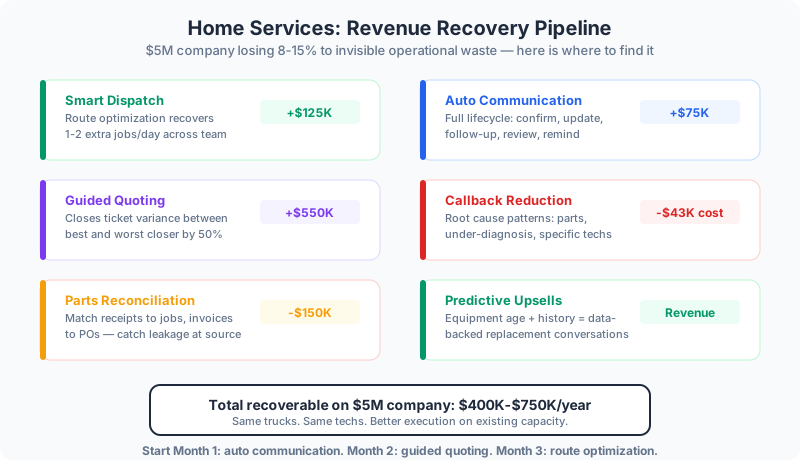
1. Smart Dispatch and Route Optimization
Your dispatcher is solving a math problem that gets exponentially harder as the day goes on — tech locations, job locations, skill requirements, drive times, emergency calls, parts availability. She’s doing it in her head, and she’s good at it. But “good” isn’t optimal.
AI route optimization takes every variable and returns a schedule that recovers 1-2 jobs of capacity per day across your team. No new trucks, no new techs — just less windshield time.
The math: 8 techs, 4-6 jobs each, $250 average ticket. Recovering one job per day across the team is $250/day or $62,500 annually. At two jobs per day, it’s $125K.
👉 Tip: Don’t rip out your dispatch process overnight. Start by having your dispatcher review AI-generated schedules instead of building from scratch. Three months of that cuts dispatch time 40-60% and gives you real data on the efficiency gain.
2. Automated Customer Communication
Most home services businesses lose 10-20% of potential repeat and referral revenue because follow-up falls through the cracks. No post-job check-in. No maintenance reminder. No review request.
AI-driven communication sequences handle the entire lifecycle:
- Appointment confirmation (immediate)
- Tech-on-the-way notification with GPS window
- Post-job follow-up within 24 hours
- Review request at day three
- Maintenance reminder before the next service window
A $5M business converting 15% more customers into second-year repeats adds $75K+ in revenue without a single marketing dollar.
3. Guided Quoting for Consistent Tickets
Here’s a pattern I see at every home services company: your best closer quotes comprehensively with good/better/best options and upsells where appropriate. Your newest tech quotes the minimum and leaves. The gap in average ticket between your best and worst is usually 25% or more.
AI-guided quoting fixes this. The tech enters job site findings — equipment age, condition, problem, related systems — and the AI generates a complete quote with pricing, options, and talking points.
This isn’t replacing judgment. It’s making sure the checklist gets applied consistently regardless of who’s on site.
The impact: Closing half the average ticket variance on 3,000 annual jobs means a 10-12% ticket improvement. On $5M revenue, that’s $500K-$600K in additional revenue from your existing customer base.
4. Callback Pattern Analysis
Callbacks cost 2-3x the original job. Most operators know their callback rate, but they don’t know why callbacks happen at the pattern level.
Feed AI 12 months of job data — job type, tech, equipment, parts used, diagnosis — and correlate against callbacks. The patterns are often non-obvious:
- A specific parts supplier with higher defect rates
- A job type that gets under-diagnosed consistently
- A tech who closes fast but generates 3x the callbacks of peers
Benefits of systematic callback analysis:
- Root cause visibility you can’t get from anecdotal observation
- Parts supplier quality data for vendor negotiations
- Tech-specific coaching opportunities based on real patterns
- Quantified cost savings when you fix the root cause
Reducing callbacks 30% in a business with a 12% rate saves roughly $43K annually at $400 average callback cost across 3,000 jobs.
5. Parts and Invoice Reconciliation
Your techs order parts in the field from multiple suppliers. Parts get billed to the wrong jobs. Supplier invoices don’t match purchase orders. Margins erode and nobody can pinpoint why.
AI-powered reconciliation matches receipt photos against job records, reconciles supplier invoices against POs, and flags discrepancies automatically — instead of discovering them at month-end.
The typical home services business has 2-4% of revenue in reconciliation errors. On $5M, that’s $100K-$200K in controllable cost leakage.
👉 Tip: Start by having techs photograph every parts receipt in the field. Even before you deploy AI reconciliation, this one habit creates the data trail you need to spot problems.
6. Predictive Maintenance Upsells
Your techs are on site staring at equipment every day. Most of the time, they diagnose the immediate problem and move on. But that 14-year-old furnace with a cracked heat exchanger? That’s a $4,000-$8,000 replacement conversation waiting to happen.
AI takes equipment age, service history, and common failure patterns to generate proactive replacement recommendations. Not pushy sales scripts — data-backed maintenance timelines your tech can share with confidence.
The result: more replacement jobs captured at the right time instead of emergency calls six months later when the customer is angry and shopping three competitors.
7. Review and Reputation Management
Going from 4.1 to 4.5 stars on Google meaningfully improves inbound conversion for home services. The problem isn’t that your customers won’t leave reviews — it’s that nobody asks at the right time in the right way.
AI-timed review requests sent 3 days after job completion, referencing the specific work done, convert at 2-3x the rate of generic “please review us” emails. And when negative reviews do come in, AI-drafted responses go out in 24 hours instead of sitting unanswered for two weeks.
8. Demand Forecasting for Seasonal Planning
Every HVAC company knows summer is busy. But “busy” isn’t useful for staffing decisions. How busy? Which weeks? Which service types?
AI demand forecasting uses your historical job data, local weather patterns, housing data, and seasonal trends to produce week-by-week demand projections. You hire and schedule to actual projected demand instead of gut feel.
The difference between overstaffing by 10% and right-sizing to demand is real margin — especially in shoulder seasons where one extra truck on the road costs more than it earns.
Where to Start
Don’t try all eight at once. Here’s the priority sequence I recommend:
Month 1: Automated customer communication. Highest ROI, lowest complexity. Most platforms already have this built in — you’re configuring, not building.
Month 2: Guided quoting checklist. Build the inspection checklist first, implement manually for 30 days, then layer in AI-assisted quote generation.
Month 3: Route optimization. If you’re on ServiceTitan or Jobber, turn on AI routing. If not, test a stand-alone tool for 30 days.
Quarter 2: Callback analysis. Export 12 months of data. Identify your top three callback contributors. Fix at root cause.
The businesses that win aren’t the ones with the most trucks. They’re the ones squeezing maximum value from every job, every tech, and every customer interaction they already have.
Continue reading:
Related AI Articles
First-Call Resolution Is Killing Field Service Margins
Every failed first visit costs $250. For a 20-tech operation, that's $100K/month in lost margin. Here's the operational fix.
Read moreWhat Your Senior Accountants Wish You Knew About AI
Most AI-for-accounting pitches miss the point. Here's what matters and the myths keeping firms from recovering senior capacity.
Read moreThe AEC Firm's Guide to Recovering 30% of Lost Billable Hours
A practical how-to for architecture and engineering firms that want to stop losing billable capacity to proposals, RFIs, spec coordination, and reporting.
Read moreHow a Mid-Size GC Cut Bid Prep Time by 60% Without Adding Estimators
How one general contractor used AI to fix estimating bottlenecks, catch cost overruns weeks earlier, and stop losing tribal knowledge to turnover.
Read more