
The Independent Retailer's No-BS Guide to AI
Big-box stores have planning teams. You have a spreadsheet. How independent retailers use AI for inventory, scheduling, and markdowns.
Twelve cases of sparkling water sitting on an endcap that were supposed to sell through during the weekend promotion. Meanwhile, a customer just asked for the third time this week about the protein bars you’ve been out of since Thursday.
If you run an independent retail operation, this is your life. Hundreds of inventory decisions a week with incomplete data, thin margins, and no safety net. The big-box stores have demand planning teams and automated replenishment systems. You have a POS system, a spreadsheet, and your gut.
Here’s the good news: the analytical capability that’s been locked behind enterprise budgets is now accessible to independent retailers — and it runs on data you already have.
This is a practical, no-BS guide to where AI actually helps in independent retail. No vendor hype. No “AI will transform your business” hand-waving. Just the specific applications that produce measurable results.
How to Fix Your Inventory Problem
Most independent retailers reorder based on minimum stock levels set months ago, or whatever feels right based on recent memory. Both approaches fail in predictable ways.
Overstock ties up cash. A single-location retailer carrying $15,000 in excess inventory has $15,000 not buying faster-moving product, paying down debt, or funding marketing. At 3-5% net margins, that idle capital matters a lot.
Stockouts kill revenue you never see. The customer who wanted protein bars didn’t leave a note. They left. Your POS only tracks what sold, not what would have sold.
What AI-driven forecasting actually does:
Instead of static par levels, the model incorporates signals you already know matter but can’t process at scale:
- Sales velocity by SKU by day of week. Tuesday protein bar sales look nothing like Saturday. A weekly average hides this.
- Seasonality and trend detection. Sparkling water sells 40% more in June than March. Your ordering shouldn’t treat them the same.
- Promotional impact modeling. When you run a 20% off endcap, how much does it actually lift volume? Not the vendor’s claim — your actual historical lift.
- Product correlation. When chips are on promo, salsa moves. When you stock a new kombucha, your existing line dips.
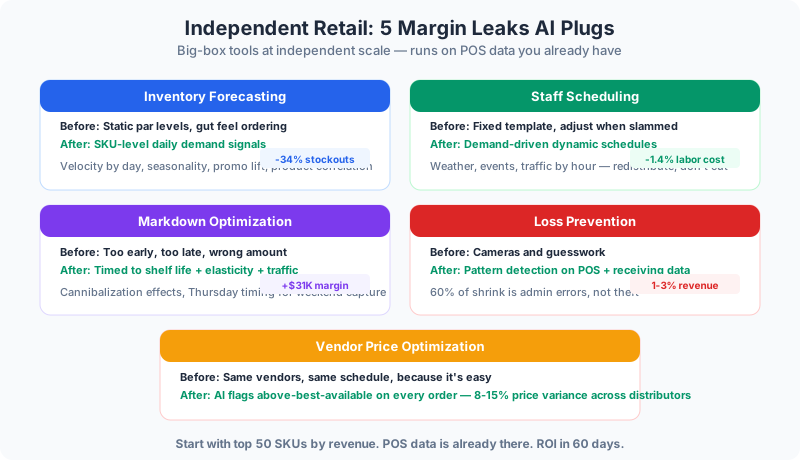
One independent grocer running three locations reduced stockouts by 34% while simultaneously reducing total inventory value by 11%. They weren’t carrying less product — they were carrying the right product in the right quantities at the right time.
👉 Tip: Start with your top 50 SKUs by revenue. Get forecasting right on those before expanding to the long tail. The Pareto principle applies — your top 20% of SKUs probably drive 80% of your revenue.
How to Fix Your Scheduling Problem
Labor is typically 10-15% of revenue in independent retail. Most retailers schedule from a fixed template and adjust when someone calls out or when the owner notices the store was slammed with two people on a Thursday.
The cost of getting this wrong:
Overstaffing: Two extra labor hours at $16/hour across five slow days is $160/week, or $8,300/year. In a store doing $1.2M at 4% net margins, that’s 17% of annual profit.
Understaffing: Missed sales, poor customer experience, shelves not restocked, checkout lines growing, shrink increasing with fewer eyes on the floor.
The fix:
AI scheduling uses demand signals — weather, events, historical traffic by hour — to generate staffing recommendations that flex with expected volume. Not a fixed template. A dynamic schedule that puts your best cashier on Saturday morning when traffic peaks and your stocking team on Tuesday when deliveries arrive.
One multi-location convenience store operator reduced labor cost by 1.4 percentage points using AI-driven scheduling. The savings came from redistributing hours — moving coverage from predictably slow periods to predictably busy ones. Nobody lost hours. The hours moved to where they mattered.
How to Fix Your Markdown Problem
Every independent retailer has a markdown problem. Perishables approaching expiration. Seasonal product that didn’t move. Overstock from a bad forecast.
Mark down too early — you give away margin on product that would have sold full price. Too late — you’re clearancing at 70% off just to recover shelf space. Wrong amount — product still doesn’t move or you’ve left money on the table.
What AI considers that you can’t calculate manually:
- Remaining shelf life and historical sell-through rates at each price point. Three days of shelf life with strong velocity at 15% off doesn’t need 30% off.
- Elasticity by category. Dairy customers are more price-sensitive than specialty snack customers. Same discount drives different volume responses.
- Cannibalization effects. Marking down Brand A yogurt pulls sales from Brand B at full margin. Net category impact might be negative.
- Timing within the week. A Thursday markdown captures weekend traffic. Monday misses four days of highest volume.
A natural foods retailer with two locations used AI-driven markdown timing on perishables and reduced spoilage waste by 23% while only increasing markdown expense by 6%. Net improvement: $31,000 annually in recovered margin.
How to Fix Your Shrink Problem
Shrink runs 1-3% of revenue for most independent retailers. On a $2M operation, that’s $20,000-$60,000/year disappearing. And most retailers are focused on the wrong source.
One convenience store chain found 60% of their shrink was receiving errors and administrative mistakes — not theft. They’d been spending on cameras while actual loss was at the back door and in the POS system.
Benefits of AI-driven loss prevention:
- Flags cashiers with unusually high void rates during specific hours
- Catches patterns of “no sale” register openings
- Identifies refund transactions that don’t match purchase patterns
- Matches POs against receiving logs against invoices — catching vendor overcharges that typically run 0.5-1.5% of total purchasing
- Correlates inventory variance with delivery dates, staffing schedules, and transaction patterns to narrow down the cause
This isn’t surveillance. It’s pattern detection on data that’s already in your POS and inventory systems.
👉 Tip: Before investing in more cameras, run an analysis on your receiving discrepancies and POS anomalies. Administrative shrink is usually a bigger number than theft — and it’s easier to fix.
How to Fix Your Vendor Problem
Most independent retailers order from the same vendors on the same schedule because it’s easy. This works. It’s also leaving money on the table.
The same product from three distributors can vary 8-15%. Comparing prices across 800 SKUs every order cycle is a full-time job nobody has. AI flags when you’re paying above best available price — on every order.
Some vendors offer better pricing on certain days. Some have minimums you’re barely missing — adding $12 to hit a $500 minimum saves $35 in delivery fees. AI tracks these thresholds and optimizes total landed cost, not just unit price.
Where to Start
Don’t implement everything at once. Start where data already exists and impact is most measurable:
- Inventory forecasting if your stockout rate exceeds 3% or overstock write-downs exceed 1% of revenue. POS data is already there. ROI measurable within 60 days.
- Staff scheduling if labor is your largest controllable expense and you schedule from a fixed template. Traffic data exists in POS transactions by hour.
- Markdown optimization if you’re perishable-heavy and losing 2%+ to spoilage.
- Loss prevention analytics if shrink exceeds 2% and you haven’t done systematic analysis.
You don’t need a data science team. You need your existing POS, inventory, and scheduling data connected to an AI layer that surfaces patterns you can’t see manually. The data is already there. The question is whether you’re using it.
Continue reading:
Related AI Articles
What Mid-Market HR Teams Actually Use AI For (It's Not What LinkedIn Says)
LinkedIn is full of AI hype about replacing recruiters. Here's what mid-market HR teams actually use AI for — and what works.
Read moreWhich of These 4 AI Adoption Profiles Is Holding Your Company Back?
Most companies stall at the same AI adoption stage. A framework for finding where you are, why you're stuck, and what actually moves you forward.
Read moreThe AEC Firm's Guide to Recovering 30% of Lost Billable Hours
A practical how-to for architecture and engineering firms that want to stop losing billable capacity to proposals, RFIs, spec coordination, and reporting.
Read moreWhat Your Senior Accountants Wish You Knew About AI
Most AI-for-accounting pitches miss the point. Here's what matters and the myths keeping firms from recovering senior capacity.
Read more