
Run Your Own AI Readiness Assessment in One Day (Skip the Consultant)
Most AI readiness assessments are consultant traps. Here's a one-day version with five signals, honest scoring, and an action plan by 5 PM.
A consulting firm pitched one of my portfolio companies a “comprehensive AI readiness assessment.” Six weeks. $85,000. They’d deliver a 120-page report with a maturity score on a five-point scale.
I asked what would differ between a score of 2.3 versus 3.1. The partner paused and said, “Well, the phasing would be different.” Eighty-five thousand dollars for different phasing.
You don’t need that. You need one honest day, five signals, and a willingness to score yourself without flattery. Here’s exactly how to do it.
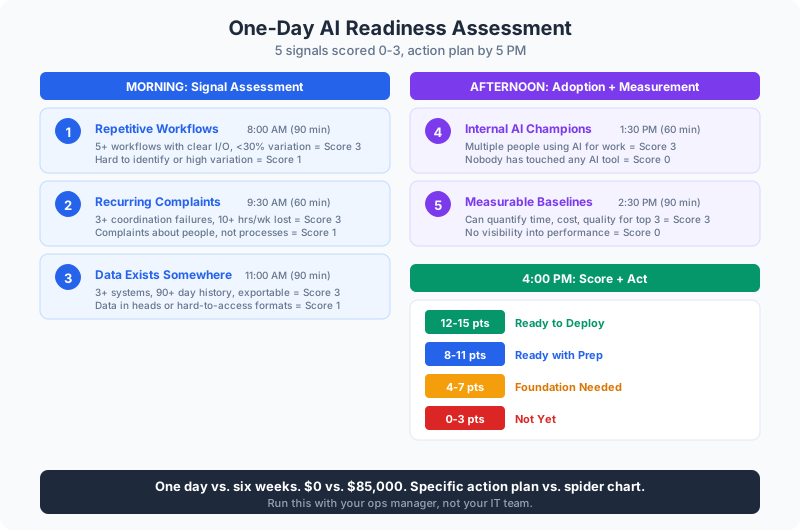
Why Most Assessments Are Designed to Sell More Consulting
Traditional AI readiness assessments evaluate “data maturity” on a spectrum. They map your “technology ecosystem” across fourteen dimensions. They assess “organizational change capacity” using frameworks from academic papers nobody has read since 2019.
At the end, you get a spider chart showing you’re strong in “leadership vision” but weak in “data governance.” The recommended next step is always another engagement.
The problem isn’t that they’re wrong — they’re usually directionally correct. The problem is they’re wildly overcomplicated for what you actually need to know:
- Do I have the raw ingredients to make AI work?
- If yes, where do I start?
- If no, what’s the one or two things to fix first?
Step 1: Signal Assessment (Morning)
8:00 AM — Signal 1: Repetitive Workflows (90 min)
AI needs patterns. Whiteboard your top 10 most time-consuming workflows with your ops manager. For each one, define the trigger, the steps, the output, and the time per instance.
Score yourself:
- 3 (Strong): 5+ repetitive workflows with clear inputs/outputs and less than 30% variation
- 2 (Moderate): 2-4 workflows, but inputs/outputs aren’t always clean
- 1 (Weak): Hard to identify repetitive workflows, or high variation each time
- 0 (Missing): Genuinely ad hoc operation with no repeatable patterns
9:30 AM — Signal 2: Recurring Complaints (60 min)
This is the signal most assessments miss — and one of the most reliable indicators of fast ROI. Walk the floor or get on a call. Ask 3-5 team members: “What wastes your time every week?” Don’t defend. Just listen and write it down.
Recurring complaints map your invisible factory. “I spent all morning chasing that information.” “The schedule changed and nobody told the warehouse.” Those are broken workflows AI can fix.
Score yourself:
- 3 (Strong): 3+ recurring complaints involving information flow or coordination failures. 10+ hours/week lost to workarounds.
- 2 (Moderate): 1-2 recurring issues, but vague rather than specific
- 1 (Weak): Complaints are about people, not processes
- 0 (Missing): You don’t hear complaints because you’re too far from the operation
11:00 AM — Signal 3: Data Exists Somewhere (90 min)
You don’t need a data lake. You need data. Somewhere. Spreadsheets count. Your ERP counts. Even paper logs count if someone can photograph them.
The myth that you need “clean data” before using AI has delayed more implementations than any other misconception. Modern AI works with messy, incomplete, inconsistently formatted data. Not ideal — but not a showstopper. What’s a showstopper: no data at all. But I’ve never encountered a business over $1M where that was actually true.
List every system, spreadsheet, database, and data source. Note what data it holds, how accessible it is, and how far back history goes.
Score yourself:
- 3 (Strong): 3+ systems with structured data, 90+ days history, and export capability
- 2 (Moderate): Data exists but is fragmented across ERP, spreadsheets, and email
- 1 (Weak): Most operational data lives in people’s heads or hard-to-access formats
- 0 (Missing): No recorded operational data
Step 2: Adoption and Measurement (Afternoon)
1:30 PM — Signal 4: Someone’s Already Using AI (60 min)
If someone on your team is already using ChatGPT to draft emails or experimenting with AI tools, you have something money can’t buy: an internal champion past the skepticism barrier. That person is your accelerator.
Talk to your team or send a quick survey: “Are you using any AI tools? What for? How often?”
Score yourself:
- 3 (Strong): Multiple people actively using AI for work. Organic momentum.
- 2 (Moderate): One or two experimenting in isolation
- 1 (Weak): Someone tried ChatGPT personally but hasn’t applied it to work
- 0 (Missing): Nobody has touched any AI tool
👉 Tip: If you score a 0 or 1 here, don’t panic. Give your most curious team member a week to experiment with AI on one specific task. You’re not behind — you just haven’t started. And starting is fast.
2:30 PM — Signal 5: Measurable Baselines (90 min)
Without this signal, you’ll never know if AI is working. You need: “Today this process takes X hours with Y errors. After AI, we expect A hours and B errors.” Doesn’t need decimal precision. “45 minutes per quote, 30 quotes per week” is specific enough. “Our quoting process is slow” is not.
For the top three workflows from Signal 1, establish rough metrics: time per instance, volume per week, error/rework rate, loaded labor cost.
Score yourself:
- 3 (Strong): Can quantify time, cost, and quality for top 3 workflows. Baseline data exists or can be established within a week.
- 2 (Moderate): General sense of time and cost but no formal tracking
- 1 (Weak): Know things are “slow” or “expensive” but can’t put numbers to it
- 0 (Missing): No visibility into process performance
Step 3: Score and Act (4:00 PM)
Add up your points across all five signals.
12-15 Points: Ready to Deploy
You have the raw ingredients. Stop assessing and start building. Pick the highest-value workflow from Signal 1, confirm it against Signal 2 complaints, and deploy your first AI agent with human-in-the-loop oversight. Be operational within 30 days.
8-11 Points: Ready with Prep Work
Most of what you need is there, with fixable gaps. Low on data? Spend two weeks organizing data sources. Low on measurement? Spend a week baselining top workflows. Low on adoption? Give your most curious team member a week to experiment. A score of 8 means start now — address the weak signal in parallel.
4-7 Points: Foundation Building Needed
The potential exists but the foundation isn’t there. Document your top five workflows, start tracking basic process metrics, get operational data into accessible formats. This takes 30-60 days and pays off whether or not you deploy AI.
0-3 Points: Not Yet
You have more fundamental operational challenges to address first. Focus on documented processes, accessible data, and basic metrics. Reassess in 90 days.
Benefits of running your own assessment:
- Completed in one day instead of six weeks
- Costs you nothing except time
- Produces a specific action plan, not a spider chart
- Forces honest self-evaluation without consultant diplomacy
- Reveals operational gaps worth fixing regardless of AI plans
- Gets your team involved from day one instead of handing them a report
👉 Tip: Run this assessment with your ops manager in the room, not your IT team. The signals are operational, not technical. The person closest to the workflows gives the most honest scores.
What This Assessment Won’t Tell You
This tells you whether the raw ingredients exist. It doesn’t tell you which platform to buy, how to integrate with your ERP, or how to manage change with your specific team.
Those are implementation questions — important, but the wrong questions to ask first. The right first question is: “Am I ready?” And you just answered it.
Done by 5:00 PM. You completed in one day what a consulting firm takes six weeks to deliver. Don’t let an $85,000 assessment be the reason you wait another quarter.
Continue reading:
- The 12-Month AI Roadmap: From First Agent to Compounding Intelligence — What to do after you score yourself ready
- The 5 Discovery Questions for AI — The discovery questions behind each signal
- Building Effective Business Systems — If you scored low on Signal 1, start here
- Operational Thinking: From Theory to Practice — The mindset that turns assessment into action
Related AI Articles
The AEC Firm's Guide to Recovering 30% of Lost Billable Hours
A practical how-to for architecture and engineering firms that want to stop losing billable capacity to proposals, RFIs, spec coordination, and reporting.
Read moreThe Real Money in Your Dental Practice Isn't in the Chair
Most dental AI marketing focuses on imaging and diagnostics. That's not what's killing your margins. Here's what is — and how to fix it.
Read moreFinancial Advisors: Double Client Capacity, Same Staff
A guide for advisors and RIAs who want more clients without more staff — by cutting the admin that eats 40% of the week.
Read more5 Compliance-Safe AI Wins for Banks, RIAs, and Insurance Firms
Financial services firms think compliance blocks AI. It doesn't. Five automation wins that improve operations without regulatory risk.
Read more