
Which of These 4 AI Adoption Profiles Is Holding Your Company Back?
Most companies stall at the same AI adoption stage. A framework for finding where you are, why you're stuck, and what actually moves you forward.
I’ve worked with dozens of mid-market companies on AI initiatives. And here’s the pattern I keep seeing: the technology isn’t what holds companies back. It’s a failure to connect AI to the work that actually drives margin.
Every company I’ve assessed falls into one of four adoption profiles. Not based on budget or technical sophistication — based on whether they’ve moved past “playing with tools” into changing how work gets done. Your adoption profile isn’t about how many AI tools you’ve bought — it’s about whether any of them have changed a single workflow on a Monday morning.
Here’s the framework. Be honest with yourself about where you land.
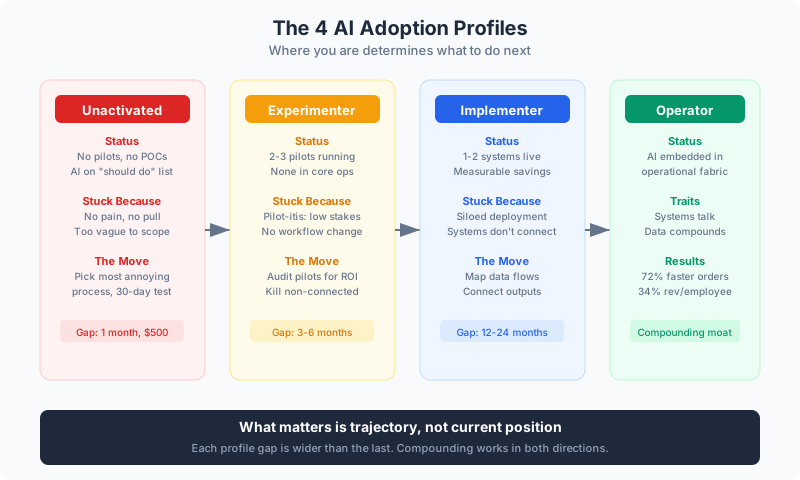
Profile 1: The Unactivated
What it looks like: Leadership has heard about AI. Someone has a ChatGPT login. But nothing has been tried — no pilot, no proof of concept, nothing operational.
This isn’t resistance. Nobody’s anti-AI. There’s just no catalyst. The business runs fine. Margins are acceptable. AI sits on the “things we should look into” list somewhere between an ERP upgrade and warehouse layout optimization.
Why they’re stuck
No pain, no pull. AI adoption requires someone to own it, and ownership requires either a burning problem or an executive mandate. The Unactivated have neither.
The other factor: “AI” is too vague. When you can’t describe what you want it to do in operational terms, you can’t scope it, evaluate vendors, or calculate ROI. So you do nothing.
The risk
Competitors activate. I watched a $40M distribution company lose a key account because a competitor turned quotes in 2 hours instead of 24. That competitor deployed AI-assisted quoting — historical pricing, inventory checks, formatted output. The capability gap was 18 months of adoption head start.
The move
Pick one process. Not the most important one — the most annoying one. The one where someone spends hours on pattern-based work:
- Data entry from paper forms
- Coding invoices to the right GL account
- Writing first drafts of inspection reports
Run a 30-day test. Budget $500. Use an off-the-shelf tool. Measure time saved.
👉 Tip: You don’t need a strategy to start. You need a first experience. Strategy comes after you’ve seen what’s possible.
Profile 2: The Experimenter
What it looks like: Two or three AI pilots have run. Someone built a chatbot. The marketing team uses AI for social posts. There’s a general sense of “we’re doing AI stuff.”
But none of it connects to core operations. Pilots were chosen based on what seemed cool, not what drives margin. The chatbot answers 30 questions a month — mostly about the holiday schedule.
This is the most common profile. Probably 60% of mid-market companies are here right now.
Why they’re stuck
Pilot-itis. Experiments are comfortable because stakes are low. Nobody changes their workflow. Nobody trusts a machine with real decisions. There’s enough activity to feel productive without any organizational commitment.
The deeper issue: experiments were disconnected from operations. Piloting AI on a non-critical process teaches you about the technology, not about changing how work gets done.
The risk
Pilot fatigue. Teams start viewing AI as a distraction. Budget gets harder to justify. The company develops a belief that AI is “not ready for us” when the real problem was aim, not technology.
I saw a $28M professional services firm run five AI pilots over 18 months. Total investment: ~$60K. Total operational impact: zero. They tested transcription (useful, not transformative), blog content (partners hated it), and scheduling (solved a problem nobody had). They never tested AI on what drives their economics: scoping, estimating, and staffing projects.
The move
Audit your pilots. For each one, answer two questions:
- Does this connect to revenue, margin, or capacity?
- Did we measure the result with a number?
Kill everything that gets “no” on both. Then pick the single process with the most labor hours spent on pattern-based work — following templates, applying rules, or transforming data between formats. That’s your first real deployment target.
👉 Tip: The difference between an experiment and an implementation is that an implementation changes how work gets done on Monday morning. If nobody’s workflow changed, it was a science project.
Profile 3: The Implementer
What it looks like: One or two AI systems in production. Actually running. People use them daily. Maybe an AI-assisted quoting tool, a document processing system, or a demand forecasting model feeding weekly buy decisions.
It works. The team trusts it. It saves measurable time and money.
Why they’re stuck
The implementation is siloed. Works in one department, on one process. Doesn’t talk to anything else. The AI quoting tool doesn’t inform demand forecasting. Each system is an island of automation in an ocean of manual process.
This happens because the first implementation was (correctly) scoped narrowly. But “connecting systems” requires different muscle than “deploying a tool” — data architecture, cross-functional alignment, process redesign spanning departments.
The risk
Local optimization. You make one process 40% faster, but upstream and downstream are untouched, so overall throughput doesn’t change.
A $55M manufacturer deployed AI quality inspection. Defect detection improved 35%. But the data didn’t feed back into production scheduling or supplier quality. They caught problems faster but didn’t prevent them. After a year: $120K spent, $80K saved — positive ROI but a fraction of the potential.
The move
Map the data flows. Take your working implementation and trace what it knows:
- What data does it generate or process?
- Where does that data go next?
- Who uses it, and what decisions do they make?
Then identify the shortest connection. If your AI processes incoming POs, the next system should be exception handling — flagging POs that don’t match contracts or have unusual quantities. The data is already there.
👉 Tip: Your next implementation should consume the output of your current one. That’s how you go from “useful tool” to “compounding advantage.”
Profile 4: The Operator
What it looks like: AI is embedded in the operational fabric. Systems talk to each other. Data from one process feeds the next. The organization has moved past “AI projects” to “this is how we work.”
Order processing feeds exception management, which feeds demand forecasting, which feeds purchasing optimization, which feeds supplier performance scoring. Each system makes the others more accurate. The data compounds.
What Operators actually achieve
One distribution company over two years:
- Order processing time reduced 72%
- Order error rate reduced 85%
- Stockout rate reduced 60%
- Inventory turns improved from 8.2 to 11.4
- Customer retention went from 89% to 96%
- Per-employee revenue grew 34% without adding headcount
Three things that make Operators different
1. Someone owns the system, not just the tools. An operations function ensures AI systems connect, data flows correctly, and architecture serves the business.
2. They measure compound metrics. Not “time saved by the quoting tool” but end-to-end: quote-to-cash cycle time, perfect order rate, inventory turn, revenue per employee.
3. They reinvest the gains. When AI saves 200 hours/month, Operators redeploy that capacity into higher-value work. The savings fund the next implementation.
The Quick Diagnostic
Answer these five questions honestly:
1. How many AI systems are in production — actively used daily, not in trial?
- Zero → Unactivated
- None in production, but tested some things → Experimenter
- 1-2 in production → Implementer
- 3+ in production, sharing data → approaching Operator
2. Can you state the dollar value AI has created or saved in the last 12 months?
- No → Unactivated or Experimenter
- Yes, for one or two processes → Implementer
- Yes, and growing quarter over quarter → Operator
3. Does any AI system’s output feed directly into another AI system?
- No → not yet Operator, regardless of tool count
- Yes, one chain → early Operator
4. When someone leaves, does AI knowledge leave with them?
- We don’t have AI knowledge → Unactivated
- Yes, it lives in one or two heads → Experimenter or early Implementer
- No, it’s documented and maintained by a team → Implementer or Operator
5. Has AI changed how you hire, staff, or allocate headcount?
- No → haven’t reached Implementer yet
- Yes, in one department → Implementer
- Yes, across multiple functions → Operator
The Distance Between Profiles
Unactivated → Experimenter: Small gap. A 30-day test and $500. Most companies cross it in a month.
Experimenter → Implementer: Larger gap. Requires picking a real process, committing budget, changing how work gets done, and measuring results. Most need 3-6 months. Many never cross because they keep experimenting instead of committing.
Implementer → Operator: Widest gap. Requires systems thinking — connecting tools, flowing data between processes, measuring compound metrics, building organizational capability. A 12-24 month journey requiring leadership that treats AI infrastructure as seriously as physical infrastructure.
Compounding works in both directions. The longer you wait, the further behind you fall. An Operator with two years of learning has data and improvement you can’t buy, shortcut, or replicate.
What Matters Is Trajectory
The profiles are descriptive, not prescriptive. A well-run $20M manufacturer as an Implementer with two solid systems is better positioned than a $200M Experimenter with twelve pilots and zero production deployments.
What matters is trajectory. Are you moving forward? Is each step connected to the last? Is the value compounding?
Your profile today is a snapshot. What you do next determines the next one.
Benefits of knowing your profile:
- You stop wasting budget on the wrong type of initiative for your stage
- You can communicate clearly to leadership where you are and what it takes to move
- You avoid the most common trap at each stage
- You build a roadmap that connects each step to the last
Continue reading:
- The 11 AI Primitives — the building blocks that power every implementation at every profile stage
- The 5 Discovery Questions for AI — how to find the right first (or next) process to target
- AI Implementation Roadmap — the phased approach to moving from one profile to the next
- Why Smart Businesses Start Manual Before Automating — the principle behind why Experimenters get stuck
Related AI Articles
AI Combo Plays: 6 Ways to Stack Primitives for 10x Results
Single AI tools save time. Stacked primitives change economics. Six combo plays that create compound systems from simple parts.
Read moreThe AEC Firm's Guide to Recovering 30% of Lost Billable Hours
A practical how-to for architecture and engineering firms that want to stop losing billable capacity to proposals, RFIs, spec coordination, and reporting.
Read moreThe Real Money in Your Dental Practice Isn't in the Chair
Most dental AI marketing focuses on imaging and diagnostics. That's not what's killing your margins. Here's what is — and how to fix it.
Read moreFinancial Advisors: Double Client Capacity, Same Staff
A guide for advisors and RIAs who want more clients without more staff — by cutting the admin that eats 40% of the week.
Read more