
What Actually Changes When a Medical Practice Implements AI
What happens when medical practices deploy AI across scheduling, prior auth, documentation, and billing — the real numbers.
I’ve worked with enough medical practices to know that the word “AI” triggers one of two reactions. Either the practice administrator’s eyes glaze over, or someone on the team starts talking about robot surgeons. Neither is helpful.
Here’s what actually happens when a medical practice implements AI: the phones still ring, the waiting room still fills up, and providers still see patients. But the operational chaos that sits between all of those things — the prior auths, the incomplete charts, the coding mismatches, the referrals that vanish into the void — starts shrinking. Fast.
AI in medical practices doesn’t change medicine. It changes the operational failures that make medicine harder than it needs to be.The Practice Before: A Real Snapshot
I’ll walk you through what I’ve seen at a four-provider primary care group doing about $2.8M in annual collections. Pretty typical mid-market setup. Two MAs, an office manager, a billing person, and a part-time front desk.
Their overhead ran about 65% of collections. That’s normal. What wasn’t normal — or rather, what was too normal — was where the labor was going:
- 23 minutes per prior auth, and the office manager was processing 30-40 per week
- 4+ hours per provider per day on documentation — charting, coding, closing notes after hours
- 11% claim denial rate, with each denial costing $25-35 to rework
- Referral completion sitting at 58% — meaning 42% of patients referred to specialists never followed through
None of these are clinical problems. They’re information problems. The right data isn’t in the right place at the right time, so humans spend hours bridging the gap manually.
What Changed: Scheduling
They started with scheduling because it had the clearest ROI and the least clinical risk.
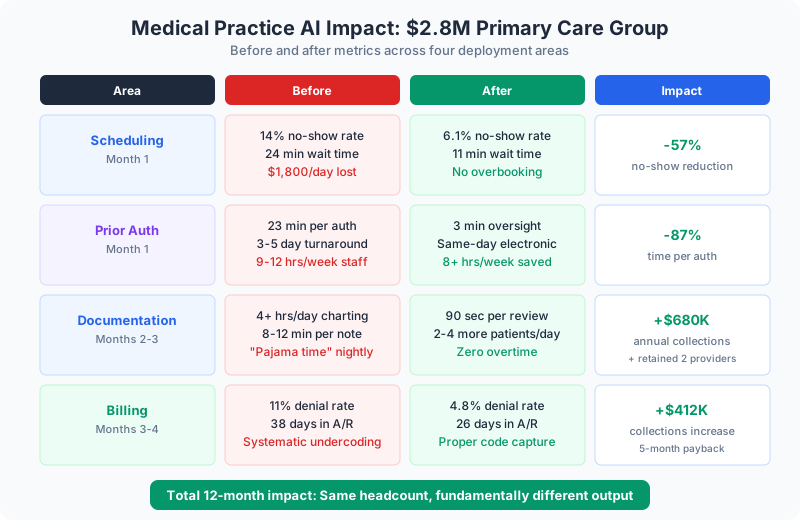
Their no-show rate was running 14%. At 80 daily appointments, that’s roughly $1,800/day in empty slots. They’d tried overbooking, which just created wait times and burned out the staff.
The AI agent built risk profiles for every patient — appointment history, day of week patterns, time since scheduling. High-risk patients got earlier and more frequent outreach. Patients who historically reschedule got a reschedule prompt instead of a generic reminder.
Within 90 days:
- No-shows dropped from 14% to 6.1%
- They stopped overbooking entirely
- Patient wait times fell from 24 minutes to 11
- Provider satisfaction went up because they weren’t constantly running behind
👉 Tip: Don’t start by trying to fix your worst scheduling day. Start by identifying your highest no-show patient segments and targeting outreach there first. The data’s already in your PM system.
What Changed: Prior Authorization
Prior auth is where admin labor goes to die. Their office manager was spending 9-12 hours a week just on auths — calling payers, pulling documentation, following up on pending requests.
The AI agent started monitoring the schedule 72 hours ahead. For any appointment or order needing authorization, it pulled clinical documentation, mapped it to payer-specific requirements, and submitted electronically. When denied, it drafted appeals with the relevant clinical evidence already attached.
Here’s the part that surprised them: denial rates dropped not because the AI argued better, but because submissions were complete the first time. The agent knew that Aetna denies knee MRI requests 34% of the time without documented conservative treatment duration — so it included that upfront.
Results:
- Staff time per auth dropped from 23 minutes to about 3 minutes of oversight
- Turnaround went from 3-5 business days to same-day for electronic submissions
- The office manager got 8+ hours a week back
👉 Tip: Track your first-pass approval rate before you start. Most practices don’t know this number, and it’s the single best indicator of how much improvement is available.
What Changed: Documentation
This was the big one. Their providers were spending 4+ hours a day on documentation — charting, coding, closing notes. Two of the four were doing “pajama time” at night just to stay current.
They rolled out ambient clinical documentation with one willing provider first. The provider talks to the patient like a normal human conversation. The AI captures it, structures it into a proper clinical note with appropriate terminology, suggests ICD-10 codes, and flags quality measures.
The provider reviews and signs. Average review: 90 seconds per note versus 8-12 minutes for manual charting.
The financial impact was significant:
- Providers saw 2-4 more patients per day — not from rushing, from not spending half the day typing
- At their visit rate, that translated to roughly $680K in additional annual collections across all providers
- Provider overtime dropped to near zero
- Two providers who’d been considering leaving decided to stay
That last point matters more than the revenue number. Replacing a provider costs $200-500K when you factor recruiting, onboarding, and lost patient volume.
What Changed: Billing
Their 11% denial rate was costing them roughly $60K annually in rework — and that doesn’t count the revenue they were leaving on the table through undercoding.
This is something I see in almost every practice: providers consistently undercode. They bill 99214 when the documentation supports 99215. At $18-24 per visit difference across 15,000 annual visits, that’s $270-360K in legitimately earned revenue that never gets billed.
The AI agent reviewed every claim before submission — comparing documentation to selected codes, checking for denial triggers, tracking payer-specific patterns.
Results over 12 months:
- Denial rate dropped from 11% to 4.8%
- Collections increased by $412K
- Average days in A/R dropped from 38 to 26
- The billing person shifted from rework to revenue optimization
Benefits of the billing AI layer:
- Catches undercoding before claims go out
- Flags payer-specific denial triggers proactively
- Tracks claim status at payer-appropriate intervals (Medicare at 14 days, state Medicaid at 31)
- Builds institutional knowledge about what gets denied and why
What Changed: Follow-Up and Referrals
This was the sleeper. Their referral completion rate was 58% — meaning nearly half of patients who needed specialty care never received it. That’s a clinical risk and a revenue leak.
The AI agent tracked every referral from order to completion. Automated outreach when a patient hadn’t scheduled within 7 days. Flagged referrals that exceeded expected timelines. Ensured specialist notes came back to the referring provider.
Referral completion went from 58% to 81%. Annual wellness visit completion went from 62% to 79%. Incremental revenue from care gap closure alone: $230K annually.
What Didn’t Change
Being honest about this matters. Some things aren’t ready:
- AI diagnostic tools for general primary care aren’t ready for broad deployment. Useful in narrow specialties (derm imaging, radiology reads), but liability exposure for complex cases isn’t resolved.
- Chatbot-only patient communication generates complaints. Patients tolerate bots for scheduling and refills. They don’t tolerate them for clinical questions.
- Full billing automation without oversight is a bad idea. AI should draft, flag, and optimize. A human reviews every claim.
The Timeline That Worked
Here’s the sequence this practice followed:
- Month 1: Scheduling optimization and prior auth automation — fastest payback, lowest risk
- Months 2-3: Ambient documentation — started with one provider, proved it, expanded
- Months 3-4: Billing accuracy review — layered on top of existing workflow
- Months 4-6: Patient follow-up and referral tracking — benefited from cleaner data foundation
The total investment paid back within 5 months. By month 12, the practice was operating at a fundamentally different level — same headcount, dramatically different output.
Continue reading:
Related AI Articles
The Real Money in Your Dental Practice Isn't in the Chair
Most dental AI marketing focuses on imaging and diagnostics. That's not what's killing your margins. Here's what is — and how to fix it.
Read moreThe AEC Firm's Guide to Recovering 30% of Lost Billable Hours
A practical how-to for architecture and engineering firms that want to stop losing billable capacity to proposals, RFIs, spec coordination, and reporting.
Read moreWhat Your Senior Accountants Wish You Knew About AI
Most AI-for-accounting pitches miss the point. Here's what matters and the myths keeping firms from recovering senior capacity.
Read moreHow a Mid-Size GC Cut Bid Prep Time by 60% Without Adding Estimators
How one general contractor used AI to fix estimating bottlenecks, catch cost overruns weeks earlier, and stop losing tribal knowledge to turnover.
Read more